
Anthropic's Claude Opus 4.8 Beats GPT-5.5 on Agentic Coding With No Price Hike
Claude Opus 4.8 tops the AI leaderboard on agentic work and scientific reasoning, reclaiming the #1 spot from OpenAI's GPT-5.5 at the same price
Takeaways
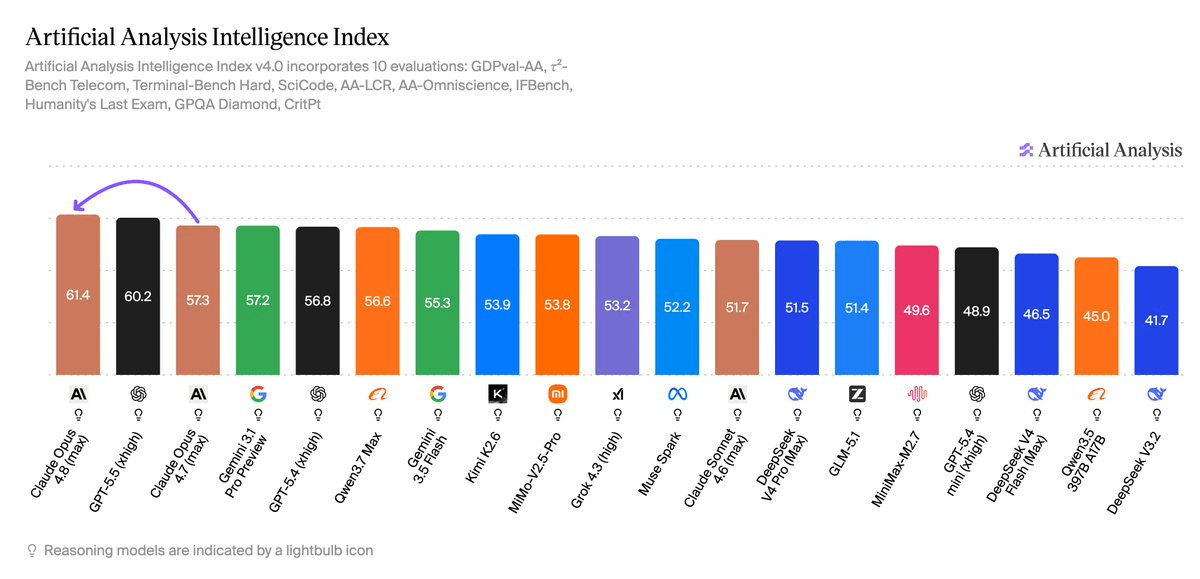
- New #1 model: Claude Opus 4.8 tops the Artificial Analysis Intelligence Index at 61.4, beating GPT-5.5 by 1.2 points.
- Agentic dominance: Scores 1,890 Elo on GDPval-AA knowledge work benchmark, implying a ~67% win rate against GPT-5.5 in head-to-head tasks.
- Same price, better performance: Pricing unchanged at $5/$25 per million input/output tokens; fast mode now 3x cheaper than prior Opus fast mode.
- Dynamic Workflows launched: New Claude Code feature orchestrates hundreds of parallel subagents for codebase-scale tasks, available on Enterprise, Team, and Max plans.
- Honesty gains: Opus 4.8 is ~4x less likely than Opus 4.7 to silently pass flawed code, and shows lower misalignment rates than any prior public Opus model.
- Mythos incoming: Anthropic confirmed Mythos-class models are coming to all customers soon, as the company filed for IPO at a $965B valuation.
Anthropic just reclaimed the top spot in the frontier model race. Claude Opus 4.8 landed as the new leader on the Artificial Analysis Intelligence Index, scoring 61.4 , a 4.1-point jump from Opus 4.7 and 1.2 points ahead of GPT-5.5, the previous leader. The gains are concentrated where it matters most for production AI: long-horizon agentic tasks, scientific reasoning, and real-world knowledge work.
The numbers that matter
Opus 4.8 is an upgrade to Anthropic's flagship model with better coding and knowledge work skills, all for the same price as its prior version. That last part is worth emphasizing , no price increase for a meaningful capability jump. Here is the full scorecard:
- Artificial Analysis Intelligence Index: 61.4 (+4.1 from Opus 4.7, +1.2 ahead of GPT-5.5)
- GDPval-AA (knowledge work): 1,890 Elo , 121 points ahead of GPT-5.5's 1,769, implying a ~67% head-to-head win rate
- SWE-Bench Pro (agentic coding): Opus 4.8 at 69.2% vs GPT-5.5 at 58.6% vs Gemini 3.1 Pro at 54.2%
- Humanity's Last Exam (multidisciplinary reasoning): Opus 4.8 leads both competitors with and without tools
- Finance Agent v2: Opus 4.8 at 53.9%, edging GPT-5.5's 51.8%
- Terminal-Bench Hard: +6.8 points vs Opus 4.7; though GPT-5.5 still holds a slight edge in terminal-heavy workflows
Pricing for Claude Opus 4.8 when not in fast mode remains at $5 per million input and $25 per million output tokens. Fast mode allows it to work at 2.5x the speed while being three times cheaper than it was for previous models. The context window stays at 1 million tokens, matching Opus 4.7.
Where Claude finally caught up
One of the most notable storylines in this release is scientific reasoning. Previous Claude Opus versions consistently trailed OpenAI and Google on hard academic benchmarks , a gap that made Anthropic's models feel like the "practical" choice rather than the "smartest" choice. Opus 4.8 closes that gap decisively.
Anthropic highlighted improvements in model honesty, noting that Opus 4.8 is more likely to acknowledge when it lacks sufficient information and less likely to make unsupported claims. And on the AA-Omniscience hallucination benchmark, evaluations showed Opus 4.8 is around four times less likely than its predecessor to allow flaws in code it generated to go unremarked. That kind of calibration matters enormously in unattended agentic pipelines where a silent failure can cascade.
The agentic leap
GDPval-AA is the benchmark to watch here. It tests agentic performance across 44 occupations and 9 industries using real web and shell access tasks , not toy problems. GDPval-AA measures agentic performance across 44 occupations and 9 industries using real-world web and shell access tasks. Opus 4.8 scores 1,890 Elo , 121 points ahead of GPT-5.5's 1,769. That gap translates to roughly a 67% head-to-head win rate. For enterprise deployments, this is the benchmark that matters most.
Efficiency improved alongside raw performance. Opus 4.8 achieves its GDPval-AA score with 15% fewer turns per task and 35% fewer output tokens than Opus 4.7. That said, it still uses approximately 30% more turns than GPT-5.5 on the same task set , a trade-off between reasoning depth and speed that teams will need to weigh based on their use case.
Dynamic Workflows: the real sleeper feature
Alongside the model itself, Anthropic launched a feature called Dynamic Workflows, available in research preview, designed to help larger models like Opus manage complex tasks across hundreds of parallel subagents. This is not just a quality-of-life improvement , it is a fundamental shift in how Claude Code can be used.
- Claude Code with Opus 4.8 can now carry out codebase-scale migrations across hundreds of thousands of lines of code from kickoff to merge, with the existing test suite as its bar
- Dynamic Workflows is available for Claude Code users on Enterprise, Team, and Max plans
- The Messages API now accepts live changes to the messages array, which lets developers update instructions during a task without breaking prompt cache use or needing a separate user turn
- The release also includes controls that allow users to adjust how much effort the model spends on a task, which can be used to balance response speed, reasoning depth, and cost
Early testers from Cursor, Devin (Cognition), and Hebbia all reported meaningful gains. The CEO of Cursor noted that Opus 4.8 uses tools cleanly and follows instructions with the consistency autonomous engineering workloads need to keep running unattended, and it fixes the comment-verbosity and tool-calling issues seen with Opus 4.7.
Honesty as a product feature
Anthropic has long positioned safety and alignment as a differentiator, and Opus 4.8 makes that concrete in ways that show up in production. The Alignment team concluded that Opus 4.8 reaches new highs on measures of prosocial traits like supporting user autonomy and acting in the user's best interest, and showed rates of misaligned behavior substantially lower than Opus 4.7, and similar to Claude Mythos Preview.
Opus 4.8 leads on SWE-bench Pro (69.2% vs 58.6%) while GPT-5.5 leads on Terminal-Bench 2.0 (82.7% vs 74.6%). The more interesting story is qualitative: Anthropic is betting that honesty and calibrated uncertainty are the next frontier for production AI, while OpenAI is betting on raw agentic throughput. That is a genuine philosophical split, and which approach wins will depend heavily on your failure tolerance in production.
Who wins, who loses
The competitive picture is nuanced. With Claude Opus 4.8 launching, the three frontier AI models , Opus 4.8, OpenAI's GPT-5.5, and Google's Gemini 3.1 Pro , are now close enough that picking between them comes down to the specific job. Anthropic claims Opus 4.8 tops both competitors on a range of agentic benchmarks. The reality is more nuanced: each model wins different categories.
- Anthropic wins: Agentic coding (SWE-Bench Pro), knowledge work (GDPval-AA), scientific reasoning (Humanity's Last Exam), browser agents (Online-Mind2Web at 84%), and hallucination rates
- OpenAI wins: Terminal-heavy coding workflows (Terminal-Bench 2.1), and GPT-5.5 still uses 30% fewer turns on GDPval tasks
- Google wins on cost: Gemini 3.1 Pro is priced at $2.00 input / $12.00 output per 1M tokens versus $5.00 / $25.00 for Opus 4.8 , roughly 2.1x cheaper on output alone
For teams running high-volume agentic pipelines where Gemini's quality is sufficient, the cost gap is real. For a workload processing 100 million input and 50 million output tokens monthly: Opus 4.8 runs roughly $1,750/month versus GPT-5.5 at roughly $2,000/month and Gemini 3.5 Flash at roughly $600/month.
The bigger picture: Mythos is coming
Opus 4.8 is impressive, but Anthropic was explicit that it is not the ceiling. Anthropic has released Claude Opus 4.8 and outlined plans for broader access to its Mythos-class models, which the company expects to make available to all customers in the coming weeks. Mythos Preview has been restricted to ~50 defensive-security partners under Project Glasswing due to its ability to find and exploit software vulnerabilities at expert level , a capability that required new safety infrastructure before general release.
Anthropic is still holding back its most advanced Mythos model after a tentative preview last month raised cybersecurity concerns. However, the company hinted in the Opus release that the Mythos preview period might soon end, once necessary safeguards are complete. This context makes Opus 4.8 look less like a destination and more like a bridge , a meaningful upgrade that keeps Anthropic competitive while the company prepares to ship something significantly more powerful.
The broader strategic backdrop is hard to ignore. Anthropic raised a $65B Series H at a $965B post-money valuation, hit a ~$47B revenue run-rate, and confidentially filed for an IPO on June 1, 2026 , surpassing OpenAI as the most valuable AI startup. The new model comes as Anthropic and archrival OpenAI race to make their public market debuts. Shipping a clear benchmark leader right before an IPO filing is not a coincidence.
What this means for your stack
If you are building agentic systems today, Opus 4.8 is the strongest general-purpose option for knowledge work and coding tasks that require long-horizon reliability. The combination of a 67% win rate on GDPval-AA, four times fewer silent code failures, and the new Dynamic Workflows feature makes it a compelling upgrade for anyone already on the Opus line.
The API name is claude-opus-4-8.
The platform can be used through claude.ai, Claude Code and the Claude API.
Pricing is unchanged at $5/$25 per million input/output tokens, with cache writes at a 25% premium and a 90% discount on cache hits. If you are cost-sensitive and your workloads tolerate slightly lower agentic depth, Gemini 3.5 Flash remains a strong alternative at a fraction of the price. But for high-stakes, long-running autonomous work , legal analysis, codebase migrations, financial document processing , Opus 4.8 just set a new bar.