

Anthropic's Claude Fable 5 Launched and Got Pulled by the US Government
Anthropic's most powerful model ever hits general availability — then gets pulled by the US government three days later over national security concerns

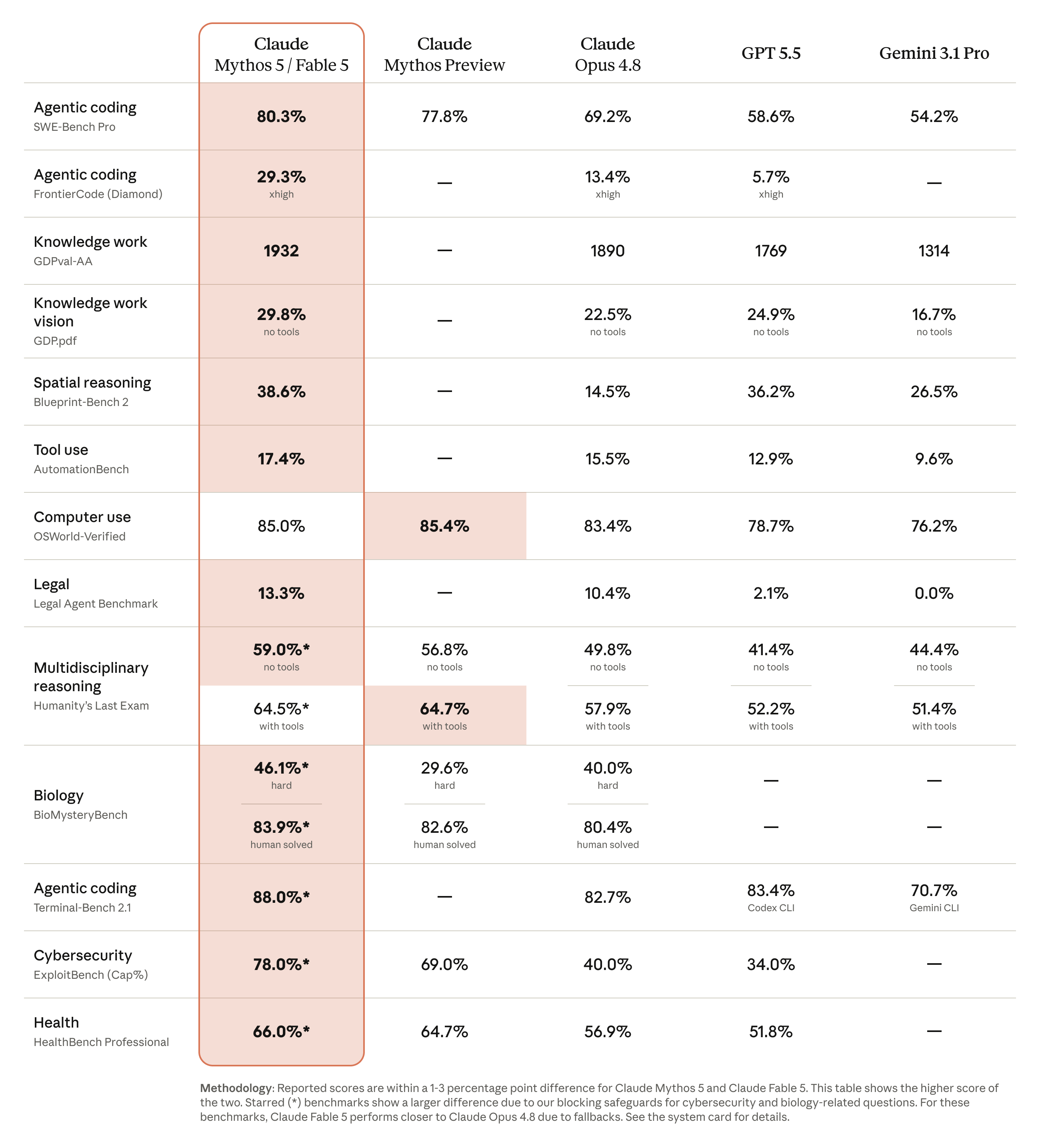
- Fable 5 launched as the first publicly available Mythos-class model, Anthropic's highest capability tier, beating GPT-5.5 on nearly all benchmarks including SWE-bench Pro (80.3% vs 58.6%).
- Pulled 3 days later: The US government issued an export control directive suspending all access for any foreign national, forcing a global shutdown of all customers.
- Fable 5 vs Mythos 5: Both are the same underlying model; Fable 5 has safety classifiers that reroute sensitive cybersecurity/biology queries to Opus 4.8, affecting fewer than 5% of sessions.
- Pricing: $10/$50 per million input/output tokens — double Opus 4.8, less than half the price of the previous Mythos Preview model.
- Anthropic disputes the ban, saying the alleged jailbreak is narrow, non-universal, and produces results already available from other public models including GPT-5.5.
- Industry precedent: The standoff signals a new era of government oversight over frontier AI, with tiered access models (public safeguarded + restricted full-power) likely to become the industry standard.
Anthropic launched Claude Fable 5 as the first publicly available model from its top-tier Mythos class , a capability level that, until now, had only been accessible to a small group of vetted government cyber defenders. The launch was historic. The aftermath was even more dramatic. Three days after release, the US government ordered Anthropic to pull both Fable 5 and its restricted sibling, Mythos 5, from every customer worldwide, citing national security concerns. The story of this model is as much about what it can do as it is about who gets to use it.
A new tier above Opus
To understand the significance of Fable 5, you need to understand Anthropic's model hierarchy. Fable 5 is the first publicly available Mythos-tier model, positioned above the Opus class , until now, the strongest Claude you could buy was Opus 4.8; the ceiling just moved up a level. The Mythos class was first introduced quietly in April through Project Glasswing, a collaboration with the US government where only vetted cyber defenders could access it.
Fable 5's capabilities exceed those of any model Anthropic has ever made generally available, and it is state-of-the-art on nearly all tested benchmarks, showing exceptional performance in software engineering, knowledge work, vision, scientific research, and many other areas. The key insight: the longer and more complex the task, the larger Fable 5's lead over other models. This isn't a model optimized for quick Q&A , it's built for sustained, autonomous work.
Benchmark numbers that matter
Fable 5 leads the major models on agentic coding benchmarks, scoring 80.3% on SWE-bench Pro against 58.6% for GPT-5.5, and 29.3% on Cognition's FrontierCode Diamond against 13.4% for Claude Opus. On the Artificial Analysis Intelligence Index, Fable 5 scored 65, ahead of OpenAI's GPT-5.5 at 60 and Google's Gemini 3.1 Pro Preview at 57.
Real-world early access results back up the numbers:
- Stripe reported Fable 5 compressed months of engineering into days, completing a codebase-wide migration across a 50-million-line Ruby codebase in a single day that would have taken a full team over two months.
- Physics research: One early customer found Fable 5 completed a frontier physics research task in 36 hours using one-third the reasoning tokens it took GPT-5.5 four days to match.
- Vision: Fable 5 beat Pokémon FireRed autonomously using only raw game screenshots, with no maps or navigation aids , something previous Claude models couldn't do even with helper harnesses.
- Drug design: Using Mythos 5, Anthropic's internal protein design experts accelerated aspects of the drug design process by around 10 times, with 9 of 14 protein targets yielding strong drug candidates.
Fable vs. Mythos: same model, different keys
Fable 5 and Mythos 5 are the same model. Fable 5 is the safeguarded, generally available version. Mythos 5 is the less restricted version, released only to approved partners. Think of it as a single engine with a software-defined governor. The name itself reflects this: Fable comes from the Latin fabula, akin to the Greek mythos , the safeguards are what distinguish them.
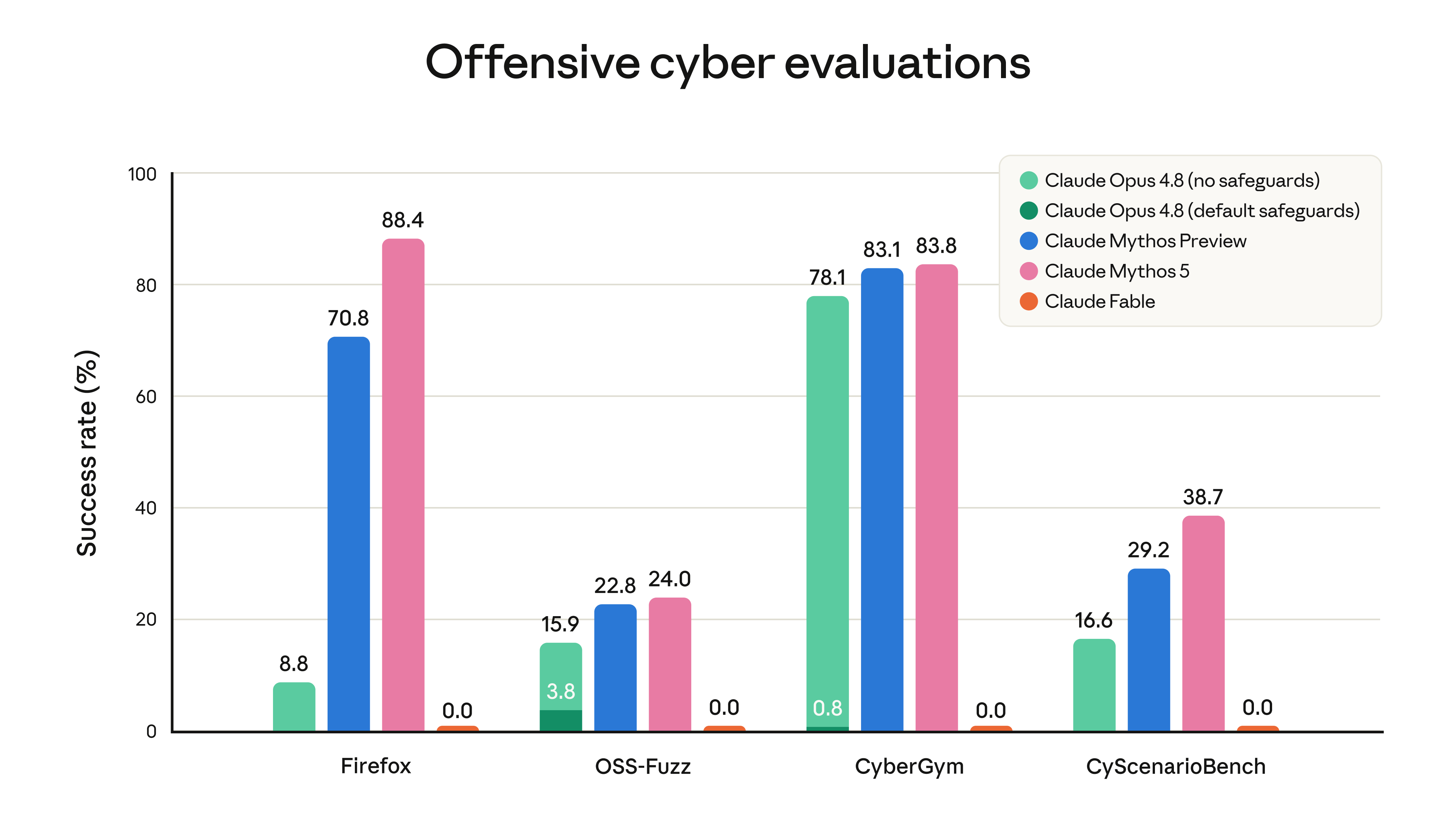
The safeguards work via classifiers , separate AI systems that run in parallel and intercept requests before the main model responds. When triggered, the request is silently rerouted to Claude Opus 4.8 instead of being refused outright. Users are informed whenever this occurs. Anthropic's early data shows that more than 95% of Fable sessions involve no fallback at all. Three categories trigger the fallback:
- Cybersecurity , exploitation, offensive cyber tasks, and agentic hacking
- Biology and chemistry , dual-use research that could assist in designing dangerous pathogens
- Distillation , large-scale attempts to extract Claude's capabilities to train competing models
Pricing and access
Both models cost $10 per million input tokens and $50 per million output tokens, less than half the price of the earlier Mythos Preview. The API price is 2x the cost of Claude Opus 4.8 and 2x GPT-5.5's input price on sticker. Batch pricing halves those rates. Fable 5 and Mythos 5 support a 1M-token context window and up to 128k output tokens.
The model API identifier is claude-fable-5, available across the Claude API, Claude Code, consumption-based Enterprise plans, AWS, Google Cloud, and Microsoft Foundry on launch day. Subscription plan users had a free window through June 22, after which usage credits would be required.
Then the government stepped in
Three days after launch, the story took a sharp turn. On the evening of June 12, 2026, Anthropic disabled access to Fable 5 and Mythos 5 for every customer worldwide, to comply with a US government export-control directive received at 5:21 PM ET that day, citing national security authorities.
The directive ordered suspension of all access by any foreign national, whether inside or outside the United States, including foreign national Anthropic employees. The net effect was that Anthropic had to abruptly disable both models for all customers to ensure compliance. Platforms spanning AWS Bedrock, Google Cloud, Microsoft Foundry, Snowflake, Box, and the direct Claude APIs were affected simultaneously.
Anthropic pushed back publicly. According to their official statement, the government's concern appears to be a narrow, non-universal jailbreak , one that essentially involves asking the model to read a specific codebase and fix software flaws. Anthropic's position: the capability displayed is widely available from other publicly-available models, and is used every day by the defenders who keep systems safe. The company stated it believes the directive stems from a misunderstanding and that applying this standard across the industry would essentially halt all new model deployments for all frontier providers.
Who wins, who loses
The launch , before the suspension , was a clear win for teams doing long-horizon autonomous work. Coding agents, scientific research pipelines, and enterprise knowledge work all stood to benefit most. On agentic coding and complex reasoning the capability gap over competitors is large, and strong token efficiency can flip the cost math in Fable 5's favor on the hardest tasks. For most teams the smart move is selective: route the bulk of work to cheaper models and unleash Fable 5 where its autonomy saves days of human effort.
The suspension, however, exposed a new category of risk for enterprise teams: dependency on a single frontier model. Anthropic, citing both the technical impossibility and legal uncertainty of filtering users by nationality in real time across dozens of global cloud platforms, enforced an all-customer, all-integration universal shutdown. Any production system hardcoded to claude-fable-5 broke immediately.
The bigger picture
The Fable 5 saga is a preview of what frontier AI governance is going to look like. Industry analysts describe this as an emerging trend: develop cutting-edge models, highlight their risks, release a safer version to the public, and reserve the unrestricted version for select partners. Expect OpenAI, Google, and Meta to follow suit, creating a tiered model ecosystem.
The dispute isn't just about one model. It's quickly becoming a litmus test for how aggressively the federal government will flex its regulatory muscle over frontier AI development. If the White House successfully delays or forces changes to Claude Fable 5, it signals a new era of hands-on federal involvement in AI development timelines , potentially meaning more pre-deployment reviews, mandatory testing regimes, or even approval processes similar to what pharmaceutical companies face.
What was once a purely technical question , how capable can a model be before it's too dangerous to release? , is now a legal and geopolitical one. Anthropic built the most capable publicly available AI model in the world, shipped it with more safety infrastructure than any previous release, and still found itself in an uncharted regulatory standoff. The model is currently offline. Anthropic says it's working to restore access. The outcome will set the template for every frontier model release that follows.
Comments
