
Anthropic's Claude Fable 5 Beats Every Rival but Blocks Itself on Dangerous Requests
Anthropic's Mythos-class intelligence is now publicly available, with hard safety guardrails that automatically route dangerous queries to a safer fallback model
Takeaways
- New #1 model: Claude Fable 5 scores 65 on the Artificial Analysis Intelligence Index, ~5 points ahead of GPT-5.5.
- Mythos-class, publicly available: Fable 5 shares the same base model as the restricted Claude Mythos 5, with safety classifiers added for broad release.
- Hard safety guardrails: Queries touching cybersecurity, biology, chemistry, or model distillation are blocked and routed to Claude Opus 4.8 as a fallback (~5-8% of sessions).
- Coding benchmark leader: 80.3% on SWE-Bench Pro vs. 69.2% for Opus 4.8 and 58.6% for GPT-5.5; Stripe used it to finish a 2-month migration in one day.
- Pricing doubles: $10/$50 per million input/output tokens (2x Opus 4.8); free on Pro/Max/Team plans until June 22, then credits required.
- New data retention rule: All Mythos-class model traffic now carries a mandatory 30-day retention period, even for enterprises with prior zero-retention agreements.
Two months after Anthropic quietly unveiled Claude Mythos to a handful of partners and then quietly panicked about what it had built, the company is ready to let everyone use it. Anthropic launched Claude Fable 5, the first publicly available version of its Mythos model, which excels at software engineering, knowledge work, and vision but comes with hard safety limits. The catch: in high-risk areas like cybersecurity, biology, chemistry, and distillation, the model blocks responses and falls back to Claude Opus 4.8.
Anthropic initially revealed its Claude Mythos Preview in April, noting that it proved particularly adept at finding vulnerabilities across every major operating system and web browser, despite not being designed for cybersecurity. Launched as a preview in April, Mythos was initially limited to a handful of partners due to cybersecurity concerns. Last week, Anthropic expanded access to hundreds of organizations across 15 countries, again focusing on organizations that manage critical infrastructure. Now, a version of that same underlying model is available to anyone.
The safety architecture that makes this possible
The key innovation that unlocks public access is a new classifier-based safety system. Claude Fable 5 represents a "significant jump" in capability, which is why Anthropic had to implement additional guardrails to prevent misuse. If a user asks a high-risk question, like how to make ricin, the model will block its response and fall back to Claude Opus 4.8 to deliver a safe answer.
The classifiers cover three distinct threat categories:
- Cybersecurity: offensive exploitation, vulnerability research
- Biology and chemistry: bioweapons, dangerous synthesis routes
- Distillation: attempts to extract model weights or replicate capabilities, a concern Anthropic links to suspected model cloning by foreign labs
Anthropic also ran an external "bug bounty" program with more than 1,000 hours of testing, during which no one found a universal jailbreak for the model. In cyber-specific tests, Fable 5 scored a zero percent success rate on offensive tasks. That said, Anthropic acknowledges the filters are currently too aggressive and can occasionally block harmless requests.
There is one meaningful tradeoff for API users: Anthropic has required a 30-day data retention period on all traffic, even if enterprises previously had zero-retention agreements. Anthropic says the data won't be used for training, only to detect novel jailbreaks and reduce false positives. For teams with strict data compliance requirements, this is a real constraint to evaluate before migrating.
For developers integrating Fable 5 via the Claude API, the refusal mechanism works differently than a standard error. Claude Fable 5 includes safety classifiers that can decline requests, while Claude Mythos 5 does not include these classifiers. If your integration calls Claude Fable 5, plan for three changes: new response handling for refusals, fallback options for retrying on another Claude model, and new billing rules. When a refusal fires before any output is generated, you are not billed for that request.
Benchmark dominance, with an asterisk
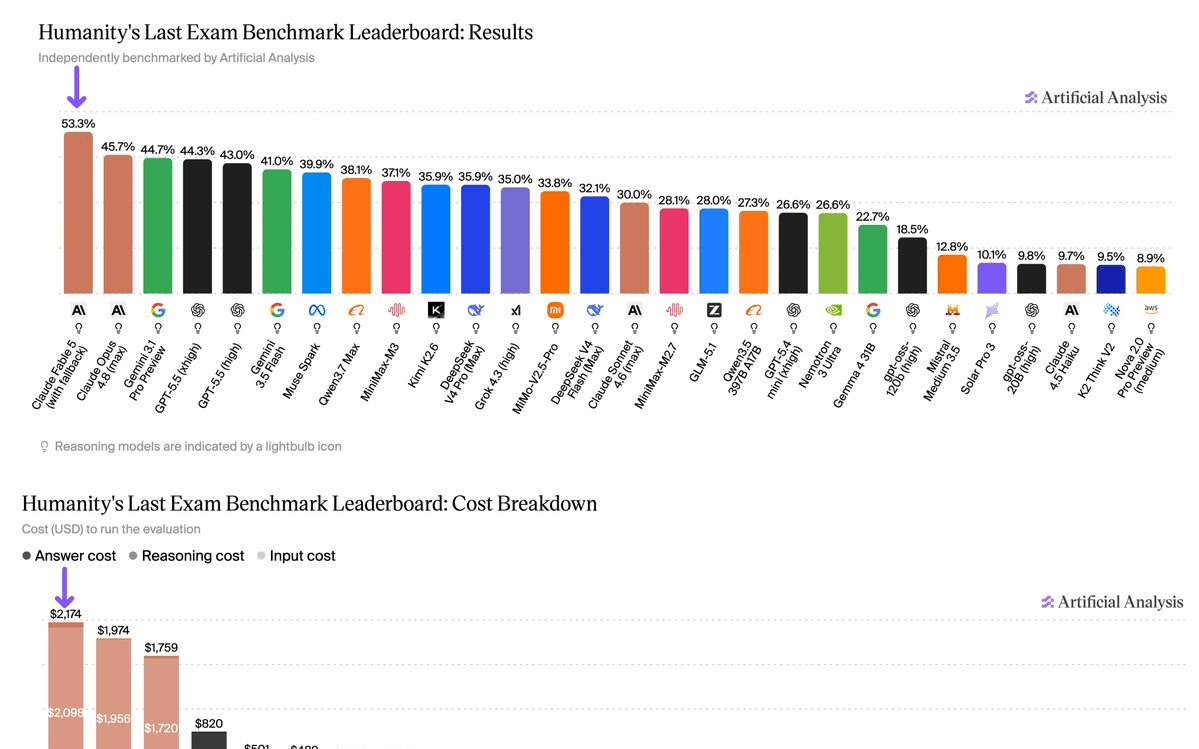
Anthropic says Fable 5 beats every generally available model the company has ever shipped and claims state-of-the-art results in nearly all benchmarks tested. The gap widens on long, complex tasks. Independent evaluation by Artificial Analysis confirms this: Claude Fable 5 scores 65 on the Artificial Analysis Intelligence Index, placing it well above average among comparable models.
The coding numbers are particularly striking:
- SWE-Bench Pro (real GitHub issues, no human help): Fable 5 hits 80.3%. Claude Opus 4.8 lands at 69.2%, GPT 5.5 at 58.6%, and Gemini 3.1 Pro at 54.2%.
- FrontierCode (production-grade coding tasks): Fable 5 scores 29.3% vs. 13.4% for Opus 4.8 and just 5.7% for GPT 5.5.
- Humanity's Last Exam: Fable 5 scores 53%, more than 7 points ahead of the next-best model, Claude Opus 4.8.
The asterisk: because the safety classifiers route some queries to Opus 4.8, Fable 5's scores on science-heavy benchmarks like GPQA and HLE are slightly lower than its unconstrained twin, Claude Mythos 5. Artificial Analysis recorded fallback routing in roughly 8% of Intelligence Index tasks, mostly on scientific questions.
What it's actually built for
The model can work for days at a time in an agent harness like Claude Code. It can plan its approach, check progress against the goal, and refine its work as it goes. This makes it qualitatively different from previous Claude models for long-horizon work. Payment processor Stripe says Fable compressed five months of engineering work into days. In a Ruby codebase with 50 million lines, the model finished a migration in one day that would have taken a full team over two months.
Early enterprise feedback points to a few high-value use cases:
- Complex analytics: Hex reported Fable was the first model to hit 90% on its core analytics benchmark of complex, long-running analytical tasks, noting "strong judgement and attention to nuance on the hardest questions."
- Full-stack app generation: Vibe-coding platform Base44 noted Fable is better at "one-shotting full apps" with excellent tool-calling.
- Financial analysis: On Hebbia's Finance Benchmark, which tests AI at the level of seasoned financial analysts, Fable posted the highest score of any model.
- Autonomous agents: Rakuten noted that "at the highest effort, Fable reflects on and validates its own work,