

Anthropic's Claude Design Ships Directly to Replit, Killing the Design-to-Code Gap
Replit is now a native destination inside Claude Design, letting anyone go from AI-generated mockup to deployed app without leaving the conversation
- New integration: Replit is now a native export destination inside Claude Design, letting users send designs directly to Replit to build and deploy without context switching.
- Two-way connection: A new official Replit Connector also lets Claude autonomously delegate any development task to Replit mid-conversation.
- Bigger rollout: Claude Design now exports to 9+ platforms including Adobe, Canva, Vercel, Lovable, and Miro, positioning it as the start of every workflow, not the end.
- Replit's scale: Replit has 50M+ users, $525M estimated ARR, and a $9B valuation after a $400M Series D, making it a heavyweight partner for Anthropic.
- Design system continuity: Claude Design reads your codebase and Figma files to extract your design system, so apps shipped through Replit stay on-brand automatically.
- Availability: Requires a Claude Pro, Max, Team, or Enterprise subscription; the Replit Connector is live in Claude's Connectors directory today.
Anthropic and Replit just closed the most annoying gap in AI-assisted app building: the moment you finish designing something in Claude and have to manually copy it into a development environment. Replit is now a first-class export destination inside Claude Design, meaning a working prototype can go from a natural language prompt to a live, deployed app in one uninterrupted workflow.
Two tools, one pipeline
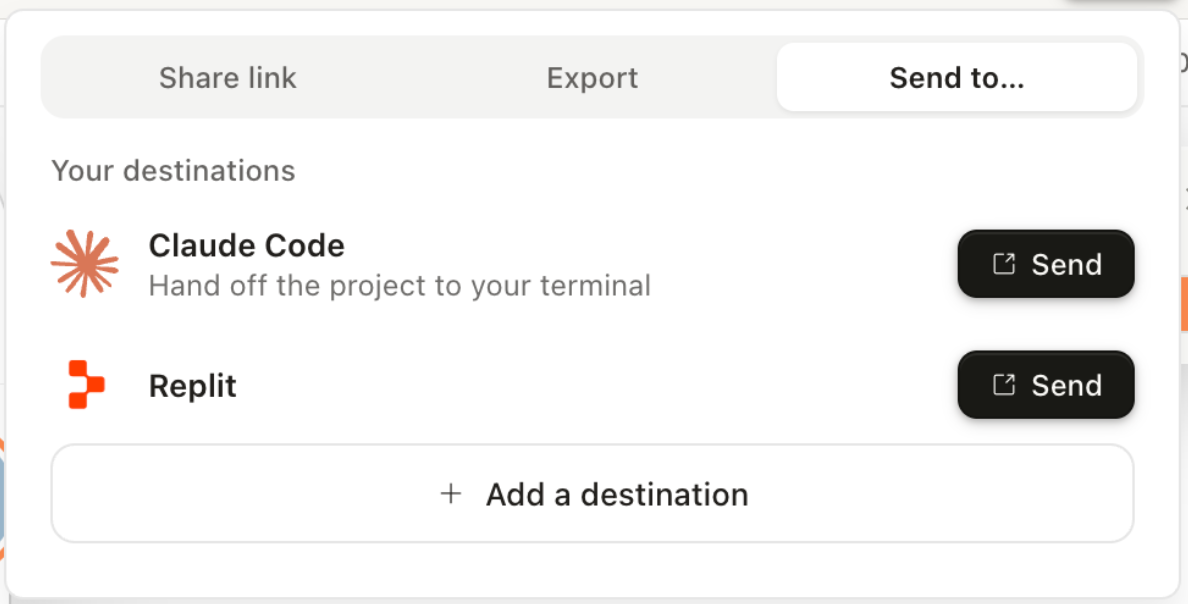
The integration works in two directions. First, when you finish a design in Claude Design, a "Send to Replit" button packages everything and hands it off directly. No copy-pasting markup, no re-explaining what you built. Second, a new official Replit Connector lets Claude hand off any general development task to Replit mid-conversation. Whether you are spinning up a backend, building out a feature, or iterating on an existing project, Claude delegates the work and Replit executes it.
Replit's own statement frames the partnership as a shared philosophy: "Replit and Anthropic share a belief that anyone, anywhere should be able to bring their ideas to life with AI. Our mutual goal is to meet builders wherever ideas begin. The Claude Design MCP integration is a natural next step."
What Claude Design actually is
If you have not used it yet, Claude Design is worth understanding before the integration makes sense. Launched as an Anthropic Labs product, it lets you collaborate with Claude to create polished visual work like designs, prototypes, slides, one-pagers, and more. The output is not a static image: it is live HTML, clickable and testable, which you then refine through voice, inline comments, or sliders.
Claude Design is powered by Claude Opus 4.7 and is available in research preview for Claude Pro, Max, Team, and Enterprise subscribers. The key differentiator is that Claude Design can read your codebase and Figma files to automatically extract your design system, then apply that system to any new project. That means the app you ship through Replit will actually look like your brand, not a generic AI-generated template.
Part of a much bigger push
This is not a one-off integration. Claude Design now sends work to Adobe, Base44, Canva, Gamma, Lovable, Miro, Replit, Vercel, and Wix, in addition to PDF and PowerPoint. The breadth of this list reveals a deliberate positioning strategy: Anthropic is building Claude Design not as a place where work is finished, but as the place where it begins.
Claude Design's transformation from prototype toy to enterprise platform is the latest move in a company-wide strategy to make Claude not just an assistant people talk to, but a worker embedded in the systems where work actually happens. The Replit integration is the most direct expression of that strategy for builders: design intent flows directly into running code, with no human translation layer in between.
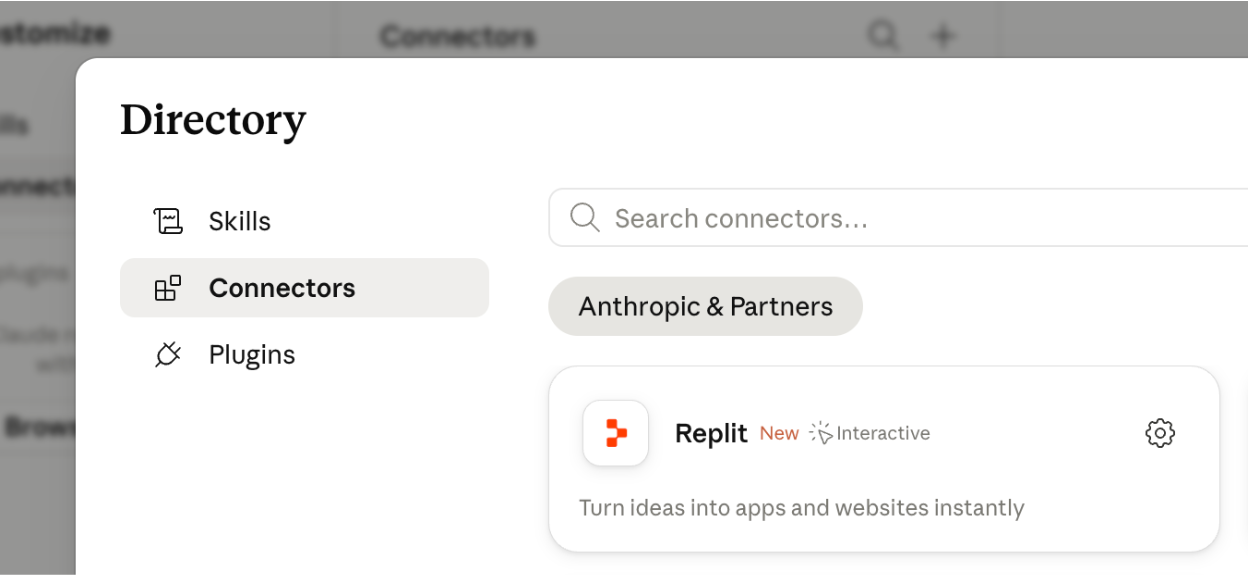
Claude's connector ecosystem has transformed dramatically in the first half of 2026. The official Connectors Directory has grown to over 418 verified integrations across 30 categories, spanning revenue tools, creative software, developer platforms, and consumer apps. Connectors work across Claude, Claude Desktop, Claude Code, and the API, and once connected, Claude can bring a tool into conversation on its own when it fits what you are asking for, without you naming it every time.
Why Replit is the right partner here
Replit is not a small bet. The company raised a $400 million Series D at a $9 billion valuation, led by Georgian Partners. Sacra estimates that Replit hit $525 million in annualized revenue in April 2026, up from $300 million at the end of 2025. By March 2026, the user base had grown to 50 million users, with users from 85% of the Fortune 500 on the platform.
The two companies have been orbiting each other for a while. Replit already ships Claude Opus 4.7 as the model powering its Power mode for agents. The new integration formalizes what was already a deep technical relationship into a seamless product experience.
What this unlocks
The practical impact comes down to eliminating the translation step between design and code. Previously, even with AI tools, you would design something in one place, export it, re-import it somewhere else, and re-explain the context. Now:
- Describe an app in natural language inside Claude Design
- Refine the visual design using Claude's inline editing, sliders, and your existing design system
- Hit "Send to Replit" and continue building, iterating, and deploying without switching contexts
- Or, mid-conversation, ask Claude to delegate any development task to Replit via the Connector
Anthropic is betting that if the same AI system both designs and codes, and if both modes share the same underlying component library, the gap disappears. It is arguing that the design-to-code problem was never really about better specification formats or smarter handoff tools. It was about the fact that two different humans, or two different tools, were interpreting the same intent. A single AI system that operates on both sides of the workflow does not need to interpret; it just continues.
Who wins and who loses
For non-technical builders, founders, and product managers, this is a meaningful step forward. Replit hopes to stand out from the competition by being the coding agent for non-technical workers, like sales staff, marketers, and small business owners. Instead of working inside a code editor, the company wants to make building apps and software more like graphic design.
The tools that lose ground are the ones that lived in the gap between design and deployment. Standalone prototyping tools that required a separate handoff step now have a harder value proposition. Anthropic knocked 7% off Figma's stock in a single day when Claude Design launched, not with a funding round, not with a pivot, but with a product. This integration makes that original disruption stickier by connecting it directly to deployment.
For the broader AI coding market, AI coding grew to $4.2 billion of the $19 billion AI applications market in 2025 while enterprise AI spending surged to $37 billion, growing faster than any software category. Both Anthropic and Replit are betting that the next wave of that growth comes from collapsing the design-to-ship pipeline entirely. This integration is the clearest signal yet that they are building toward the same end state.
The integration is available now. You need a Claude Pro, Max, Team, or Enterprise subscription to access Claude Design, and a Replit account to receive the handoff. The Replit Connector is listed in Claude's official Connectors directory and marked as interactive, meaning Claude can invoke it autonomously during a conversation when it determines that building something is the right next step.
Comments
