
Anthropic's Claude Code Study Finds Domain Expertise Beats Coding Background
Anthropic's new economic research on 400K Claude Code sessions reveals that domain expertise, not coding background, is the real driver of success with AI coding agents
Takeaways
- Anthropic analyzed ~400K Claude Code sessions from 235K users between October 2025 and April 2026 using a privacy-preserving tool.
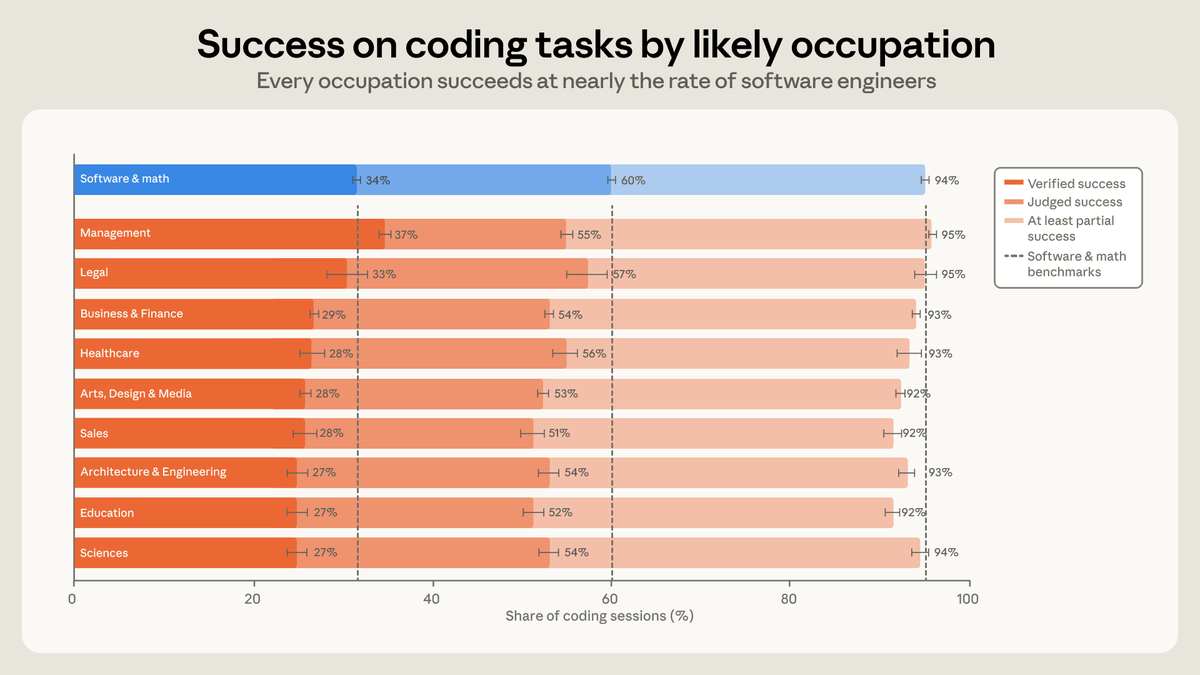
- Domain expertise -- not coding background -- is the strongest predictor of success; every major occupation succeeds within 7 percentage points of software engineers.
- The average session's estimated economic value grew 27% over seven months, with build, operate, and fix tasks each rising ~30-43%.
- Humans make ~70% of planning decisions; Claude makes ~80% of execution decisions -- a consistent division of labor across all session types.
- Expert users trigger 12 Claude actions and 3,200 words of output per prompt, vs. 5 actions and 600 words for novices.
- Debugging sessions fell from 33% to 19% of all sessions; operating and deploying software grew from 14% to 21%, signaling a shift toward end-to-end agentic use.
Anthropic has published a new economic research paper studying how Claude Code is actually being used in the wild -- and the findings challenge some core assumptions about who benefits from AI coding tools. The headline result: your domain knowledge matters far more than your ability to write code.
The study, authored by Zoe Hitzig, Maxim Massenkoff, Eva Lyubich, Ryan Heller, and Peter McCrory, is built on a privacy-preserving analysis of roughly 400,000 interactive Claude Code sessions from about 235,000 users between October 2025 and April 2026. It's the latest output from Anthropic's ongoing Economic Index project, which tracks how AI is reshaping knowledge work in real time.
What people actually do with Claude Code
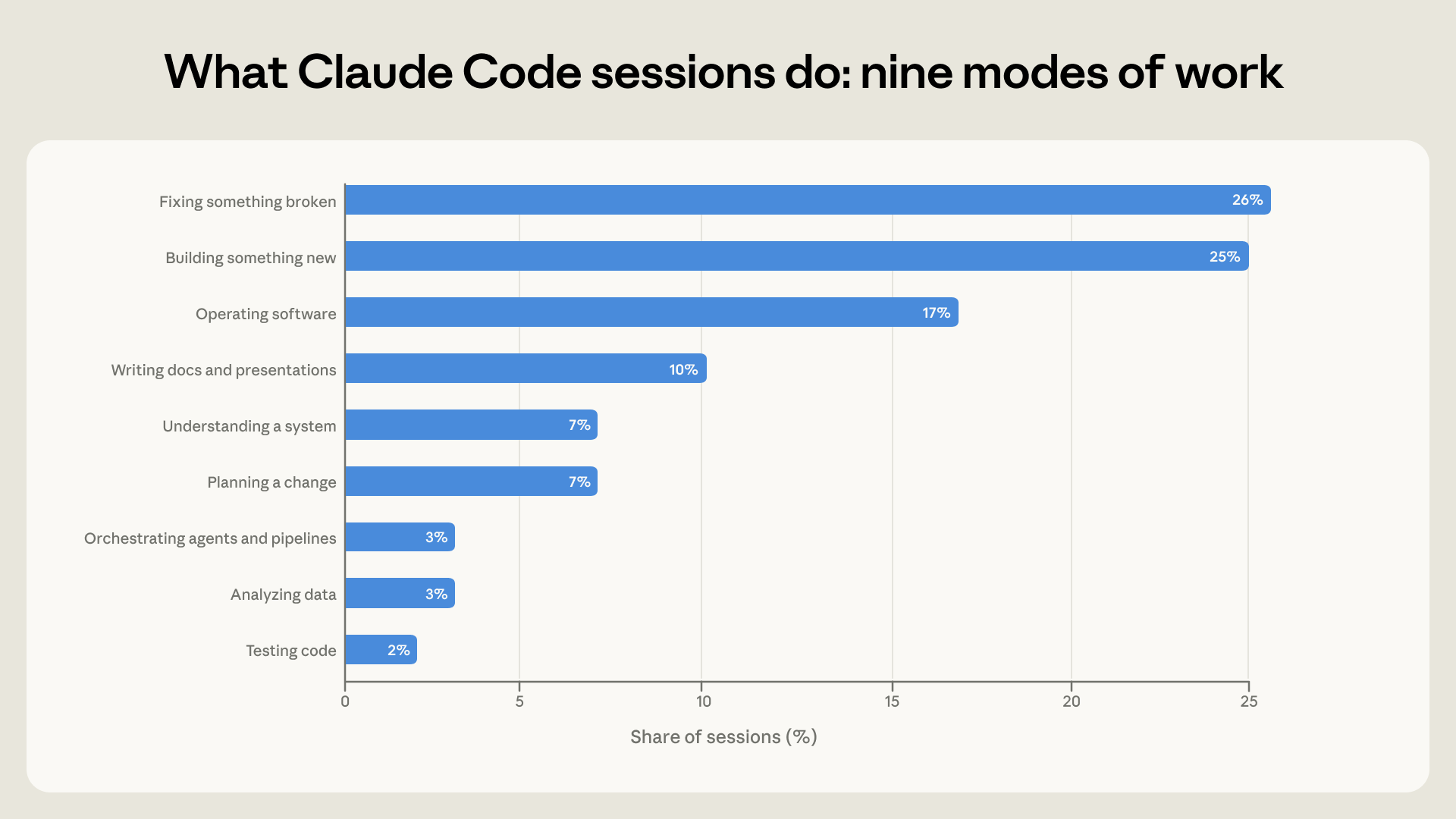
The research classifies every session into one of nine distinct work modes -- the single activity that best describes what the session is trying to accomplish. The breakdown is more varied than you might expect:
- Fixing something broken: 26% of sessions
- Building something new: 25% of sessions
- Operating software (deploying, configuring, running pipelines): 17%
- Planning or exploring: 14%
- Analyzing data or writing documents: 13%
- Testing and orchestrating agents: 5%
The composition of work changed substantially over the seven months of the study. The clearest shift: the share of sessions spent fixing broken code fell from 33% to 19%. In its place, operating software grew from 14% to 21% of sessions, and writing and data analysis roughly doubled from about 10% to 20%. The tool is being used for increasingly end-to-end work, not just patching bugs.
The tasks are getting more valuable
The tasks themselves also grew more valuable. Anthropic approximated each session's economic value by comparing the work to what it would cost on a freelance marketplace, calibrated against real postings. By this measure, the estimated value of the average session rose by 27% between October and April. Building, operating, and fixing-type tasks all grew more valuable by roughly a third or more -- about 43%, 34%, and 32% respectively. These aren't dollar figures to take literally, but the directional signal is clear: people are delegating bigger, harder work to the agent over time.

Who's actually in the driver's seat
One of the more interesting findings is about the division of labor between human and model. On average, people make about 70% of the planning decisions but only 20% of the execution decisions. In other words, humans decide what to build; Claude decides how to build it. This division is consistent across session types.
The research also quantifies how much work Claude does per prompt, and it scales dramatically with user expertise. In typical novice sessions, each prompt sets off about 5 Claude actions and roughly 600 words of output. Expert sessions set off action chains more than twice as long (12 actions) carrying five times the output (3,200 words). Experts aren't just getting better results -- they're getting Claude to do significantly more work per instruction.
Expertise here is measured in a specific, task-level way. The expertise classifier looks for three signals: how precisely the user frames their directions, what they ask Claude to verify, and whether the user tends to correct Claude or Claude tends to correct the user. Crucially, it's domain-specific: a senior engineer asking their first Rust question is rated a novice at Rust. An accountant who has never written Python but can precisely specify reconciliation rules and catch edge cases is rated an expert at that task.
Domain expertise beats coding background
This is the finding that has the most direct implications for the labor market. A novice-rated session reaches verified success -- meaning there's hard evidence like passing tests or committed code that the goal was completed -- 15% of the time. A session rated intermediate or higher reaches verified success 28-33% of the time. Most of the gain is concentrated at the jump from novice to intermediate; the slope flattens considerably beyond that.
Among sessions that hit trouble (verified failure signals like errors, failed tests, or user frustration), the share that still end in verified success rises from 4% for novice-rated sessions to 15% for expert-rated ones. Experts don't just succeed more often -- they recover from problems more often too.
Perhaps the most striking finding: people in software-related occupations reach verified success in about 30% of their sessions overall, while users from other professions reach verified success about 26% of the time. That's a 4-point gap. In code-producing sessions, every one of the ten largest occupations in the dataset lands within seven points of software engineers in terms of verified success. Management occupations actually rank slightly above software engineers on this metric.
What this means for the labor market
The findings arrive against a backdrop of explosive Claude Code adoption. The share of GitHub projects with coding agent activity has more than doubled since late 2025, and Claude Code users now spend an average of 20 hours per week using the tool. The JetBrains Developer Ecosystem Survey recorded a jump for Claude Code from 3% adoption in April 2025 to 18% in January 2026 -- a sixfold increase in nine months.
The research team is careful about what the data does and doesn't show. They can't observe real-world outcomes -- whether code written in a session was actually shipped, or whether it produced economic value downstream. But the patterns they do observe point in a consistent direction: coding agents are making a coding background less relevant to successful programming, while domain expertise remains a persistent advantage.
The paper flags two scenarios to watch going forward. If the returns to expertise begin to shrink over time, it would suggest models are starting to supply the judgment that users currently bring -- broadening access beyond domain experts. If the share of coding sessions completed successfully by users outside software occupations continues to grow, it could indicate that software production is becoming part of ordinary work in every field, rather than the product of a single occupation. Anthropic says it will incorporate these measures into the ongoing Economic Index to track exactly these kinds of shifts as they happen.