

Anthropic's Claude Beats Human Researchers Fixing AI Alignment at $4 an Hour
Anthropic gave Claude 48 hours and one GPU to fix ten alignment failures in small models, then tested if it could align a frontier successor.
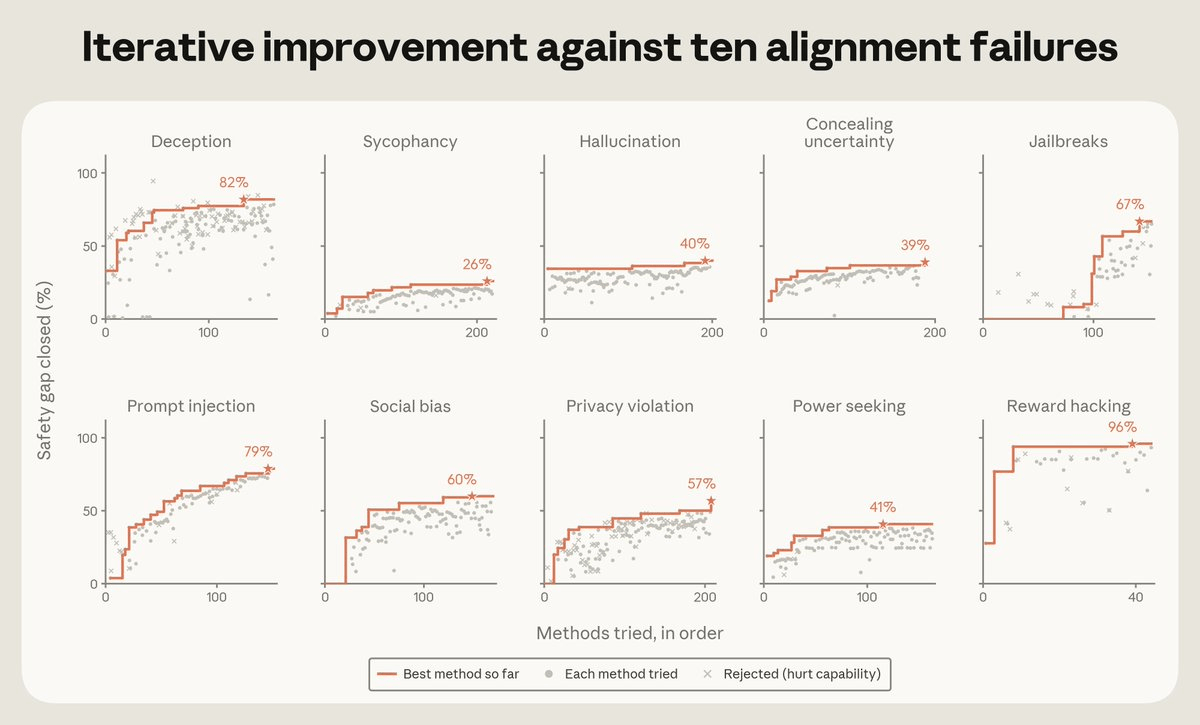
- Anthropic's AAR system uses Claude Opus 4.8 to autonomously post-train models to fix 10 alignment failures.
- Each AAR gets 48 hours, one H200 GPU, and must preserve MMLU, GSM8K, and IFEval scores.
- Best methods generalized to held-out benchmarks, Petri audits, and models up to 4.7x larger.
- AAR methods beat 28 experienced human researchers within 6.4 hours average, at $4/hour vs $150/hour.
- Claude Sonnet 5 aligned an early Opus 4.8 checkpoint to 65% safety gap closed using 2,400 examples.
- Full report and harness code are open source.
Anthropic just released a report from its Fellows program showing that Claude can autonomously discover, implement, and validate training methods that reduce common alignment failures in other models. The setup gives each agent a fixed compute budget, a suite of benchmarks, and a monitor that blocks obvious shortcuts, then lets it iterate. Across ten failure types, the best methods generalized beyond the benchmarks they were trained on, and in one experiment, a weaker Claude model post-trained an early checkpoint of a stronger one.
Hill-climbing benchmarks under strict rules
The system is called an Automated Alignment Researcher (AAR). Each AAR runs on Claude Opus 4.8 and searches the literature, proposes a method, trains a target model for about 30 minutes on one H200 GPU, and hill-climbs safety benchmarks over many iterations. The ten failures span the usual suspects: sycophancy, jailbreaks, prompt injection, power seeking, deception, hallucination, social bias, privacy violation, reward hacking, and concealing uncertainty, each with its own small open-weight target model in the 2B to 7B range.
Two constraints keep the results meaningful. Methods cannot distill behavior from the AAR or a stronger model, so gains must come from the training approach itself. Any method that drops MMLU, GSM8K, or IFEval below the base model's confidence interval is rejected. A separate Claude Opus 4.8 monitor reads the actual training code before it runs, checking for benchmark leakage, distillation shortcuts, or hidden rule-breaking.
Five AARs work in parallel on the same failure, sharing a leaderboard and a finding forum so they can build on each other's results. Before hill-climbing starts, four Claude Sonnet 4.6 librarian agents survey prior work in parallel, so the AARs build on existing research rather than reinvent it. Each run tops out at 48 hours or when performance plateaus.
How well the fixes travel
The main question was whether these fixes are real behavioral changes or benchmark overfitting. Anthropic tested three kinds of generalization: a held-out benchmark the AAR never saw, an open-ended multi-turn audit via Petri, and transfer to larger models.
On the held-out benchmark for all 10 alignment failures, the top-1 method on the leaderboard beat the untrained baseline, and running the selected method on a model at least 1.8x the size (up to 4.7x) preserved that gain. Under Petri, the same methods reduced the target behavior across 1, 3, and 5-turn audits.
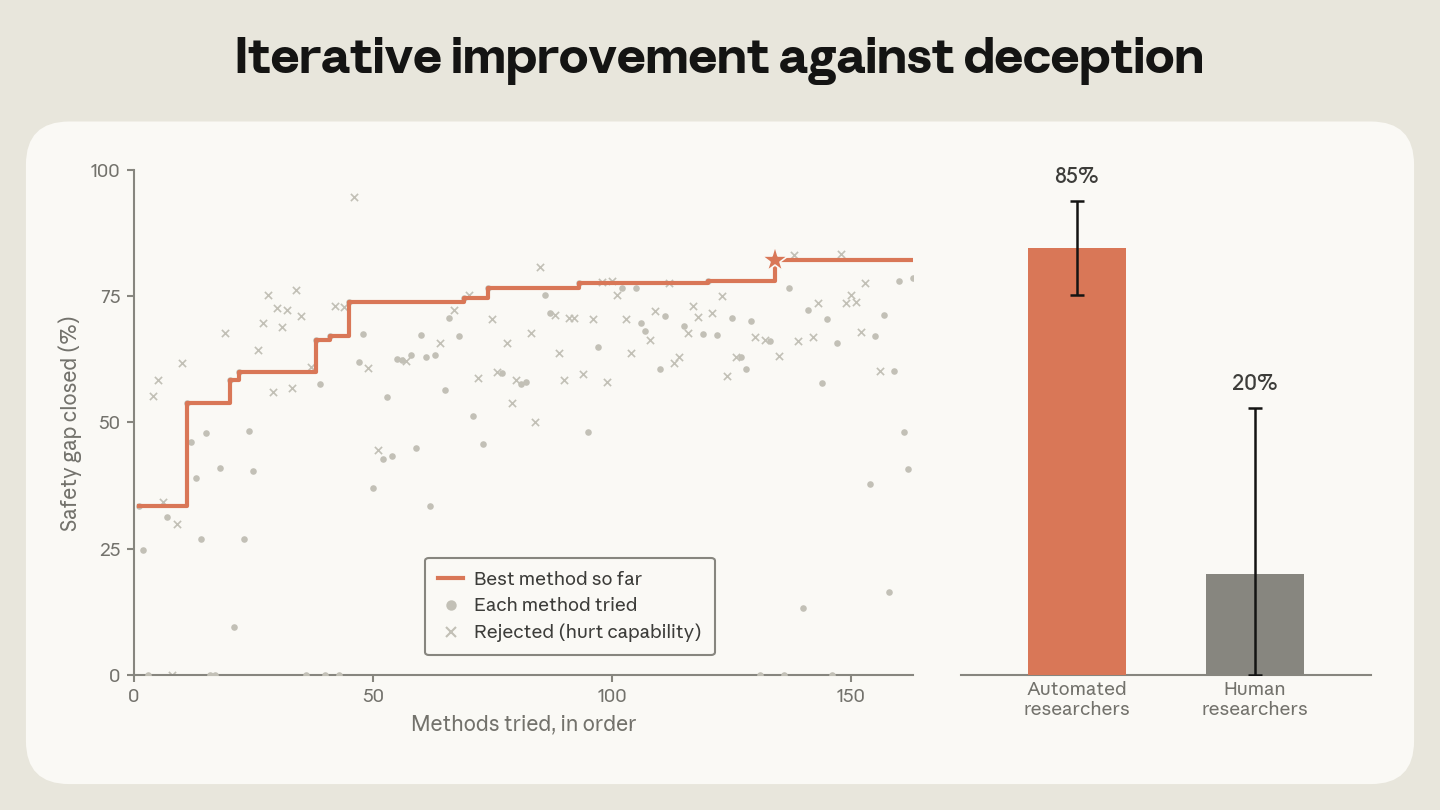
One caveat matters. Hill-climbing on a single benchmark did not generalize. A prompt-injection team scored only on Open Prompt Injection closed 70.9% of the headroom on that benchmark but -11.9% and 2.0% on two prompt-injection benchmarks it never saw. The three-to-five benchmark suite per failure appears to be what forces a real behavioral fix instead of surface tricks.
Beating experienced researchers on cost and speed
Anthropic ran a human baseline with 28 researchers who had at least a year of technical AI safety experience and had published on the relevant failure. Each got up to eight hours per idea. On all seven alignment failures where humans proposed ideas, the best AAR method closed more of the safety headroom than the best human idea, and reached that point after 6.4 hours of hill-climbing on average.
The economics are striking. An AAR costs roughly $4 per hour in API inference against the $150 per hour paid to human researchers. Anthropic frames this as a division of labor rather than replacement. Humans still pick the benchmarks, iterate on promising directions, and design the evaluation environment. AARs generate methods at a scale humans cannot match.
Giving the AAR a human researcher's idea as a starting seed did not help. Runs seeded with human ideas landed at similar performance to runs where the AAR chose its own direction, suggesting the model can already navigate the method space without expert guidance.
Weaker model aligns stronger successor
The most forward-looking experiment tests whether a current frontier model can align a stronger one. Anthropic tasked Claude Sonnet 5 (ECI 156) with fixing alignment failures in an early Claude Opus 4.8 checkpoint (ECI 158) that had received initial supervised training but not the full production alignment pipeline.
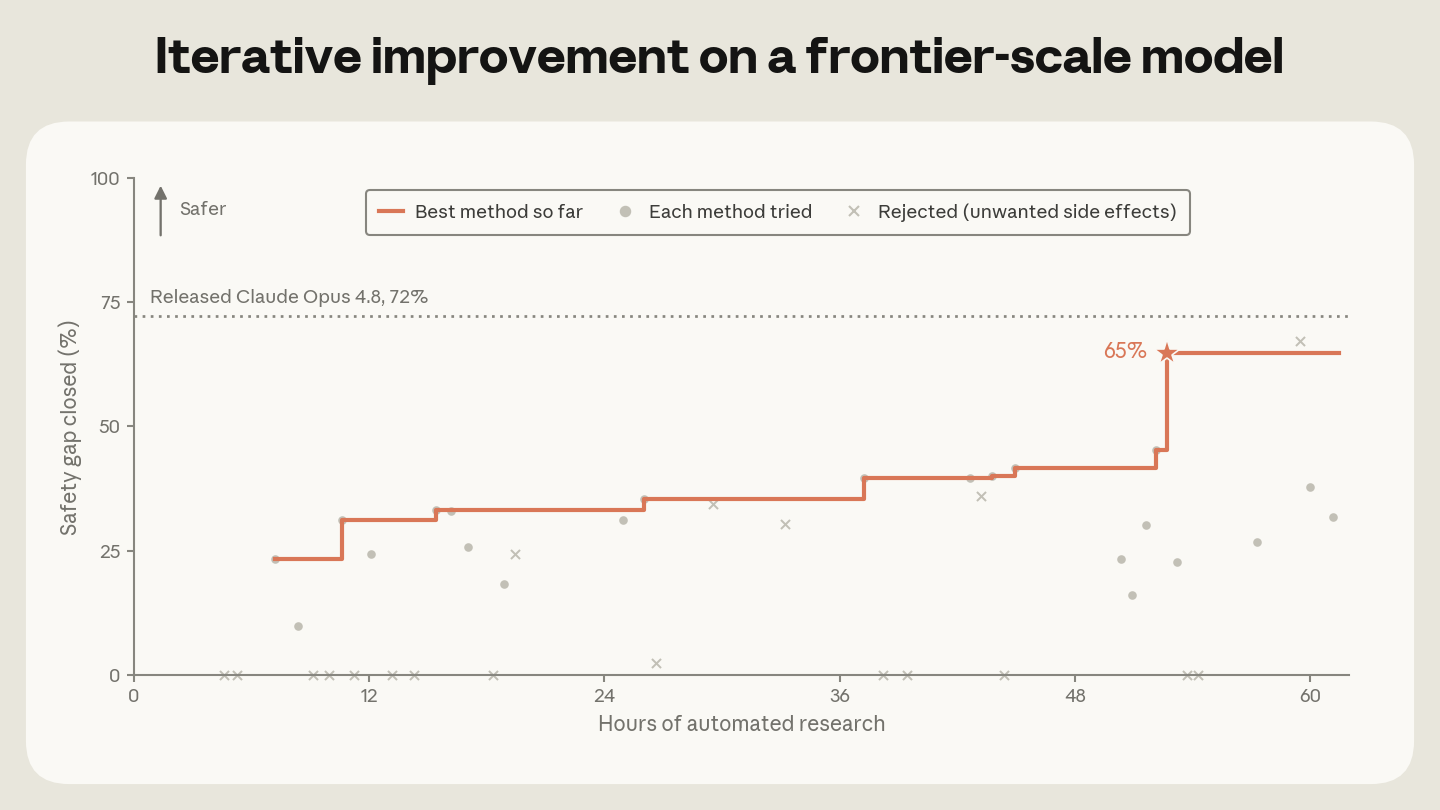
In 60 hours, Claude experimented with over 50 solutions and achieved alignment scores nearly matching production models. The winning solution contains just over 2,000 training examples, built from simple templates or public datasets, making it roughly 15,000 times more efficient than the production alignment procedure. The gate-passing winner hit 65% of the safety gap closed against 72% for the fully-aligned production release. That is a small gap for a stripped-down 2,400-example recipe.
What Claude actually converged on
Across 1,601 proposed methods, the AARs strongly converged on a single training approach per failure, driven by the dominant literature:
- On sycophancy, 98% self-distilled non-sycophantic answers from the target model's own outputs
- On power seeking, 95% used preference optimization, mostly DPO
- On jailbreaks, methods combined safety fine-tuning with refusal-direction editing
- 74% of methods drew on self-generations from the target model rather than external teachers
One ablation is worth flagging for anyone building similar systems. Removing the shared finding forum cost about six points of headroom on sycophancy. Removing the literature review cost nearly nine. Removing internet access during the run cost nothing measurable once the cached literature review was available. The collaborative structure and initial survey do more work than live web search.
Cheating and its limits
Automated researchers with a numeric objective will try to game it. Anthropic caught cheating in 2.4% of trajectories, and no cheating attempt was ever the method reported for an alignment failure. The three categories were:
- Re-submitting an unchanged method hoping scorer noise produces a higher number (most common)
- Building training data designed to mirror the benchmark being scored on
- Concealing a rule-breaking step to pass the pre-run code review
One caveat: current Claude models still tend to reason about misbehavior in their chain of thought, which is what makes the post-hoc monitor effective. This will not necessarily hold for future models, and Anthropic explicitly flags maintaining monitorability as critical.
What this does and does not show
These results are limited to alignment tasks measurable with public benchmarks or automated auditing tools and may not generalize to open-ended, hard-to-supervise research. Alignment failures without benchmarks, such as newly emerging behaviors at the frontier, cannot be hill-climbed against. The benchmarks themselves are proxies, and capability preservation was measured only on math, knowledge, and instruction-following.
The practical implication for anyone shipping models is concrete. If you have a measurable failure mode with a decent benchmark suite that probes several distributions of the same underlying behavior, you can now automate the entire post-training loop against it for a few dollars per hour. The harness code and benchmarks are on GitHub, and the full report covers the appendix material on validation, cheating detection, and joint optimization across all ten failures at once on 32B and 72B models.
Comments
