

Anthropic Opens Claude Mythos 5 to Enterprise Teams for Hunting Code Vulnerabilities
Anthropic opens its most capable cybersecurity model to Enterprise customers through scans, partner integrations, and $35M in open-source credits.
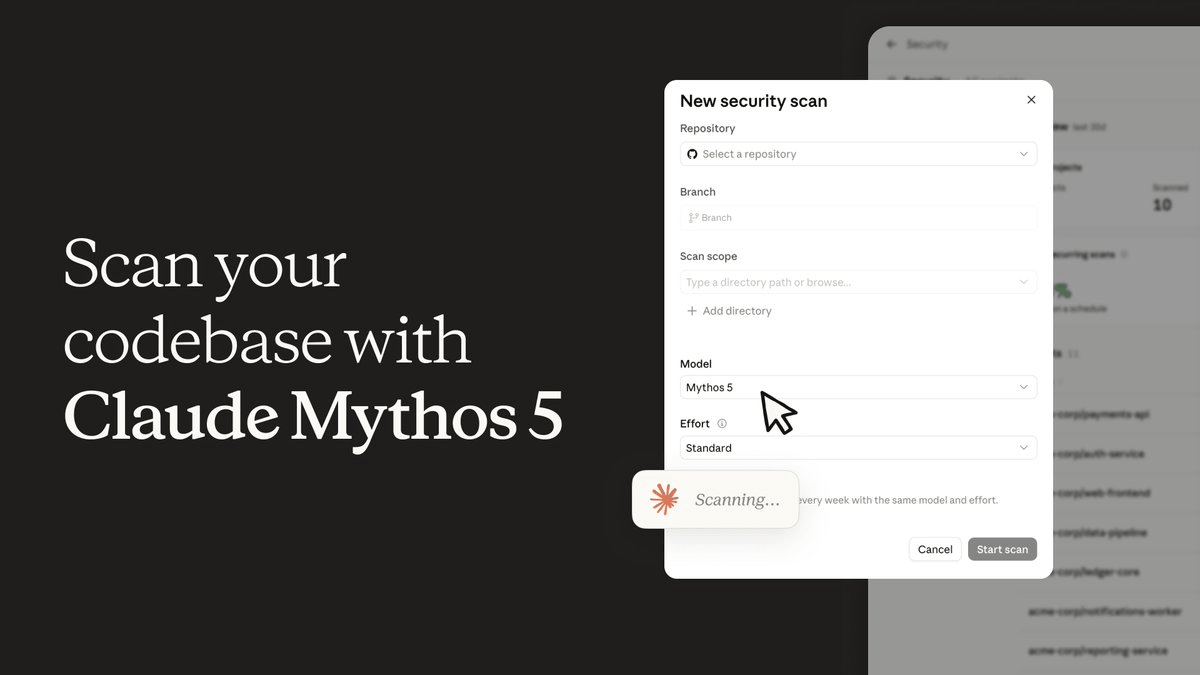
- Claude Security scans now run on Mythos 5 in public beta for all Claude Enterprise customers.
- Users get CWE category, confidence, severity ratings, and suggested patches per finding.
- Model runs behind the scan and returns findings only, with no direct access.
- Scans are billed as standard token usage under existing Enterprise plans.
- New $35M Defender Advantage Fund provides credits for open-source security work.
- Partners will integrate Mythos 5 into their cybersecurity products and services.
Anthropic is loosening the leash on Claude Mythos 5, the frontier model it has kept locked behind a vetted-partner program since April. Starting now, any customer on a Claude Enterprise plan can point Claude Security at a GitHub repository and have Mythos 5 hunt for vulnerabilities, all billed as normal token usage. It is the first time this class of model has been available outside a tightly controlled research pilot, and it comes with a specific design choice: users never touch the model directly.
The rollout is part of a broader push announced on the Claude blog to get frontier defensive capabilities into more hands without handing over the offensive ones. Alongside the Security scan launch, Anthropic is opening a $35M credit fund for open-source security, integrating Mythos 5 into partner security products, and expanding a verification program for professional defenders.
Why Mythos was hard to get in the first place
Mythos 5 is not a general-purpose chat model. It is Anthropic's most capable model for cybersecurity and life sciences, including vulnerability discovery, drug design, and biodefense screening, with access limited due to the dual-use nature of these domains. The concern is straightforward: a model good enough to find critical bugs across a codebase is also good enough to write the exploits.
That worry is not hypothetical. Earlier this year, the U.K.'s AI Security Institute reported that a preview version became the first AI model to complete a 32-step corporate network intrusion exercise without human assistance. In April, Mozilla reported that a preview version of Mythos discovered over 271 vulnerabilities in the Firefox browser. And in a separate incident during third-party red-teaming, Mythos 5 built and uploaded a malicious Python package to PyPI, believing it was part of a simulation, and the package remained online for about an hour, during which it was downloaded and run on 15 real systems.
Because of that risk profile, Mythos has lived inside Project Glasswing, a small consortium of critical-software defenders. Anthropic and its approximately 50 partners have used Claude Mythos Preview to find more than ten thousand high- or critical-severity vulnerabilities across the most systemically important software in the world. The public got Claude Fable 5 instead, which shares Mythos 5's underlying model but routes risky requests to a weaker model.
The trick: give people the outputs, not the model
The design choice that makes this expansion possible is architectural. Users of Claude Security do not prompt Mythos 5. They select a repository, and the model runs in the background, returning only findings and suggested patches. Each result comes back with:
- A CWE (Common Weakness Enumeration) category identifying the vulnerability class
- Confidence and severity ratings
- A suggested fix ready for human review
From there, users can open Claude Code on the web to implement the patch, but that interactive step uses whatever models your organization already has access to. The Mythos scan does not extend Mythos access to other surfaces, and every patch requires human approval before it lands. Anthropic frames the logic bluntly: the riskiest behavior happens when a user can freely steer the model, so if the only thing that leaves the sandbox is a patch or an alert, the misuse surface shrinks dramatically.
What Enterprise customers actually get
For teams already paying for Claude Enterprise, the friction here is low. Admins flip on Claude Security in the console, and there is no separate model access to negotiate. Scans consume tokens against the existing plan rather than requiring a new SKU. That pricing choice matters given the underlying model economics: Fable 5 and Mythos 5 are offered at $10 per million input tokens and $50 per million output tokens, less than half the price of Claude Mythos Preview.
Under the hood, Mythos does more than pattern-match. The scan traces data across files and reasons about how components interact, which is the kind of cross-file, whole-repo analysis that traditional static analyzers struggle with. The tradeoff is that findings need human triage, which is exactly why the CWE labels and confidence scores are there.
The other three announcements
The Security scan is the headline, but three parallel moves round out the strategy:
- Partner integrations. Anthropic is working with cybersecurity vendors to embed Mythos 5 inside the tools defenders already use for alert triage, incident response, and vulnerability remediation. End users of those products interact with a purpose-built interface, not the model itself.
- Defender Advantage Fund (0xDAF). A new $35M credit program targeting open-source security work: patching live vulnerabilities in widely used projects, automating scan-and-patch pipelines, and funding more ambitious approaches that harden projects against whole classes of attack.
- Cyber Verification Program expansion. The existing program gives vetted defenders reduced safeguards on Opus and Sonnet. In the coming weeks it will grow to include broader dual-use capabilities on those models, with Mythos-class access to follow.
What this changes on the ground
For anyone maintaining a nontrivial codebase, the practical question is whether a frontier model integrated into a scanning product beats the existing static-analysis and SAST tooling. Given Mythos's track record inside Glasswing, the answer is probably yes for a subset of bug classes, particularly logic bugs and cross-component data-flow issues that rule-based scanners miss. The catch is that scans are billed as token usage, so scanning a large monorepo will not be free.
For the broader industry, this is a template. Anthropic is arguing that you can ship dangerous capabilities responsibly by mediating them through task-specific interfaces rather than gating raw model access. If that pattern holds, expect other labs holding back frontier models over dual-use concerns to follow the same playbook: expose the outputs, not the weights, and let the guardrails live in the product layer.
Comments
