

Anthropic Cuts Fable 5 Biology Blocks by 85% After Massive Overreach
Anthropic retrained Fable 5's biology classifier, cutting biology-related fallbacks by 85% while keeping dual-use research locked behind trusted access pathways.
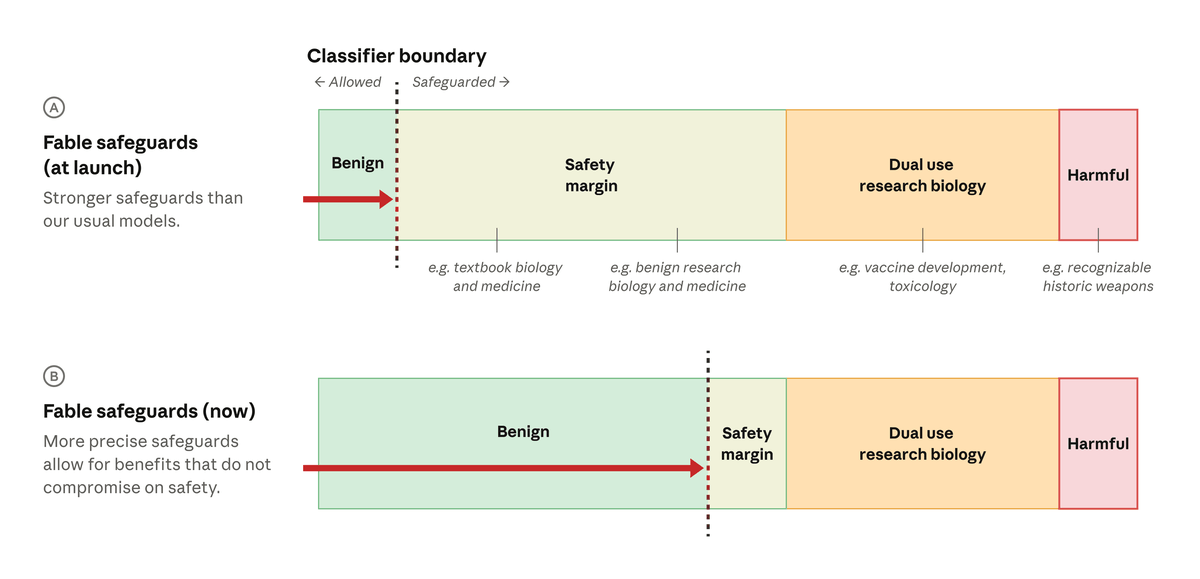
- Anthropic retrained Fable 5's biology safety classifier, reducing biology-related fallbacks by 85% across all product surfaces.
- Everyday health queries -- lab results, symptoms, educational biology -- will now reach Fable 5 directly instead of being routed to Opus 5.
- Dual-use topics (virology, toxicology, molecular design, drug development) remain blocked for general users; professional researchers must apply for trusted access.
- The classifier was rebuilt from scratch: Anthropic rewrote its "classifier constitution," gathered expert feedback, generated new training data, and retrained the model.
- Total fallbacks across all categories will drop ~67% on Claude.ai, ~55% on Cowork, ~17% on Claude Code, and ~7% on the API.
- This follows Fable 5's turbulent launch history, including a 19-day global suspension due to a US export control directive over a cybersecurity safeguard bypass.
When Anthropic launched Claude Fable 5 in June, it shipped with one of the broadest safety filters ever put on a public AI model: nearly every biology-related query got silently routed away from the frontier model and handed to a less capable one. The intent was sound, but the blast radius was enormous. Asking about mitochondria, mRNA vaccines, or cancer symptoms all triggered the fallback. Anthropic has now shipped a meaningfully better version of that system.
What the fallback problem looked like
Fable 5 and Mythos 5 share the same underlying model weights. The difference sits entirely in the safeguards wrapped around the public version. When those safeguards fire, the user's request gets silently handed to Opus 5 instead, often with a pop-up stating: "Fable 5 has safety measures that flag messages on most cybersecurity or biology topics."
Hands-on testing by The Verge and Business Insider confirmed that routine queries like "what are mitochondria," "how do mRNA vaccines work," and basic cancer questions all triggered the fallback. For a model Anthropic bills as a breakthrough for medicine and science, that was a significant friction point.
Why Anthropic built it this way
Fable 5 can now outperform experts on some highly complex biological tasks. That cuts both ways. The same capability that could help a researcher develop a new treatment could, in the wrong hands, assist in developing a biological weapon. Sophisticated actors know how to exploit ambiguity to obscure their intent, making dangerous tasks look like ordinary research. The US Intelligence Community's 2026 Annual Threat Assessment identifies exactly this risk, warning that advances in synthetic biology and genomic editing "could lead to novel biological threats."
Starting with a very broad biology classifier let Anthropic give users access to Fable 5 while continuing to refine it. Holding back the model until more safeguards progress was made would have delayed general access by weeks or months. The tradeoff was deliberate: ship fast, accept false positives, iterate.
What changed under the hood
The core of the update is a retrained safety classifier. A classifier, in this context, is a smaller AI model that runs alongside Fable 5 and screens every incoming query before the main model sees it. The key concept is the classifier constitution, a structured set of rules that tells the classifier what counts as harmful versus benign.
Over the past several weeks, Anthropic rewrote that constitution, carving out benign uses in detail. The team solicited feedback from internal and external experts, developed updated training data based on the revised constitution, retrained the classifier, and verified it still triggers on harmful and dual-use biology content while allowing a wider range of benign queries through.
The results are measurable. Biology-related fallbacks dropped by roughly 85% across Anthropic's product surfaces. Total fallbacks across all categories are expected to fall by approximately 67% on Claude.ai, 55% on Cowork, 17% on Claude Code, and 7% on the Claude Platform.
What's now unlocked, and what isn't
Users should see far fewer interruptions on everyday health and educational questions: interpreting lab results, understanding symptoms, learning biology in a classroom context. Healthcare professionals should get meaningfully more support on clinical tasks.
The guardrails on genuinely risky content remain in place. Fable 5 will continue routing to Opus 5 for queries touching:
- Virology
- Toxicology
- Molecular design
- Dual-use research biology
- Drug development
Professional biology researchers and drug developers are still hitting a ceiling. Anthropic says it hopes to narrow these restrictions further, and in the coming weeks some biomedical researchers and companies will be able to join a trusted access program for biology capabilities in Mythos 5.
A live iteration loop on safety
This update follows a pattern Anthropic established earlier with Fable 5's cybersecurity safeguards. After Amazon researchers found a method of bypassing those safeguards and the model produced code demonstrating how a vulnerability could be exploited, Anthropic pulled Fable 5 globally for 19 days before redeploying it on July 1 with updated classifiers.
The biology update follows the same playbook: ship broad restrictions, gather real-world signal, retrain the classifier with expert input, and gradually expand what's allowed. The split between Fable 5 and Mythos 5 reflects Anthropic's approach to releasing frontier systems while limiting access to capabilities it believes could be misused. The biology classifier update is the clearest sign yet that Anthropic treats this as an engineering problem with an iterative solution rather than a fixed policy decision.
For most users, the update is live now and requires no action. For researchers who need deeper access, Anthropic's trusted access pathway is the next step to watch.
Comments
