

Ant Group's LingBot-VLA Opens 20,000 Hours of Real Robot Training Data
Robbyant open-sources LingBot-VLA, a 4B-parameter dual-arm robot foundation model trained on 20,000 hours of real-world teleoperation data across 9 robot configurations.
 PRO
- Robbyant (Ant Group) open-sources LingBot-VLA: code, weights, and benchmark data under Apache 2.0.
- A 4B-parameter VLA model pretrained on 20,000 hours of real-world teleoperation across 9 dual-arm robot configurations.
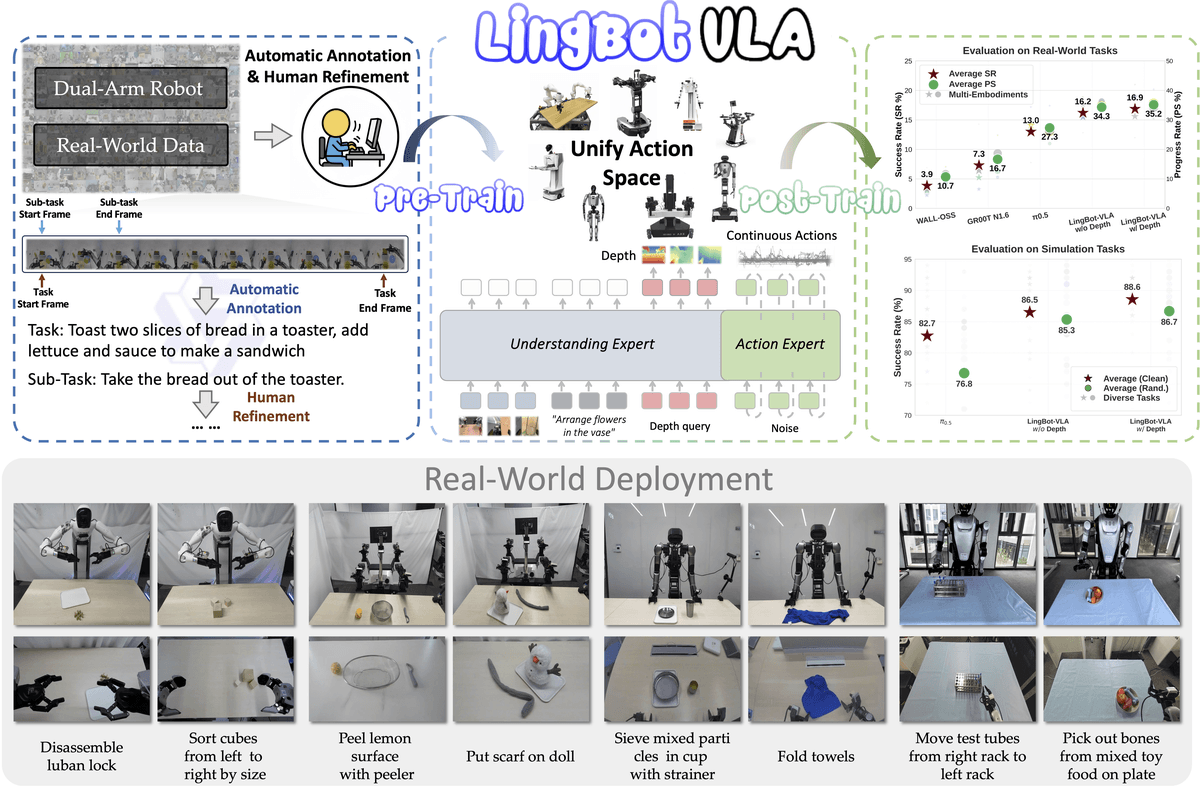
- Uses a Mixture-of-Transformers architecture where a VLM and action expert share self-attention but have separate feedforward layers.
- Depth-distilled variant achieves 17.30% SR and 35.41% progress score on the GM-100 benchmark, outperforming π0.5 and GR00T N1.6.
- Training codebase is 1.5x–2.8x faster than existing VLA implementations, hitting 261 samples/sec on 8 GPUs.
- Two pretrained checkpoints available on HuggingFace; post-training configs included for simulation and real-robot deployment.
Robbyant, the embodied intelligence arm of Ant Group, has fully open-sourced LingBot-VLA , releasing code, pretrained weights, and benchmark data for a Vision-Language-Action (VLA) foundation model built specifically for dual-arm robot manipulation. The release includes two model variants, training scripts, deployment configs, and the GM-100 benchmark dataset, all under the Apache 2.0 license.
VLA models are robot policies that take camera images and natural language instructions as input and output low-level motor actions , essentially giving robots the ability to understand instructions and act on them. Most existing VLA models are either trained on limited data, tied to a single robot platform, or too slow to train at scale. LingBot-VLA is designed to address all three at once.
20,000 hours of real-world robot data
LingBot-VLA is a Qwen2.5-VL-based VLA foundation model trained on about 20,000 hours of real-world dual-arm teleoperation across 9 robot embodiments, enabling strong cross-morphology and cross-task generalization. The robot configurations covered include AgiBot G1, AgileX, Galaxea R1Lite, Galaxea R1Pro, Realman Rs-02, Leju KUAVO 4 Pro, Qinglong humanoid, ARX Lift2, and a Bimanual Franka setup.
Systematic pre-training data scaling experiments showed that success rates climbed consistently across all three evaluation platforms with no saturation at 20K hours, suggesting continued benefit from additional diverse real-world data. In other words, the model hasn't hit a ceiling yet , more data should keep improving it.
This story is for Pro members
You've reached the end of the free preview. Upgrade to AlphaSignal Pro to read the full article - and everything else behind the paywall.
Comments
