

Ant Group's Ling 3.0 Tiny Matches GPT-120B Intelligence With 15x Fewer Parameters
Ant Group's InclusionAI releases a 7.9B MoE reasoning model that matches GPT-class performance with just 1.3B active parameters, free and MIT-licensed.
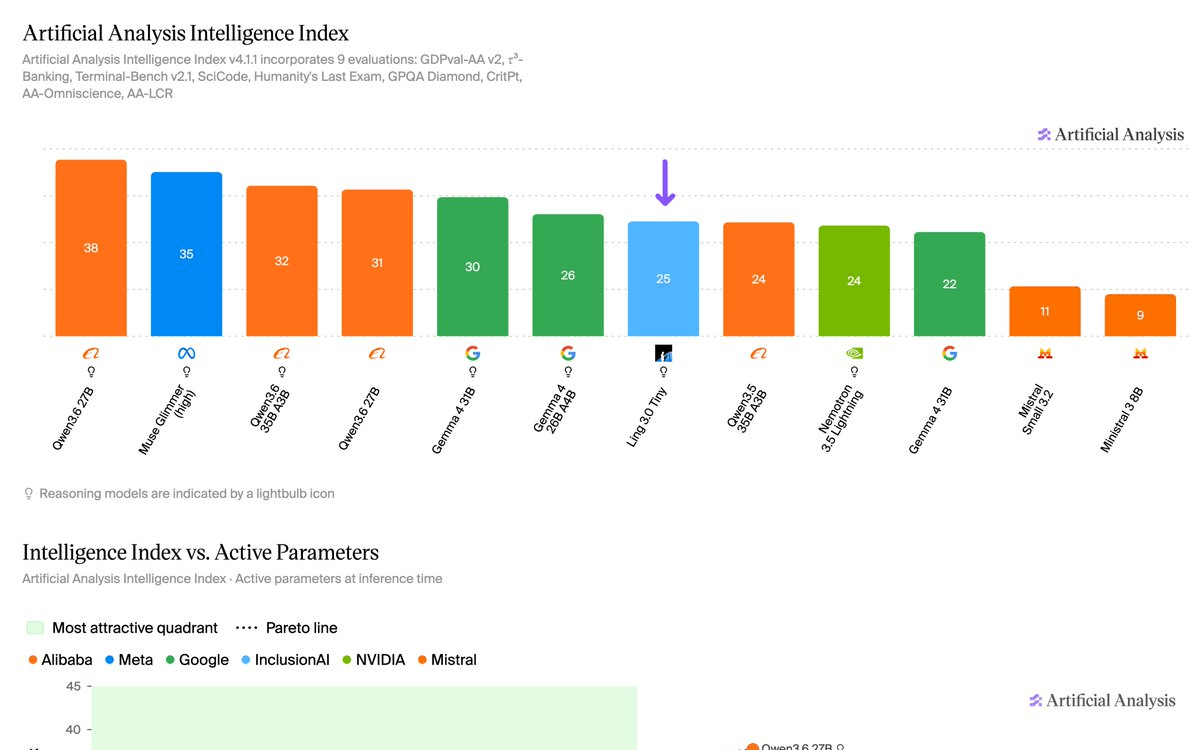
- New model: InclusionAI (Ant Group) released Ling 3.0 Tiny, a 7.9B MoE reasoning model with only 1.3B active parameters per token.
- Benchmark performance: Scores 25 on the Artificial Analysis Intelligence Index, ranking 6th of 56 models in its class, comparable to GPT-class models with 15x more parameters.
- Architecture: Uses a hybrid 3:1 KDA–MLA attention stack with 128 sparse experts, enabling 262K-token context on consumer hardware including Apple Silicon.
- Hallucination control: Achieves a 30% hallucination rate (down from 96% in Ling-mini-2.0) by abstaining on uncertain questions rather than guessing.
- Free and open: MIT-licensed weights on Hugging Face, currently $0.00/M tokens via InclusionAI API and Novita Labs; GGUF quantizations available for local use.
- Caveat: Very verbose — uses ~65% more output tokens per task than comparable models like Qwen3.6 35B A3B, which matters for latency and cost at scale.
Ling 3.0 Tiny is the latest model from InclusionAI, the AI research arm of Ant Group (the fintech giant behind Alipay). It is a small but surprisingly capable reasoning model that punches well above its weight class, and it is available right now under an MIT license with free API access.
Tiny name, real numbers
Ling 3.0 Tiny is a lightweight hybrid reasoning MoE model with 7.9B total parameters and only 1.3B activated parameters per token. That distinction matters: in a Mixture-of-Experts (MoE) architecture, the model has many specialized sub-networks ("experts"), but only a small subset are activated for any given input. This means the compute cost at inference time is much closer to a dense 1.3B model than a 7.9B one.
Independent evaluator Artificial Analysis scores it 25 on its Intelligence Index, ranking 6th of 56 models in its size class against a class median of 8. For context, that score is comparable to gpt-oss-120b (high, 24) , a model with 15x more total parameters and 4x more active parameters.
The architecture doing the heavy lifting
The Ling 3.0 family is built on a hybrid-linear attention design that combines two types of attention layers in alternation. Ling 3.0 Tiny integrates a 3:1 alternating stacking of KDA and MLA (3 Kimi Delta Attention layers followed by 1 Multi-Head Latent Attention layer per 4-layer block) with a sparse MoE FFN comprising 128 routed experts, where each token activates only 8 routed experts and 1 shared expert.
To unpack that: KDA (Kimi Delta Attention) is a linear attention mechanism , it processes long sequences in O(n) time rather than the O(n²) cost of standard attention, keeping memory and compute from exploding at long context lengths. MLA (Multi-Head Latent Attention) is a periodic full-attention layer with a compressed key-value cache. Linear attention keeps long inputs cheap, while periodic full-attention layers maintain the exact token-to-token recall needed for complex reasoning.
Ling 3.0 Tiny has been validated on NVIDIA DGX Spark, Apple Silicon MacBook, and Mac mini, enabling capable reasoning and agentic workloads without datacenter-class GPUs. That is a meaningful claim for a model with a 262K-token context window.
What it is good at , and where it falls short
It delivers balanced performance across general agent tasks, coding, mathematical and scientific reasoning, and instruction following. On tool use specifically, Ling 3.0 Tiny scores 21% on τ³-Banking, ahead of Qwen3.6 27B (17%). It also supports native function calling out of the box.
The hallucination story is particularly interesting. The model scores -19 on the AA-Omniscience Index (a benchmark that rewards correct answers, penalizes hallucinations, and ignores abstentions). That negative score sounds bad, but the mechanism behind it is deliberate: a sparse MoE FFN with 128 experts activates 8 routed experts and 1 shared expert per token, and native hybrid reasoning enables fast responses for routine tasks and multi-step reasoning for complex tasks within a single model. Rather than guessing when uncertain, the model attempted just 37% of Omniscience questions , dramatically cutting hallucinations compared to its predecessor Ling-mini-2.0, which had a 96% hallucination rate.
Where it struggles: agentic work tasks. On GDPval-AA v2 (a benchmark for real-world agentic work), it reaches an Elo of 772, behind Nemotron 3.5 Lightning at 824. It is also notably verbose , Ling 3.0 Tiny reaches an output speed of over 160 tokens/s, with approximately 18 seconds of end-to-end latency for a 500-token response, including reasoning time, but it generates a lot of those tokens. It used 51k output tokens per Intelligence Index task, roughly 65% more than models like Nemotron 3.5 Lightning and Qwen3.6 35B A3B. That verbosity has real cost implications if you are paying per token.
A pattern, not just a model
The more durable story is Ant Group's pattern: three efficiency-focused InclusionAI releases in under two weeks, each trading scale for lower active-parameter compute, and each landing amid a Chinese open-weight cycle that has otherwise been dominated by ever-larger flagship announcements.
Ling 3.0 Tiny arrives during a summer of near-constant Chinese open-weight releases, but it is not really competing in the same race as Kimi K3, Qwen 3.8 Max, or DeepSeek V4 Pro. Ling 3.0 Tiny's more direct competitive set is the small, efficient-inference tier: Google's Gemini 3.5 Flash-Lite, and open-weight efficiency plays like Liquid AI's LFM2.5 series. The question InclusionAI is answering is not "how smart can a model be" but "how smart can a model be per active parameter."
How to get it running
The weights are live on Hugging Face under an MIT license. For local inference, community GGUF quantizations are already available, though they require a patched build of llama.cpp due to the novel bailingmoe3 architecture:
git clone --branch bailingmoe3-support https://github.com/aetherbird/llama.cpp.git
cd llama.cpp
cmake -B build -DGGML_CUDA=ON
cmake --build build --config Release -j --target llama-server
./build/bin/llama-server \
  -m Ling-3.0-tiny-Q4_K_M.gguf \
  -c 131072 \
  -ngl auto \
  --flash-attn auto
Ling 3.0 Tiny supports both fast responses and multi-step reasoning, with thinking mode configurable per request through enable_thinking. Recommended sampling parameters from the model card are temperature=1.0, top_p=0.95, and top_k=20. For API access, it is available through the InclusionAI first-party API and Novita Labs, currently at $0.00 per million tokens.
Who should actually use this
- Edge and local deployment: If you need a reasoning model that runs on a MacBook or a single consumer GPU, this is one of the few options with a 262K context window at this parameter count.
- High-volume pipelines: The free pricing and fast inference speed (166 t/s) make it attractive for applications where you are running thousands of calls.
- Tool-use agents: Native function calling and a solid τ³-Banking score make it a reasonable backbone for lightweight agentic workflows.
- Knowledge-sensitive tasks: The model's conservative abstention strategy means it is less likely to confidently hallucinate , useful when factual accuracy matters more than coverage.
The verbosity caveat is real: if your use case is sensitive to output token count (latency, cost, or downstream parsing), you will want to test carefully. But for a model this small running full chain-of-thought reasoning at 166 tokens per second, Ling 3.0 Tiny achieves a score of 25 on the Artificial Analysis Intelligence Index v4.1.1 and 16 on the Artificial Analysis Agentic Index , results that would have required a much larger model just a generation ago.
Comments
