

Ant Group's Ling 3.0 Flash Beats a 1T Model With 5B Active Parameters
Ant Group's Ling 3.0 Flash packs 124B parameters with only 5B active at inference, beating its own 1T flagship on most benchmarks at a fraction of the compute cost.
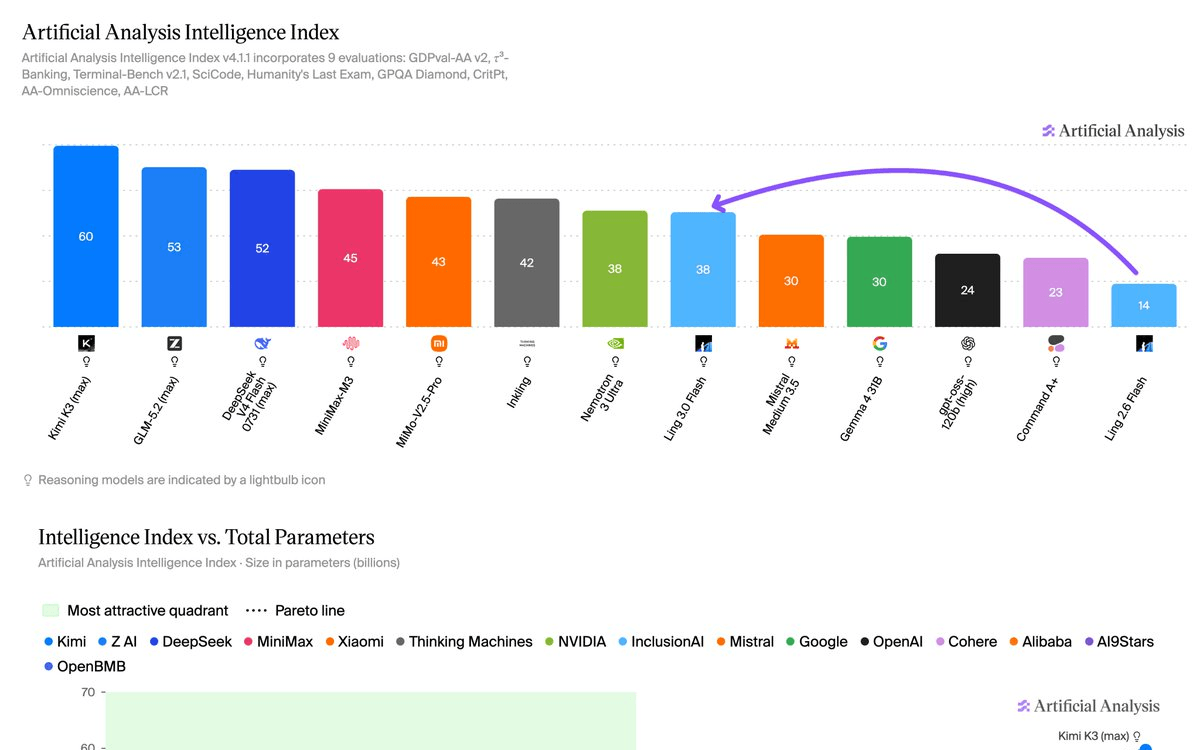
- Ant Group's inclusionAI released Ling 3.0 Flash, a 124B-parameter MoE reasoning model with only 5.1B active parameters per token.
- It scores 38 on the Artificial Analysis Intelligence Index, a 24-point jump over the previous generation, matching MiMo-V2.5 and Qwen3 27B with far fewer active parameters.
- Architecture uses a novel hybrid of KDA (linear attention) and MLA layers at a 5:1 ratio, plus a halved MoE expert activation ratio (1/64 vs. 1/32), baked in from pretraining.
- Weights are MIT-licensed and available on Hugging Face in BF16 (255GB) and FP8 (128GB); API access via inclusionAI and DeepInfra at $0.075/$0.22 per 1M tokens.
- Strong on agentic benchmarks (2nd among flash-tier open-weights on τ³-Banking), but very verbose: generates ~4x more output tokens than peers, raising cost-per-task.
- Hallucination rate dropped from 97% to 44% mostly by learning to abstain, not by gaining factual knowledge; raw accuracy only moved from 16% to 18%.
Ant Group's AI lab inclusionAI released Ling 3.0 Flash, a 124B-parameter reasoning model with only 5.1B parameters active per token at inference time. According to third-party evaluations, it lands on the open-weights Pareto frontier for intelligence versus total parameters, matching or beating the previous 1T flagship on most benchmarks while using roughly 1/8 the total parameters and 1/12 the active ones.
That gap matters in practice. Fewer active parameters means lower compute per token, which translates directly to faster inference and cheaper API calls at scale.
A New Architecture Built for Efficiency
The efficiency gains come from a native hybrid-linear attention architecture, not pruning or distillation. Ling 3.0 Flash alternates KDA (Kimi Delta Attention) and MLA (Multi-head Latent Attention) layers at a 5:1 ratio across 35 KDA blocks and 7 gated MLA blocks, over a 512-expert Mixture-of-Experts backbone.
Standard Transformer attention scales quadratically with sequence length. Linear attention, like KDA, replaces that with a recurrent state that keeps cost constant regardless of context length, historically at the cost of recall quality. Mixing KDA with MLA at a 5:1 ratio captures the speed of linear attention for most layers while preserving precise recall where it counts.
Three specific upgrades drive the efficiency:
- Upgraded KDA: Evolving from the previous Lightning Attention, KDA adds fine-grained diagonal gating in Delta Rule state updates, letting the model retain critical information more precisely across long documents and large codebases.
- Sparser MoE: The expert activation ratio per token dropped from 1/32 in the previous generation to 1/64. In a Mixture-of-Experts model, only a small subset of specialized sub-networks activates per token. Halving that ratio again cuts compute per token further.
- Long context: The model natively supports a 256K context window and can scale to 1M tokens.
Designed for Agent Pipelines
Ling 3.0 Flash was trained across more than 10,000 interactive environments, with explicit focus on self-correction and long-horizon planning. The target use cases are coding, task decomposition, and multi-source research, where traditional models tend to lose context or drift during extended operations.
The team also shipped a cluster-level hierarchical caching system alongside the model. It eliminates redundant computation in long conversations and multi-turn interactions, cutting Time-to-First-Token for long inputs by 60% to over 80%. For agent pipelines where the same system prompt repeats across thousands of calls, that reduction is a real operational saving.
What the Benchmarks Show
Independent evaluation by Artificial Analysis places Ling 3.0 Flash at 38 on the Intelligence Index v4.1.1, up 24 points from the previous generation's 14. It matches MiMo-V2.5 and Qwen3 27B at the same score, but with roughly a third of MiMo-V2.5's active parameters. The flash-tier leader is DeepSeek V4 Flash 0731 at 52.
Specific areas where the model stands out:
- Agentic tasks: 27% on τ³-Bench Banking, second among flash-tier open-weights models behind DeepSeek V4 Flash (39%), and ahead of Hy3 (23%) and Inkling Small (19%), both of which score 3–4 points higher on the overall index.
- Speed: 355.7 output tokens per second on inclusionAI's API, fast relative to other reasoning models at a similar price point.
- Active parameter efficiency: At 5B active parameters, it extends the open-weights Pareto frontier for Intelligence vs. Active Parameters, ahead of flash-tier peers running 10B to 15B active.
The hallucination numbers tell a specific story. Ling 3.0 Flash scores -18 on the AA-Omniscience Index, up from -66 for the previous generation. The improvement comes almost entirely from the model learning to abstain: the attempt rate dropped from 99% to 56%, and the hallucination rate on attempted answers fell from 97% to 44%, while raw accuracy only moved from 16% to 18%. The model got better at recognizing what it doesn't know, not at knowing more.
The Verbosity Problem
One real caveat: Ling 3.0 Flash is extremely verbose. When Artificial Analysis ran the Intelligence Index, the model generated 240M output tokens, compared to a median of 63M for similar models. That verbosity directly affects cost-per-task. At $0.02 per task, it sits inside the Pareto frontier for intelligence vs. cost-per-task rather than on it, despite having the cheapest per-token price at its intelligence tier. Teams running high-volume workloads and paying per output token should factor this in.
Pricing and Access
The model is available through two routes:
- API: inclusionAI's first-party API and DeepInfra as a third-party provider, at $0.075 per 1M input tokens and $0.22 per 1M output tokens, with an 80% cache hit discount.
- Self-hosted: Weights are released under the MIT license in BF16 (255GB) and FP8 (128GB) formats, available on Hugging Face and ModelScope, with deployment support via SGLang or vLLM.
On agentic and code benchmarks including SWE-Bench Pro, SWE-Bench Multilingual, Tau3-banking-AA, MCP-Atlas, and SkillsBench, the model performs competitively. It also runs within Claude Code, Kilo Code, Qwen Code, Hermes Agent, and OpenClaw.
Where This Fits
Ling 3.0 Flash is part of a broader architectural shift in how the field approaches model size. The older assumption was straightforward: more parameters means more intelligence. What Ling 3.0, DeepSeek, and similar models are demonstrating is that sparse activation and hybrid attention can decouple intelligence from raw compute cost. A model that activates 5B parameters per token but routes through 124B total can behave like a much larger dense model at a fraction of the inference cost.
The vLLM team noted one process detail worth flagging: Ling 3.0 Flash separated its announcement from its weight release, giving open-source inference projects a stable window for correctness testing, performance tuning, and recipe validation before the weights landed. That approach gives the community a clear timeline rather than an indefinite wait.
For teams running agent pipelines at scale, particularly on tasks requiring long-context tool use and multi-step reasoning, Ling 3.0 Flash is worth evaluating. Watch the output token counts if cost-per-task matters more than cost-per-token.
Comments
