

Anhui University's LR-GMP Unifies Graph AI Prompting With One Low-Rank Trick
A new prompt learning method unifies node features, edge features, and edge weights into a single low-rank prompt injected during message passing.
 PRO
- New method LR-GMP unifies node, edge, and weight prompts into a single message-level prompt.
- Reinterprets existing Graph Data Prompts as instances of a broader Graph Message Prompt paradigm.
- Uses low-rank factorization (matrices U and V of rank r) for parameter-efficient adaptation.
- Beats single-component and hybrid prompt baselines on Cora and CiteSeer under 3-shot and 5-shot settings.
- Robust to Random and Nettack graph perturbations using the ProGNN evaluation protocol.
- Works across APPNP and GCNII backbones and can be injected at any GNN layer.
Adapting a pre-trained graph neural network to a new task usually means one of two things: fine-tune the whole model, or attach a small "prompt" to the input graph and only train that. The second approach, known as Graph Data Prompting, has become the standard because it is cheap and preserves the pre-trained weights. It has a stubborn limitation, though. Each existing method prompts only one part of the graph, and choosing which part depends on the task.
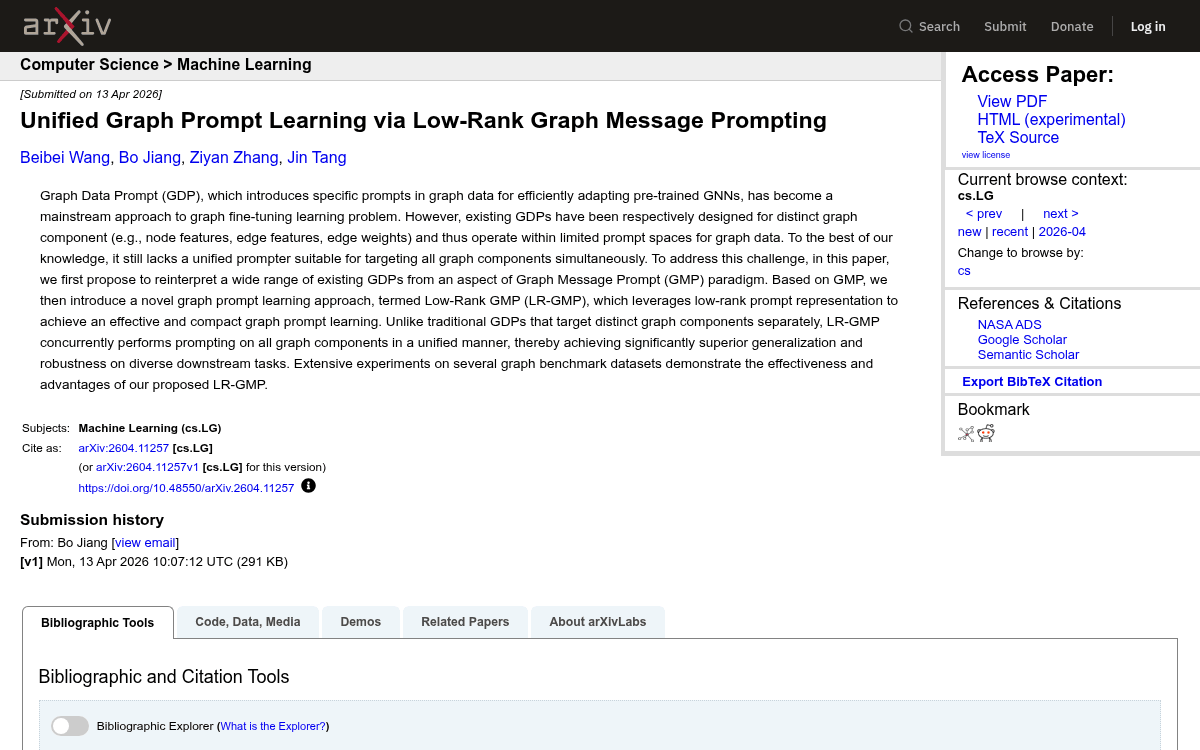
A new paper from Anhui University proposes a way out. Unified Graph Prompt Learning reframes the existing prompt families as a single object acting inside the message-passing step, then compresses that object with a low-rank factorization. The result, called LR-GMP, prompts every graph component at once while keeping the parameter count small.
Why one prompt at a time falls short
Graph Data Prompt (GDP) has become a mainstream approach to the graph fine-tuning problem, but existing GDPs are designed for distinct graph components such as node features, edge features, or edge weights, and thus operate within limited prompt spaces. No unified prompter targets all graph components simultaneously. In practice this means a prompt tuned to nudge node features cannot compensate when the issue lies in how edges are weighted, and vice versa.
The industry backdrop matters here. Self-supervised pre-training has produced strong general-purpose GNNs, and the field has moved toward parameter-efficient adaptation the same way NLP moved toward LoRA and prompt tuning. Self-supervised strategies such as GCC, which frames pre-training as a subgraph-level instance discrimination task, GraphCL, which uses contrastive learning across augmented views, and GraphMAE, which uses a masked graph autoencoder, have made label-free representation learning practical. The open question is how to reuse those encoders on downstream tasks without touching their weights.
This story is for Pro members
You've reached the end of the free preview. Upgrade to AlphaSignal Pro to read the full article - and everything else behind the paywall.
Comments
