

AMD and Cerebras Pair Helios With Wafer-Scale Engine for 5x Faster Inference
AMD and Cerebras pair Helios rack-scale GPUs with the Wafer-Scale Engine to deliver the fastest production inference on trillion-parameter models at 5x greater efficiency
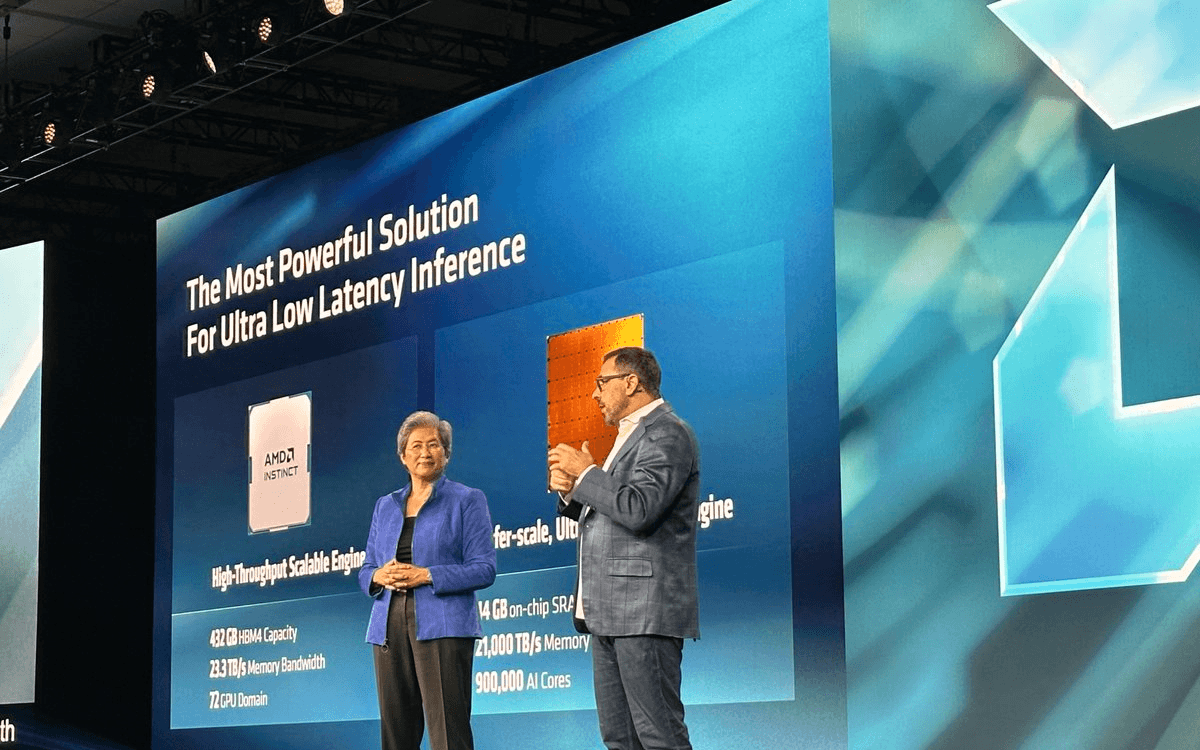
- AMD + Cerebras partnership: The two companies announced a disaggregated inference solution pairing AMD Helios rack-scale GPUs with the Cerebras Wafer-Scale Engine.
- 5x efficiency gain: The joint solution claims up to 5x higher tokens per second per watt versus a Cerebras-only setup, on 1T+ parameter models.
- Helios specs: AMD's new Helios rack packs 72 MI455X GPUs, 31 TB HBM4, and 2.9 exaFLOPS FP4 in a single $5-5.5M rack.
- Architecture split: Helios handles compute-heavy prefill (prompt processing); the Cerebras WSE handles ultra-low-latency token decode, each doing what it does best.
- Launch timeline: Available first through Cerebras Inference Cloud in H2 2026; broader availability and Helios mass production expected Q2 2027.
- Competitive context: Directly counters Nvidia's $20B Groq acquisition; Cerebras also has a similar disaggregated deal with AWS Trainium for Amazon Bedrock.
AMD and Cerebras have announced a technical partnership to build a disaggregated inference solution pairing AMD's new Helios rack-scale system with the Cerebras Wafer-Scale Engine. Cerebras CEO Andrew Feldman joined AMD CEO Lisa Su on stage at AMD's Advancing AI 2026 event to make the announcement. The pitch: the fastest production inference tokens in the industry, at 5x greater capacity, on frontier-scale models with over one trillion parameters.
Two chips, one pipeline
LLM inference has two phases with very different hardware needs:
- Prefill: Processing the input prompt and any context. Compute-heavy, parallelizes well across many GPUs.
- Decode: Generating tokens one by one. Memory-bandwidth-bound, benefits enormously from on-chip SRAM rather than off-chip HBM.
Running both phases on the same GPU cluster forces a compromise. GPUs must shuttle the entire model from HBM memory to compute for every token generated. Because the full model cannot fit on the GPU die itself, this process repeats with every token, making GPU inference persistently bandwidth-bound.
Cerebras sidesteps this entirely. The WSE-3 is a wafer-scale chip with 900,000 cores and 44 GB of on-die SRAM connected at 21 PB/s bandwidth. By putting all memory on the wafer itself, it eliminates the HBM memory wall and achieves sub-10ms latency per token at throughput levels where GPU clusters typically stall at 10–12ms.
What Helios brings
AMD's Helios is a single rack containing 72 Instinct MI455X GPUs, 31 terabytes of HBM4 memory, and 2.9 exaflops of FP4 inference compute. It is AMD's first rack-scale AI system and its direct answer to Nvidia's Vera Rubin NVL72. Full specs:
- 1.4 exaFLOPS of FP8 compute, 2.9 exaFLOPS of FP4 compute, and 31 TB of HBM4 memory
- 260 TB/s aggregate intra-rack bandwidth via UALink-over-Ethernet and a co-designed Ethernet switch
- 72 MI455X GPUs, 256-core EPYC CPUs, priced at $5–$5.5 million per rack
- Built on open standards: OCP Open Rack Wide, Ultra Accelerator Link, and Ultra Ethernet Consortium
In the joint solution, Helios handles prefill, processing prompts and large context windows at high throughput. The Cerebras WSE handles decode, generating tokens at ultra-low latency. The two engines connect through a single integrated workflow, letting each do what it was built for without forcing a tradeoff between speed and scale.
The headline number
AMD and Cerebras project up to 5x higher tokens per second per watt compared to a Cerebras WSE-only configuration. That figure comes from internal modelling using the Kimi 2.6 1T model, so independent benchmarks do not yet exist as of mid-2026.
The efficiency gain matters as much as the raw speed. High-volume workloads prioritize maximizing token generation; coding assistants, real-time copilots, and agentic workflows demand fast response times. Disaggregating the two phases lets the system optimize for both simultaneously, rather than splitting the difference on a single GPU cluster.
Why now, and why each other
Inference has overtaken training as the primary revenue driver in AI data centers. Models are trained once but queried billions of times, and the economics of the data center have followed that shift.
For Cerebras, the WSE's constraint has always been prefill. The WSE-3 holds only 44 GB of SRAM, which is not enough to fit a 70B model at FP8 without quantization or multi-system partitioning. Offloading prefill to Helios lets the WSE focus entirely on decode. For AMD, the partnership validates Helios in a production inference context and gives it a credible position in the ultra-low-latency segment it cannot reach with GPUs alone.
This is also Cerebras's second major disaggregated inference partnership in 2026. AWS and Cerebras previously announced a similar architecture, with AWS Trainium chips handling prefill and Cerebras CS-3 systems handling decode, connected via Amazon's Elastic Fabric Adapter and available through Amazon Bedrock. The AMD deal extends that playbook to a new prefill engine and a new cloud.
A crowded race
Every major cloud provider is moving toward disaggregated inference. AWS and Cerebras, Nvidia and Groq, Oracle, and Azure are all in motion. Every major LLM serving framework, including Dynamo, SGLang, vLLM, and llm-d, already supports disaggregation.
Nvidia's move is the most aggressive. In December 2025, Nvidia agreed to acquire assets from Groq for approximately $20 billion, with Groq founder Jonathan Ross and president Sunny Madra joining Nvidia to scale the licensed technology. Nvidia introduced the Groq LPX as one of three new systems at GTC 2026. The AMD-Cerebras pairing is a direct counter: two independent companies with complementary silicon, neither absorbed into Nvidia's stack.
The broader shift toward heterogeneous, disaggregated systems means different chips can now compete at each stage of inference rather than a single vendor controlling the full pipeline. That opens the door for specialized hardware to win where it is strongest and puts pressure on Nvidia's end-to-end dominance.
Who gains, who watches
The clearest beneficiaries are customers running frontier-scale agentic workloads who currently have to choose between fast and cheap. AMD has already announced Helios customers including OpenAI, Meta, Oracle, HPE, TCS, Celestica, Nutanix, and the US DOE. Any of those organizations running inference through Cerebras Cloud gains direct access to the combined architecture at launch.
Nvidia still holds roughly 90% of the accelerator market, so the pressure is real but not existential. The Groq acquisition signals that even Nvidia believes the all-GPU inference stack has a ceiling. For Intel, the competitive read is sharper: a production inference mandate for Helios is exactly the kind of validation AMD's MI400 series needed after years of hyperscale wins concentrated in internal workloads.
The second-order effect worth watching is inference pricing. If the 5x efficiency claim holds in production, it creates real pricing pressure on GPU-only inference clouds. More competing architectures means faster iteration and a sustained push toward higher performance per dollar across the stack.
What comes next
Cerebras plans to deploy Helios systems in its own data centers, with the joint solution available initially through Cerebras Cloud in the second half of 2026, followed by a broader rollout. Engineering samples and low-volume production are targeted for the same window, with mass production ramp expected by Q2 2027.
The risks are concrete. The 5x efficiency figure is internal modelling, not an independent benchmark. Cerebras is a recently public company still scaling its cloud infrastructure, and Helios is shipping engineering samples rather than production units. The architectural logic is sound, the demand signal is clear, and the competitive pressure from Nvidia-Groq means neither company can afford to wait. The disaggregated inference era is here, and this partnership is AMD and Cerebras placing a very large bet on which team wins it.
Comments
