

AllenAI Opens the Full Training Stack Behind Tulu 3 to Beat GPT-4o-mini
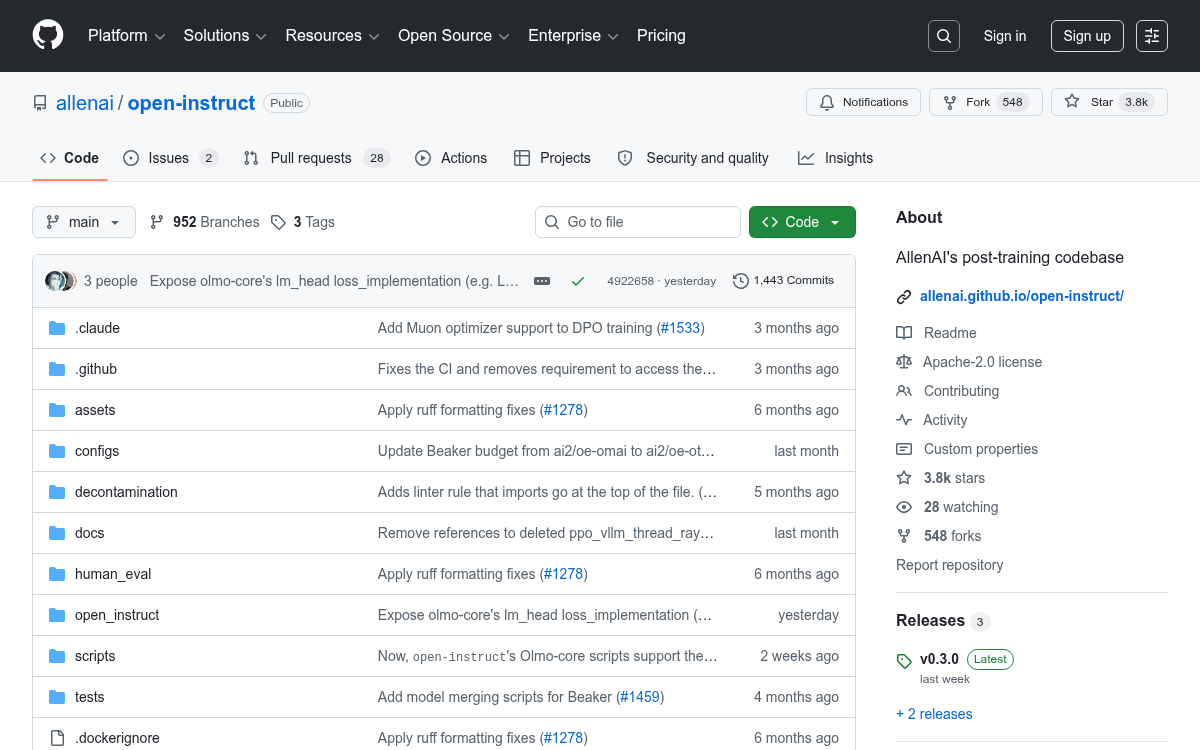
AllenAI's open-instruct ships a complete post-training pipeline covering SFT, DPO, and RLVR, powering Tulu 3 and OLMo-2 instruction models.
 PRO
PRO- AllenAI's open-instruct ships a full post-training stack: SFT, DPO, and RLVR in one Apache-2.0 codebase.
- Powers Tulu 3 and OLMo-2 instruct models on Llama 3.1 8B/70B and OLMo-2 7B/13B bases.
- RLVR uses programmatic verifiers (math, code, format) instead of learned reward models for reliable improvements.
grpo_fast.pyuses vLLM plus Ray, splitting training and rollout GPUs to cut hardware needs.- QLoRA support lets you finetune a 70B Llama on a single 80GB A100.
- Tulu 3 reportedly beats Llama 3.1-Instruct, Qwen 2.5, GPT-4o-mini, and Claude 3.5-Haiku on several benchmarks per the Tulu 3 paper.
Most labs publish their base model weights and call the release open. AllenAI has been quietly doing the harder thing: releasing the entire post-training stack that turns a raw pretrained model into something you'd actually want to talk to. Their open-instruct repository is the working codebase behind the Tulu and OLMo instruction models, and it's one of the few places you can study a frontier-quality alignment pipeline end to end.
The full alignment stack in one repo
The repo serves as an open effort on instruction-tuning and post-training popular pretrained language models on publicly available datasets. Concretely, it bundles three things that usually live in separate research codebases:
- Code for finetuning language models with latest techniques and instruction datasets in a unified format
- Code for DPO, preference finetuning and reinforcement learning with verifiable rewards (RLVR)
- Checkpoints and other useful artifacts from AllenAI's exploration
RLVR is the piece worth pausing on. Instead of training a reward model to guess what humans like, you use programmatic checks (does the math answer equal the ground truth, does the code pass tests, does the output match a format) as the reward signal. The training methodology incorporates Supervised Fine-tuning, Direct Preference Optimization, and an innovative technique termed Reinforcement Learning with Verifiable Rewards, which ensures reliable and measurable improvements in model behavior.
This story is for Pro members
You've reached the end of the free preview. Upgrade to AlphaSignal Pro to read the full article - and everything else behind the paywall.
Comments
