

Alibaba's Wan-Streamer v0.2 Triples Video Resolution Without Adding Latency
Alibaba's Wan-Streamer v0.2 runs full-duplex video conversations at 640×368 and 25 FPS with ~550ms total latency, all inside a single Transformer
- Wan-Streamer v0.2 is a single Transformer model that conducts full-duplex video conversations with ~550ms total latency.
- Resolution jumps from 192×336 (v0.1) to 640×368 at 25 FPS, with ~200ms model-side latency preserved.
- A new Thinker–Performer split lets multi-GPU Ulysses parallelism scale visual quality without increasing interaction delay.
- Unlike cascaded pipelines, all perception, reasoning, speech, and video generation are learned jointly in one model.
- The model supports arbitrary personas (humans, pets, anime) described in natural language, not fixed avatar rigs.
- No open weights or public API yet; available as paper and demo only.
Wan-Streamer v0.2 is Alibaba's latest research push toward something that has been surprisingly hard to build: a single AI model that can simultaneously watch you, listen to you, think, and respond with synchronized speech and video , in real time. The new version ships a major visual upgrade without touching the latency, going from a blurry 192p proof-of-concept to a crisp 640×368 stream at 25 FPS, all while keeping the total round-trip time at roughly 550ms.
One model to rule all the modalities
Most "real-time" AI video systems are actually pipelines: a speech recognizer feeds a language model, which feeds a text-to-speech engine, which drives a separate avatar renderer. Each handoff adds latency and a new failure mode. Unlike cascaded interactive systems that rely on separate VAD, ASR, language, TTS, audio-driven animation, or video-generation modules, Wan-Streamer does not rely on external modules , perception, reasoning, generation, response timing, turn management, and cross-modal synchronization are learned jointly within one unified model.
Wan-Streamer is a native-streaming, end-to-end interactive foundation model designed from the ground up for real-time, low-latency, full-duplex audio-visual interaction. It seamlessly models language, audio, and video as both input and output within a single Transformer, where the sequence is represented as interleaved visual, audio, and text tokens, coordinated by block-causal attention for incremental streaming. Block-causal attention means the model can look back at everything it has already generated, but cannot peek ahead , a constraint that makes true streaming possible.
Wan Streamer is the only end-to-end model that outputs synchronized audio and video, and it does so under 0.6 seconds. Systems like GPT-4o or Moshi handle speech-to-speech interaction but produce no visual output. Avatar systems do produce video, but their latency excludes the external language model, ASR, and TTS they depend on, so their true user-visible latency is higher than shown.
The Thinker–Performer split
The core engineering challenge in v0.2 was straightforward to state and hard to solve: how do you generate 3x more pixels per frame without blowing up the latency? The answer is a clean architectural split between two specialized components.
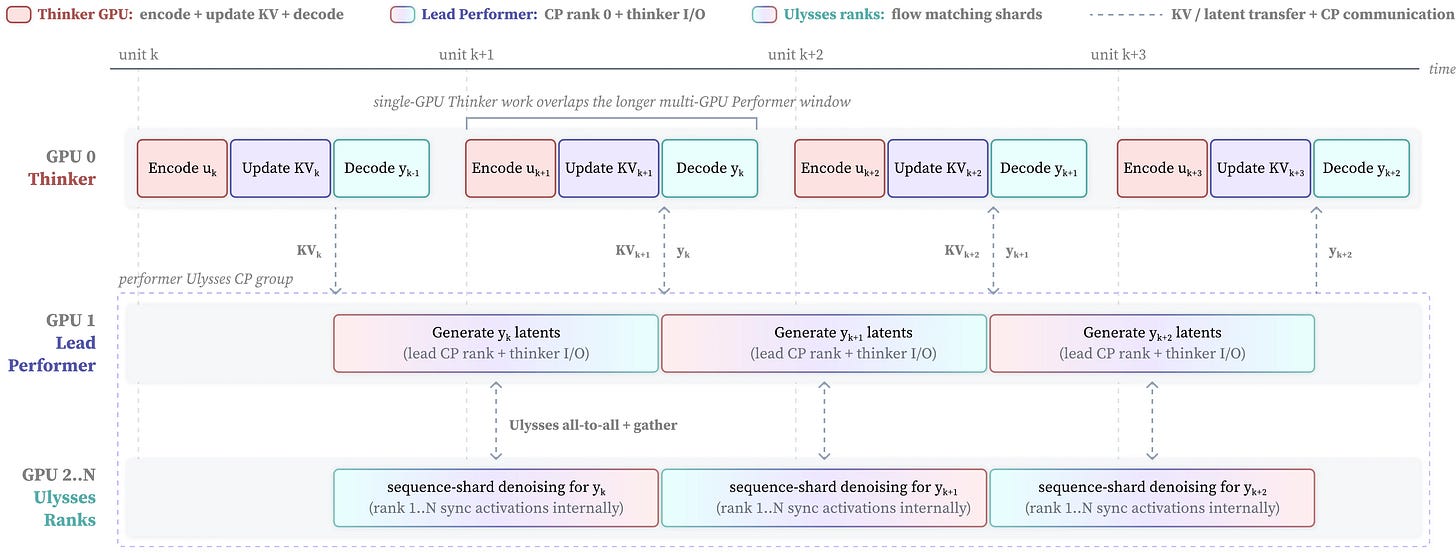
- Thinker (single GPU): handles the latency-critical path , streaming perception, language/state updates, building the generation cache (K/V), and final audio/video decoding. This is the part that determines how fast the model "feels."
- Performer (multi-GPU): handles the expensive part , generating the high-resolution video latents (compressed representations of each frame). In v0.2, this is parallelized across multiple GPUs using Ulysses-style context parallelism.
Ulysses-style context parallelism is a technique where a long sequence is split across GPUs, each GPU processes its shard, and then the results are gathered via an all-to-all communication step. The long high-resolution latent video sequence is split across ranks for denoising and gathered through Ulysses communication, while the much shorter audio latent sequence is generated without sequence sharding. The key insight: v0.2 keeps the thinker as a single-GPU low-latency path for streaming perception, the short language/state Transformer pass that builds the generation cache, and final decoding , while the performer becomes a multi-GPU Ulysses-style context-parallel group for the expensive next-unit latent generation.
This means you can throw more GPUs at visual quality without the user ever noticing a slower response. The thinker and performer are decoupled: the thinker sends only K/V conditioning to the performer, not the full language sequence, which keeps inter-GPU communication lean.
What actually changed in v0.2
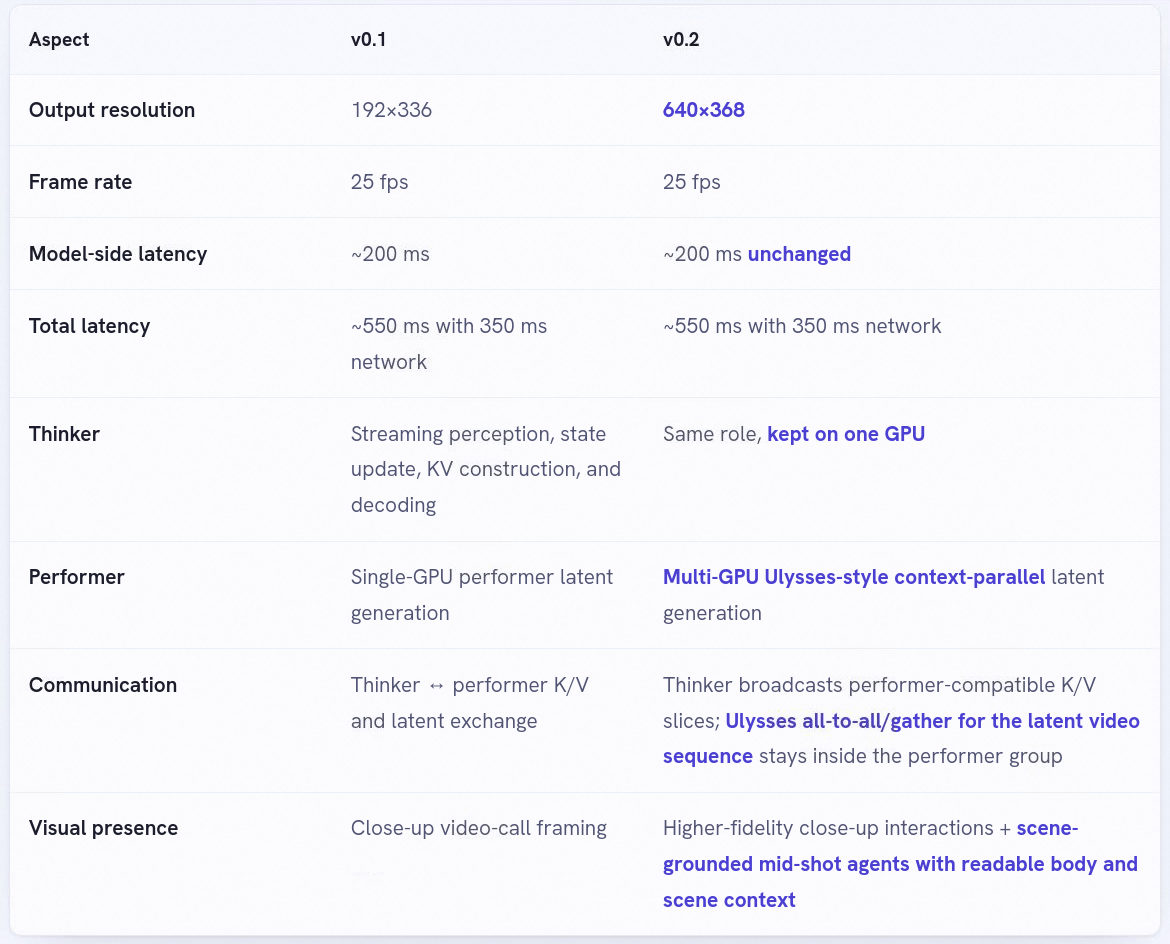
Wan-Streamer v0.2 is a latency-preserving upgrade of the native-streaming, end-to-end audio-visual interaction model. v0.2 keeps the v0.1 modeling formulation, but raises the interactive output stream from 192×336 to 640×368 while preserving approximately 200 ms model-side signal-to-signal latency. The total latency budget breaks down as:
- ~200ms model-side (perception to generation)
- ~350ms bidirectional network budget
- ~550ms total end-to-end
The higher-resolution stream supports scene-grounded mid-shot agents whose posture, gaze, hands, nearby objects, and local scene layout remain legible during real-time conversation. This is a meaningful shift: v0.1 was essentially a close-up talking-head call. v0.2 can show a full upper-body shot with readable hand gestures and scene context , much closer to what a real video call looks like.
The model can also embody arbitrary personas. Because generation is not tied to a fixed avatar rig, you can describe a character in natural language , a human, a pet, an anime figure , and the model will generate and animate it in real time during conversation.
What it's good at , and where it still has limits
The system handles several things that are genuinely hard to do simultaneously:
- Full-duplex interaction: the assistant doesn't freeze up , it maintains eye contact while listening, reacts with micro-expressions, and stops speaking when you interrupt.
- Cross-modal synchronization: lip movements, facial expressions, and voice are generated together by the same model, not stitched post-hoc.
- Flexible persona: not locked to a single avatar mesh , any describable character works.
What it doesn't yet offer: open weights. The community reaction has been enthusiastic, with researchers calling it "incredible work" and immediately asking whether releasing open weights is on the roadmap, or whether Wan-Streamer is expected to remain paper/demo-only for now. No public model release has been announced. The demos on the project website are not sped up , they reflect actual interaction latency , but there's no API or inference code available yet.
Why this matters beyond the headline
The real breakthrough here isn't the resolution bump. It's the architectural proof that you can scale visual quality in a streaming multimodal system by adding hardware to the right place, without redesigning the interaction loop. The results suggest that real-time multimodal agents should be designed from the ground up as native full-duplex systems, where listening, seeing, speaking, and visible response are learned jointly rather than assembled as post-hoc modules.
This has implications for how the field thinks about interactive AI. The dominant assumption has been that you build modular pipelines and optimize each component. Wan-Streamer's results suggest that joint end-to-end training , where turn-taking, interruption handling, and cross-modal timing are all learned together , produces fundamentally better interaction quality. Cascaded pipelines introduce waiting time at module boundaries, accumulate recognition and synchronization errors, and make response timing, turn management, identity preservation, and long-horizon consistency difficult to learn as part of one behavior.
Practical use cases where this architecture would be immediately useful:
- Customer support avatars that need natural eye contact and facial timing
- Tutoring agents that listen, explain, and adapt without awkward pauses
- Live broadcast and interactive entertainment with dynamic AI hosts
- Real-time digital human interfaces for embodied assistants
The paper and technical blog post are both available now. The team has explicitly framed this as an ongoing research line, with further iterations planned. Whether open weights or an API follow is the question the community is watching most closely.
Comments
