

Alibaba's Qwen3.8-Max-0902 Tops Code Arena, Beating Claude Opus 5
Alibaba's flagship 2.4T-parameter model gets a coding and agent-work refresh with the same pricing and 1M context window.
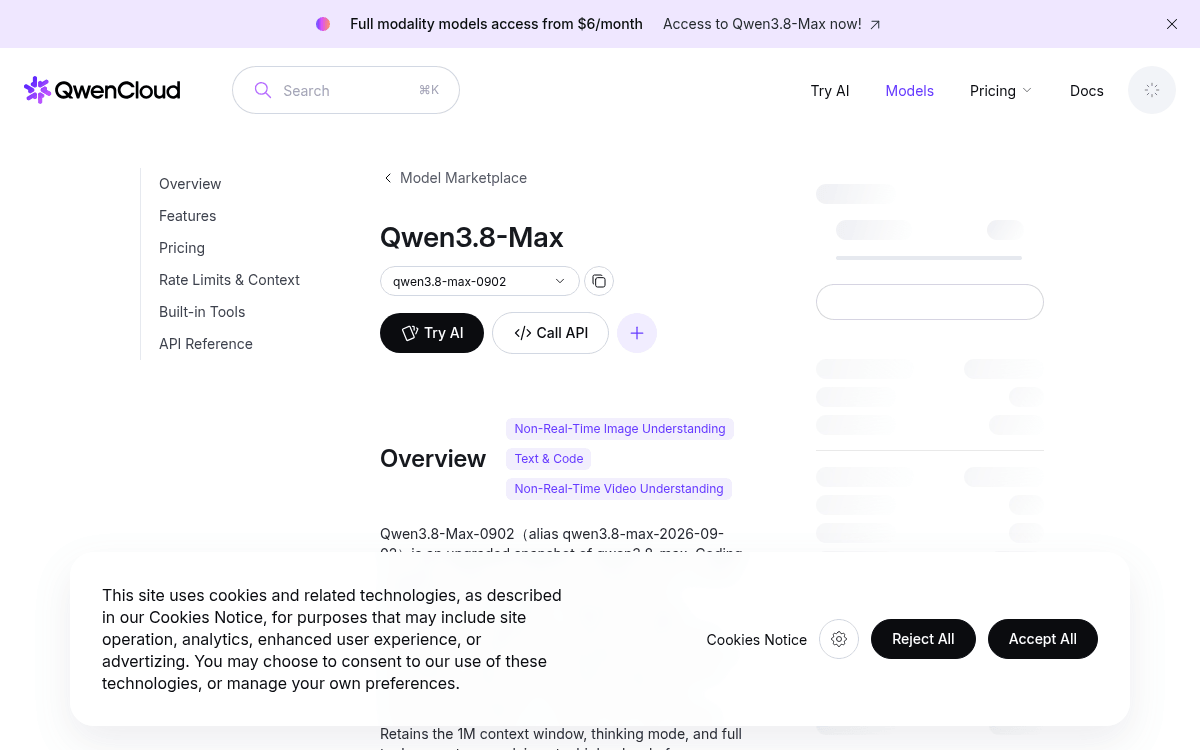
- Qwen3.8-Max-0902 is an in-place upgrade: same 2.4T params, same 1M context, same $2/$6 pricing.
- TerminalBench jumps 11.3 to 29.0, DeepSWE 56.6 to 69.3, QwenSWEbench V2 55.1 to 70.0.
- Debuted #1 on Code Arena WebDev at 1691 pts, above Claude Opus 5.
- Still trails Opus 5 on most coding rows in Qwen's own comparison table.
- Live on QwenCloud with OpenAI and Anthropic-compatible APIs, plus Claude Code and Codex integrations.
- 262K reasoning budget, thinking mode default, and explicit cache reads at $0.17 per million tokens.
Alibaba's Qwen team pushed an in-place upgrade to its flagship model, Qwen3.8-Max-0902. Same underlying architecture, same price, noticeably sharper on the tasks users were complaining about: agentic coding and long-horizon office work.
The parameter scale stays at 2.4 trillion with a 1 million-token context window. What changed is post-training. The lab extended it on coding and on Cowork, the agentic office work its own CoWorkBench benchmark measures.
The benchmark jumps worth watching
The biggest gains are on the agentic coding side, where the older checkpoint was genuinely weak. TerminalBench 3.0 rises from 11.3 to 29.0, DeepSWE 1.1 from 56.6 to 69.3, QwenSWEbench V2 from 55.1 to 70.0, and JobBench from 53.4 to 64.0.
Third-party arenas back this up. Qwen3.8-Max-0902 debuted at #1 overall in the Code Arena: WebDev with 1691 pts, three points above Claude Opus 5 (Max), 17 above Kimi K3 (Max), and 22 above the previous Qwen3.8-Max checkpoint.
Where Opus 5 still leads
Qwen's own comparison table shows Opus 5 ahead on most rows: TerminalBench, DeepSWE, NL2Repo, ProgramBench, SWE-Marathon, CoWorkBench, JobBench, and Toolathlon. Qwen3.8-Max-0902 pulls ahead on three: MLS-Bench-Lite, SWE-Atlas QnA, and QwenSWEbench V2.
Pricing and what you get
Pricing held steady, which matters for volume workloads:
- $2 per million input tokens, $6 per million output
- $0.25 per million on implicit cache hits, $0.17 on explicit cache reads, explicit cache creation at $2.50 per million
- Blended $5 per million tokens, claiming the highest-scoring position on the Code Arena WebDev Pareto frontier
The hosted model carries a 1M-token context window, a maximum input of 991K tokens, maximum output of 131K tokens, and a maximum reasoning budget of 262K tokens, with text, image, and video input supported. That 262K reasoning budget gives chain-of-thought substantial room to run before the model commits to an answer.
How to use it
The model is live on QwenCloud under the id qwen3.8-max-0902, served with OpenAI-compatible chat-completions and responses endpoints, an Anthropic-compatible API, and endpoints in Beijing, Singapore, and Virginia.
The API exposes a reasoning_effort parameter with levels low, medium, and xhigh (the default), and enables preserve_thinking by default so prior reasoning content carries across turns. Documented integrations include Claude Code, Codex, Qoder CLI, Qwen Code, and OpenClaw, so dropping it behind an existing coding agent requires minimal plumbing.
A minimal call:
from openai import OpenAI
client = OpenAI(
    api_key=os.getenv("DASHSCOPE_API_KEY"),
    base_url="https://dashscope-intl.aliyuncs.com/compatible-mode/v1",
)
completion = client.chat.completions.create(
    model="qwen3.8-max-0902",
    messages=[{"role": "user", "content": "Refactor this repo..."}],
    extra_body={"enable_thinking": True},
)
Which workloads fit
The upgrade targets two scenarios: long-context codebase work where you want a full repository in a single prompt, and multi-step agent workflows that hold state across dozens of tool calls. For short-context, one-shot generation, Opus 5 is likely worth the cost. For agents that chew through repos, parse long documents, or orchestrate tools over many turns, 0902 becomes a strong Pareto pick, particularly with cache pricing dropping repeated-prefix input costs to $0.17 per million.
Comments
