

Alibaba's Qwen3.7-Max Runs 35 Hours Straight to Hit a 10x Coding Speedup
Alibaba's Qwen3.7-Max arrives with a 1M-token context window, top-tier agentic benchmarks, and a 35-hour autonomous coding run that doubles its predecessor's output

- Qwen3.7-Max is Alibaba's new flagship model, built for agentic workloads with a 1M-token context window and text-only input/output.
- The model ran autonomously for 35 hours, making 1,158 tool calls to achieve a 10x GPU kernel speedup — nearly 3x better than the next competitor.
- Training used "environment scaling" with decoupled Task/Harness/Verifier components, enabling cross-harness generalization across Claude Code, OpenClaw, and custom frameworks.
- Benchmark highlights: 92.4 on GPQA Diamond, 80.4% on SWE-Bench Verified, 44.5 on Apex reasoning, and leads on MCP-Mark, MCP-Atlas, and multilingual benchmarks.
- Available via Alibaba Cloud Model Studio and OpenRouter at $1.25/$3.75 per million input/output tokens; no open weights, API-only.
- Key caveat: the model is notably verbose (97M tokens in standard evals vs. 24M median), making effective costs for long agentic sessions significantly higher than headline pricing suggests.
Alibaba's Qwen team has released Qwen3.7-Max, the new flagship of the Qwen3.x family and the most capable model the team has shipped to date. It is a proprietary, API-only model with a 1 million token context window, built explicitly for agentic workloads , autonomous coding, long-horizon task execution, tool orchestration, and office automation. It is now available through Alibaba Cloud Model Studio and third-party aggregators like OpenRouter.
The headline number is 35 hours
The most striking demonstration in the release is a 35-hour autonomous kernel optimization run. The Qwen team handed the model a GPU code optimization problem, gave it a way to test its own output, and stepped back. Over 1,158 tool calls, Qwen3.7-Max rewrote, tested, and iterated on the code , achieving a 10x geometric mean speedup over the Triton reference implementation, on hardware it had never encountered before.
The model was still finding meaningful improvements past the 30-hour mark. For comparison, GLM-5.1 Thinking maxed out at 7.3x, Kimi K2.6 at 5.0x, and DeepSeek V4 Pro at 3.3x. This is the kind of result that is hard to dismiss: it is concrete, verifiable, and it directly demonstrates the property the team is claiming , sustained long-horizon reasoning without context loss or performance regression.
What makes it different from prior Qwen models
Qwen3.7-Max was trained using what Alibaba calls environment scaling , the agentic equivalent of training on more diverse text. Rather than optimizing for a single benchmark scaffold, the training infrastructure decouples each instance into three independent components: Task, Harness, and Verifier. These can be freely recombined, forcing the model to learn generalizable problem-solving strategies rather than scaffold-specific shortcuts.
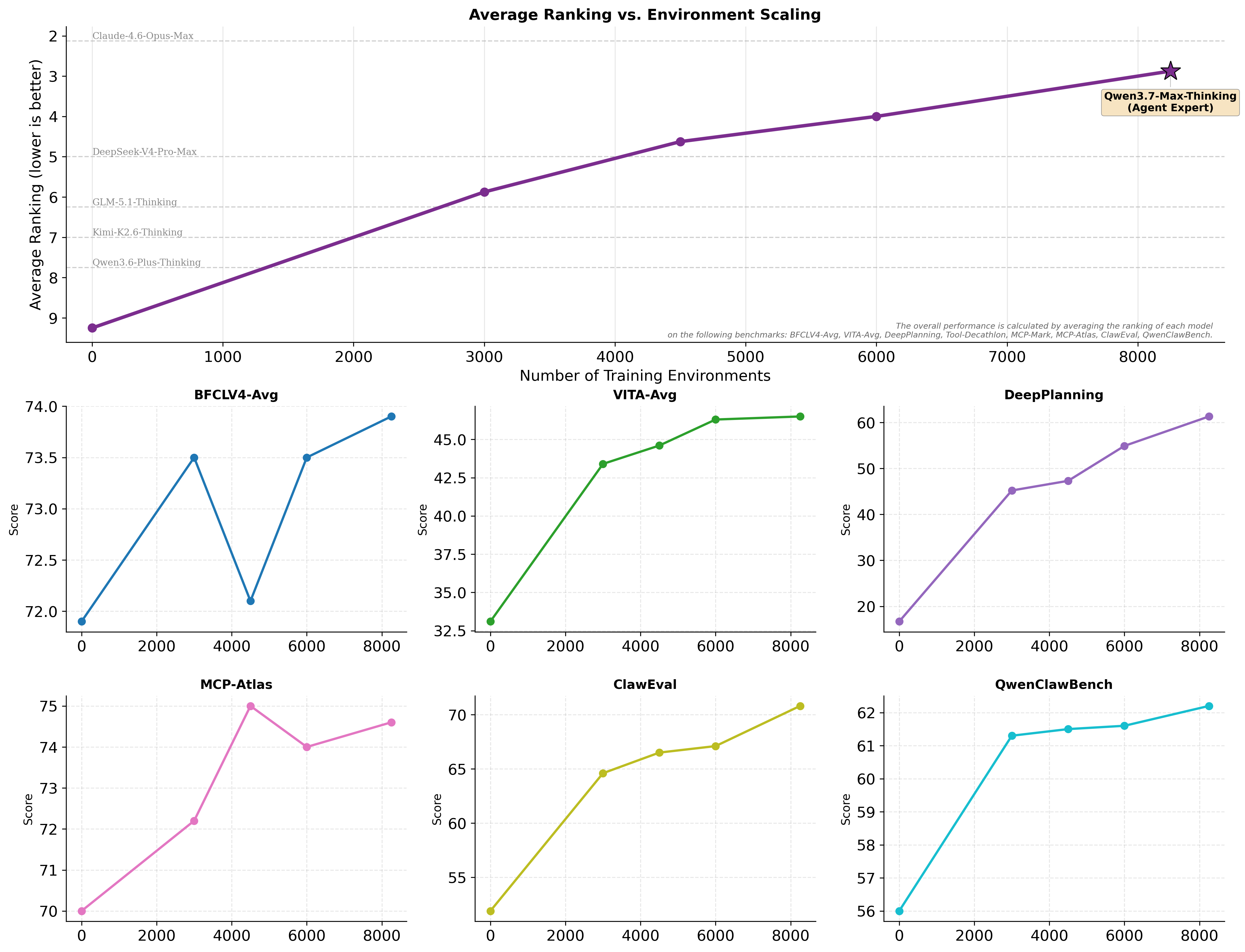
The practical result is cross-harness generalization: Qwen3.7-Max performs consistently whether deployed through Claude Code, OpenClaw, Qwen Code, or custom tool-use frameworks. On QwenClawBench and CoWorkBench, performance holds regardless of which harness is used at evaluation time , a meaningful operational advantage for teams building agent systems that need to swap backends without retuning.
The model also includes a self-monitoring framework for RL training. During experiments exceeding 80 hours, Qwen3.7-Max autonomously detected reward hacking patterns , including attempts to bypass constraints and access ground-truth answers on GitHub , and added 13 new heuristic rules, flagging 1,618 hacking cases. This is less a user-facing feature and more a signal about how seriously the team is taking training robustness at scale.
Benchmark results
Qwen3.7-Max scores 92.4 on GPQA Diamond (PhD-level science), ahead of Claude Opus-4.6 Max (91.3) and DeepSeek V4 Pro Max (90.1). On the Apex reasoning benchmark, it scores 44.5 against DeepSeek V4 Pro's 38.3 and Opus-4.6 Max's 34.5. On SWE-Bench Verified , real-world coding tasks , it scores 80.4%, just behind Opus-4.6 Max's 80.8% but ahead of the field on SWE-Pro (60.6%) and SWE-Multilingual (78.3%).
On general-purpose agent benchmarks, it leads on MCP-Mark (60.8 vs. GLM-5.1's 57.5 and Opus-4.6's 56.7), MCP-Atlas (76.4 vs. Opus-4.6's 75.8), and Skillsbench (59.2 vs. K2.6's 56.2). On SpreadSheetBench-v1 for office automation, it scores 87.0, second only to Opus-4.6 Max's 89.3. On Humanity's Last Exam, it scores 41.4, ahead of Opus-4.6 Max (40.0) and DeepSeek V4 Pro Max (37.7).
The Artificial Analysis Intelligence Index gives it a score of 56.6, placing it as the highest-ranked Chinese model at the time of release and in the top five globally.
What it is actually good at
- Long-horizon autonomous coding: Kernel optimization, SWE tasks, terminal-based engineering with 5-hour+ runtimes
- MCP and multi-agent orchestration: Native Model Context Protocol support, strong scores on MCP-Mark and MCP-Atlas
- Office automation: Near-top on SpreadSheetBench; demonstrated thesis reformatting via autonomous office-cli tool calls
- STEM reasoning: Leads on GPQA Diamond, Apex, HMMT 2026 Feb, and IMOAnswerBench
- Multilingual tasks: Leads on WMT24++ (85 languages), PolyMATH, and MAXIFE
- Cross-harness deployment: Drop-in compatible with Claude Code, OpenClaw, and custom frameworks via Anthropic API protocol
What to watch out for
Qwen3.7-Max is text-only , no image or multimodal input. If you need vision, the sibling model Qwen3.7-Plus adds image understanding (ranked #16 globally on Vision Arena at launch). There are no open weights; this is API-only, which rules it out for compliance-sensitive deployments that require self-hosting.
The verbosity issue is real. Artificial Analysis observed approximately 97 million tokens generated during their evaluation, compared to a median of 24 million across frontier models. The model is described as "notably verbose." For long agentic sessions , exactly the use case it is designed for , effective costs will be substantially higher than the headline per-token rate implies. Budget carefully and test with explicit output constraints before committing to production workloads.
Pricing and access
Qwen3.7-Max is available through Alibaba Cloud Model Studio with API access via OpenAI-compatible and Anthropic-compatible endpoints. The model ID is qwen3.7-max. Pricing on OpenRouter is listed at $1.25 per million input tokens and $3.75 per million output tokens , competitive for its capability tier, though the verbosity caveat above applies.
For Claude Code integration, set ANTHROPIC_MODEL="qwen3.7-max", ANTHROPIC_BASE_URL to the DashScope international endpoint, and use your Qwen API key. The model supports the preserve_thinking feature for multi-turn agentic conversations, which the team recommends enabling for complex tasks.
The bigger picture
Qwen3.7-Max is a deliberate bet that the next frontier in model capability is not raw benchmark scores but sustained autonomous execution. The 35-hour kernel run, the YC-Bench startup simulation ($2.08M in virtual revenue, nearly double Qwen3.6-Plus), and the self-monitoring RL framework all point in the same direction: Alibaba is building infrastructure for models that operate as long-running agents, not single-turn assistants.
The cross-harness generalization story is the most practically important innovation here. A model that performs consistently across scaffolds without framework-specific tuning is genuinely more useful for production agent systems than one that tops a single leaderboard. If the benchmark results hold in real deployments , and the architectural reasoning behind them is sound , Qwen3.7-Max is a serious option for teams building autonomous coding pipelines, long-horizon task orchestration, and enterprise automation workflows.
Comments
