

Alibaba's Qwen-Image-3.0 Turns Dense Infographics Into One-Shot Structured Documents
Alibaba's new image model targets production workflows with 4.5k-token prompts, 10px legible text, and complex one-shot layouts — but ships without benchmarks or open weights

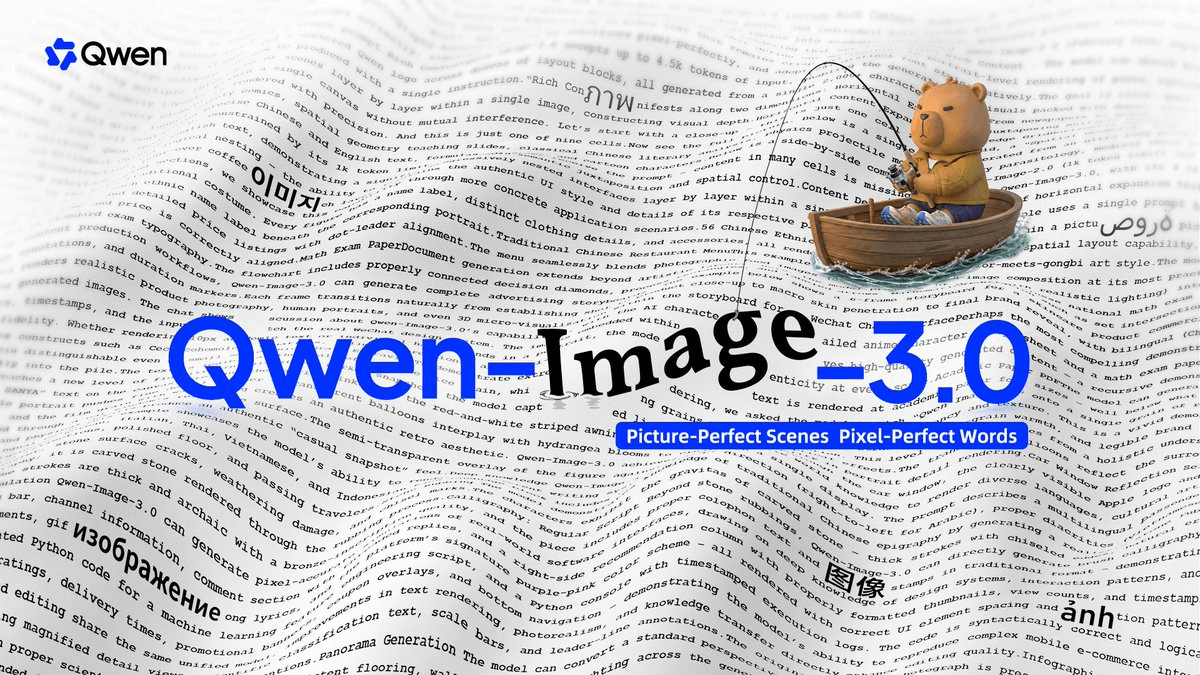
- Qwen-Image-3.0 launched — Alibaba's third-gen image model targets production workflows, not just aesthetics. Blog post
- 4.5k-token prompt input — a 4.5x increase over v2.0, enabling one-shot generation of 9-panel infographics, nested UIs, and full newspaper layouts.
- 10px legible text rendering — claims to render LaTeX, footnotes, and captions at sizes where other models produce noise.
- No benchmarks, no weights, no technical report — a significant departure from Qwen-Image 1.0 and 2.0, which both shipped with open weights and papers.
- 12 languages, 100+ styles, live web retrieval — including a demo generating a real-data weather forecast graphic from a single prompt.
- Available now via Qwen Studio — free to try on web and mobile; API pricing not yet announced.
Most image models compete on how beautiful a single picture can look. Qwen-Image-3.0 competes on how much structured, accurate, information-dense content it can pack into one image in a single pass. Alibaba's Qwen team framed the entire release around a single Chinese character, 实 (shí), meaning "real" or "substantial." The pitch is that image generation should be a genuine productivity tool.
What actually changed
Qwen-Image-3.0 accepts up to 4,500 tokens of input, a 4.5x jump over the roughly 1,000-token limit the previous generation handled. That expanded prompt budget is the number everything else depends on. More headroom means you can fully specify a complex, multi-section layout in one instruction rather than stitching together separate renders.
The team organizes the release around three pillars:
- Rich Content: one-shot generation of complex layouts including newspapers, storyboards, exam papers, 3×3 infographic grids, and nested UI elements.
- Authentic Details: precise rendering of text as small as 10 pixels and micro-level visual details such as pores and hair strands, enabling lifelike reproduction of texture and typography.
- Deep Knowledge: native support for 12 languages and more than 20 fonts, 100+ art styles, and realistic UI simulation for web, games, and livestreams.
Two layout tricks worth understanding
The long prompt budget pays off in two distinct ways. The first is horizontal expansion: generating a grid of independent panels in one pass. Qwen-Image-3.0 can produce a nine-grid knowledge diagram covering multiple topics simultaneously, with legible text throughout. A demo example covers physics, group theory, biology, medicine, and literature in a single image from a 3,700-token prompt.
The second is depth: nesting interfaces inside each other. The model can generate combinations of web pages, software interfaces, chat windows, and posters from a single instruction. In a scenario like "generate a hand-poured coffee poster for a chat interface inside a VSCode programming window," the model tracks multi-layered UI relationships while keeping styles consistent across all interfaces, down to 10-pixel text.
Here is the kind of structured prompt that exercises the new capability:
Create a single 2x2 infographic poster, "Coffee Brew Methods".
Top-left, "Pour Over": 3 steps with labels (rinse filter, bloom 30s,
  pour in circles), small caption "1:16 ratio, 92°C".
Top-right, "French Press": labelled diagram, caption "4 min steep, coarse grind".
Bottom-left, "Espresso": cross-section of a shot with layers labelled
  (crema, body, heart), caption "9 bar, 25-30s".
Bottom-right, "AeroPress": numbered steps, caption "inverted method".
Consistent flat-illustration style, legible small captions, white background.
The more explicit the structure, the more of the 4,500-token budget you actually use.
One genuinely unusual capability
The model natively renders 12 languages and over 20 fonts, which helps sidestep the garbled-text and broken-layout problems common in AI image generation. The capability that stands out most, though, is live web retrieval: Alibaba demonstrates the model generating a weather-forecast graphic for a specific city and date by pulling real data rather than inventing plausible-looking numbers. A model that fetches a current weather reading and renders it as a polished forecast graphic is doing something qualitatively different from one that draws a convincing-looking sky. If that feature holds up under real use, it points toward image generation as a data-driven design tool rather than a pure synthesis engine.
The benchmark gap
The launch includes no benchmark scores, no model card, and no technical report. That absence matters. Every claim in the release rests on example images Alibaba selected for publication, and the earlier models in this series set a higher evidentiary bar than this one meets.
Qwen-Image 1.0, released in August 2025, shipped with open 20B-parameter weights under Apache 2.0 and a technical report on the same day. Qwen-Image-2.0 also had a public technical report. This release has neither. The blog does include impressive examples: a nine-panel scene-and-text grid rendered in one shot, a hyper-realistic fake scientific paper PDF, an infographic, and a portrait. But examples are not benchmarks.
There is also a known baseline to keep in mind. In Qwen's own evaluation framework, Qwen-Image-Bench, the previous flagship Qwen-Image-2.0 Pro placed fifth overall, behind GPT Image 2, Google's Nano Banana models, and GPT Image 1.5. That is the starting point for 3.0's claimed gains, and without independent testing, those gains remain unverified.
Where it looks strong, and where to be cautious
Based on the published examples, Qwen-Image-3.0 looks strongest for:
- Dense infographics and knowledge posters with mixed text, diagrams, and labels
- Full-page document mockups: academic papers with LaTeX math, newspaper front pages
- Multi-panel storyboards and comic layouts
- UI mockups with realistic interface chrome (web, mobile, game HUDs)
- Multilingual content where the script needs to be correct, not approximated
- E-commerce visuals and branded content with embedded text
A beautiful error is still an error when the output contains a formula, product label, chart, or safety instruction. Text rendering at 10px is impressive in demos, but hand-picked demos consistently outperform systematic testing for every image generator. Until open weights or independent benchmarks arrive, treat the small-text claims as promising but unverified.
The competitive shift this signals
The release reframes image generation as structured document production rather than a contest for the most attractive single picture. OpenAI, Google, ByteDance, Black Forest Labs, and Chinese competitors now face a more demanding test than photorealism: whether an image model can become a dependable production system for information-heavy assets.
How to use it now
Qwen-Image-3.0 is available through Alibaba's chat AI service at chat.qwen.ai on web, iOS, Android, macOS, and Windows. Programmatic access is available through Qwen's API platform. API pricing has not been announced, and open weights have not been confirmed, so treat it as cloud-only for now, unlike earlier versions that shipped to Hugging Face under Apache 2.0.
Two signals worth watching over the coming weeks: whether Alibaba releases weights and a model card as it did for every earlier Qwen-Image version, and whether independent evaluations confirm the long-prompt and small-text claims. The examples are genuinely impressive. Whether they represent the model's typical output or its best day is still an open question.
Comments
