

Alibaba's Qwen-Audio-3.0-TTS Tops Speech Arena With 16-Language Voice Cloning
Alibaba's Qwen-Audio-3.0-TTS tops the global TTS leaderboard with 16-language support, inline emotion tags, and noise-robust voice cloning

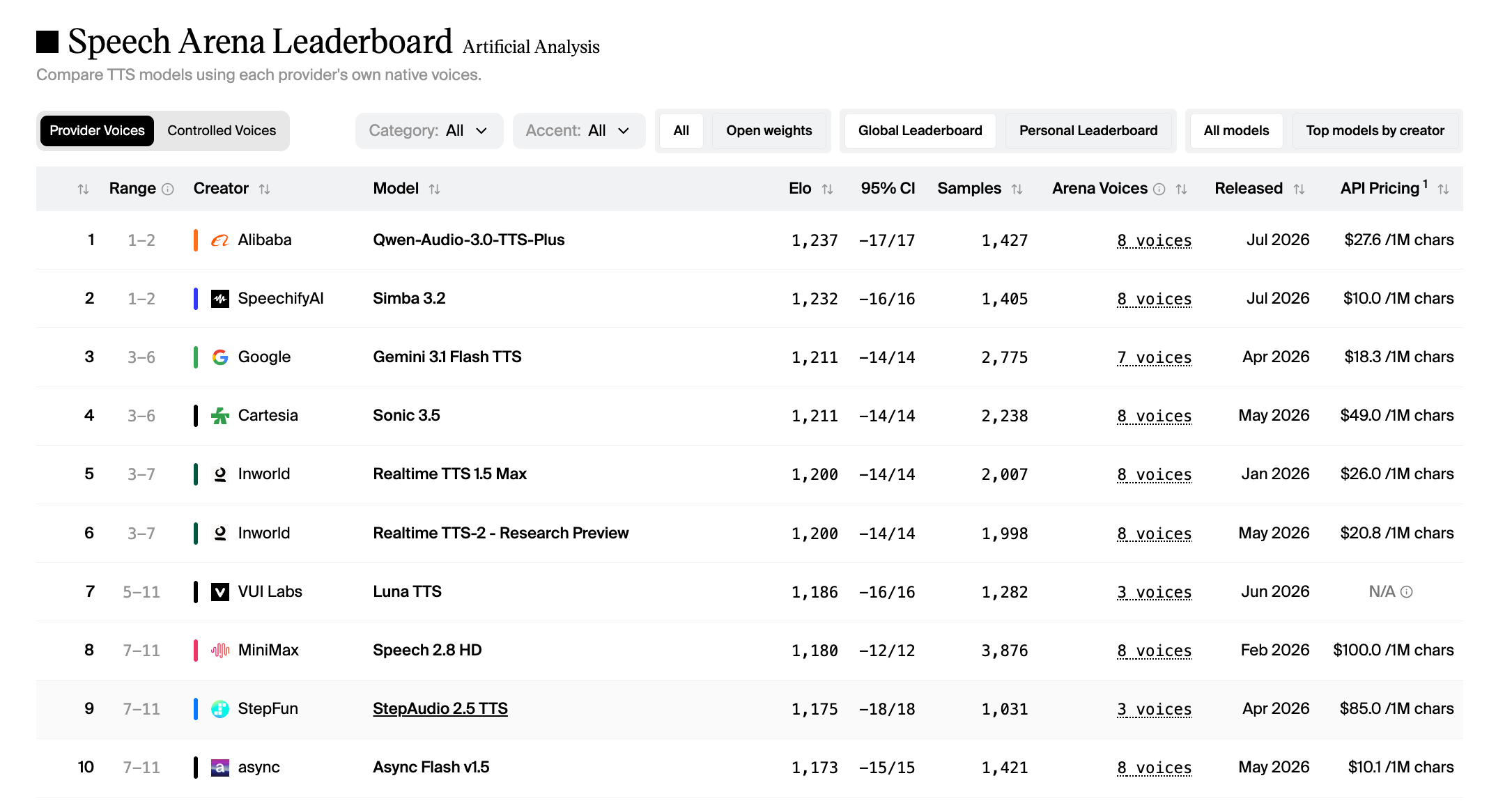
- Leaderboard #1: Qwen-Audio-3.0-TTS-Plus tops the Artificial Analysis Speech Arena with an Elo score of 1,237, beating Simba 3.2, Gemini 3.1 Flash TTS, and Sonic 3.5.
- Two variants: Flash (real-time, low latency) and Plus (high quality), both available now via Alibaba Cloud Model Studio API.
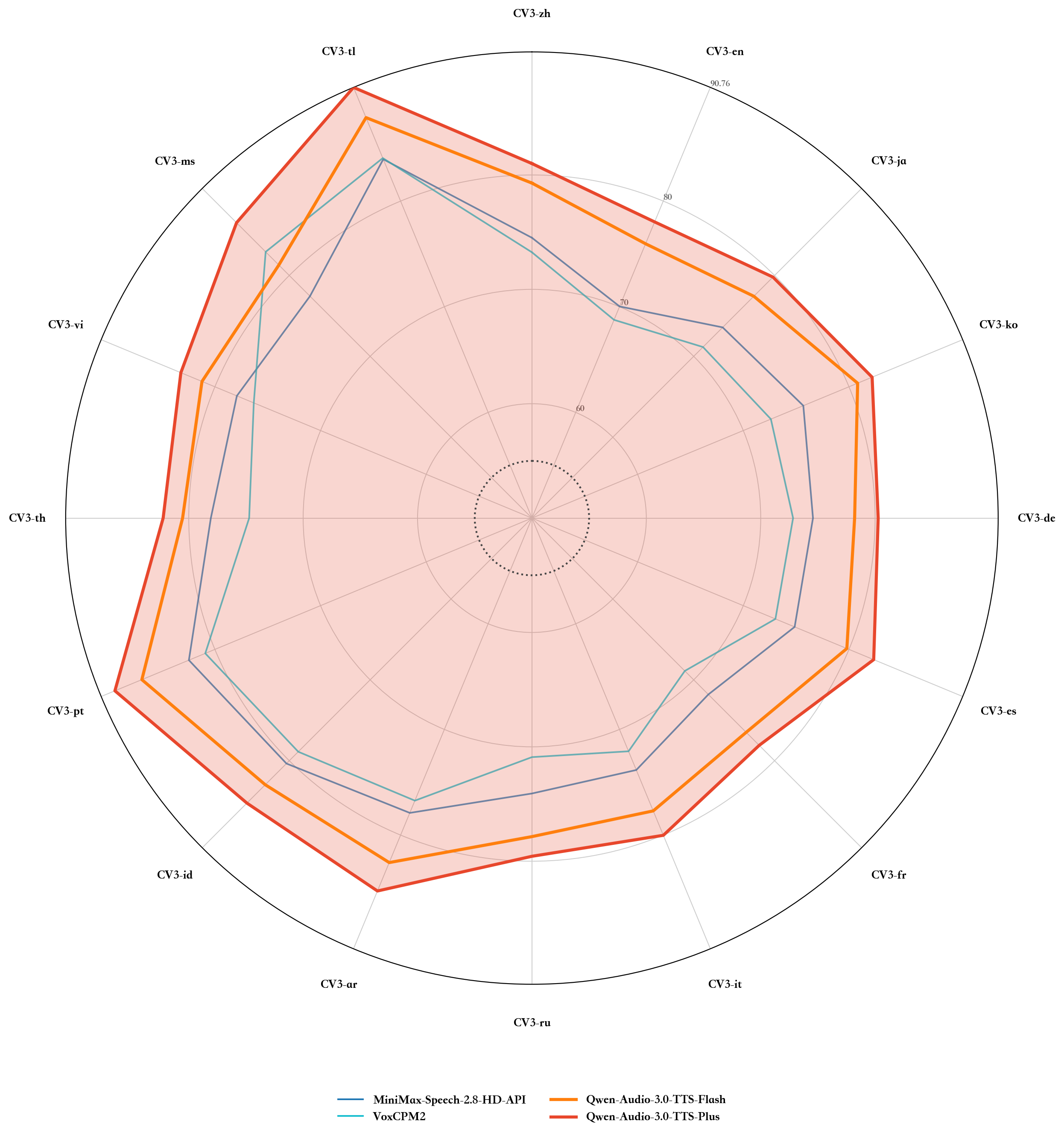
- 16 languages + 20 Chinese dialects: Adds Arabic, Indonesian, Portuguese, Thai, Vietnamese, Malay, and Filipino over the previous version.
- 86 inline control tags: Embed emotions, laughter, sighs, and style shifts directly in text; also accepts free-form natural language instructions.
- Noise-robust voice cloning: Clones voices from noisy or reverberant reference audio without a separate denoising step; supports up to 3-minute one-pass synthesis.
- Speed tradeoff: Plus generates only 16 characters/second vs. 120 for Sonic 3.5; priced at $27.59 per 1M characters.
Qwen-Audio-3.0-TTS is Alibaba's latest production-grade text-to-speech system, and it just landed at the top of the Artificial Analysis Speech Arena Leaderboard. It ships in two variants: Flash for real-time, low-latency applications and Plus for maximum output quality. Both are available via API on Alibaba Cloud Model Studio right now.
First place, by a hair
Qwen-Audio-3.0-TTS-Plus currently leads the Text-to-Speech Arena with an Elo score of 1,237. That puts it narrowly ahead of Simba 3.2 at 1,234, and ahead of Gemini 3.1 Flash TTS at 1,214 and Sonic 3.5 at 1,207. The confidence intervals overlap between the top two, so the gap is tight, but the ranking is real. Rankings are based on blind user votes in the Speech Arena, where users listen to pairs of speech samples generated from the same text and choose which sounds more natural. Higher Elo scores indicate a model produces speech preferred more often by listeners.
Qwen-Audio-3.0-TTS-Plus via Alibaba Cloud, Simba 3.2 via SpeechifyAI, and Gemini 2.5 Flash Lite TTS via Google currently offer some of the strongest quality-for-price tradeoffs in the comparison, sitting on the current quality-versus-price frontier.
What's actually new
The headline features break down into four areas worth understanding individually:
- 16 languages, 20 Chinese dialects. The model adds 7 new languages over its predecessor, including Arabic, Indonesian, Portuguese, Thai, Vietnamese, Malay, and Filipino. It also handles zero-shot voice cloning across all 20 Chinese regional dialects, from Cantonese to Sichuan to Shanghai dialect.
- Free-style natural language instructions. Instead of configuring audio parameters, you describe the voice in plain text. Instructions like "slow, calming voice" or "female morning radio host, lively but restrained, fast pace" are interpreted directly. You can also pass structured JSON like
{"speed": "fast", "volume": "loud", "rhythm": "urgent"}. - 86 fine-grained inline tags. These let you embed emotional shifts or non-verbal sounds at specific positions in the text. Tags like
[excited],[laughing],[panicked], and[sighing]act as localized style switches. A control tag affects all subsequent text until the next tag or sentence break; a rich language tag inserts a single sound effect at that position. - Noise-robust voice cloning. Previous TTS systems typically required clean, studio-quality reference audio. Qwen-Audio-3.0-TTS is designed to clone voices from noisy, reverberant, or telephone-band recordings without a separate denoising step.
How it was built
The technical paper describes a five-stage progressive training paradigm that coordinates two sub-systems: a language model (LM) that predicts speech tokens from text, and a flow-matching model (FM) that converts those tokens into waveforms.
The pipeline goes: independent LM and FM pretraining, joint training with high-quality data annealing, LM reinforcement learning, FM robustness training, and FM reinforcement learning. Each stage targets a specific quality dimension , content consistency, prosodic naturalness, voice fidelity, perceptual quality, and robustness , rather than optimizing everything at once.
A key architectural choice is a 12.5 Hz low-frame-rate speech tokenizer. Most speech tokenizers operate at 50-75 Hz, meaning the model must autoregressively predict many more tokens per second of audio. Running at 12.5 Hz dramatically reduces the number of decoding steps, which directly cuts inference latency. The model still retains speaker identity and content information at this lower rate, which is the core technical challenge the team solved.
The system also supports one-pass long-form synthesis up to 3 minutes without chunking, and outputs at up to 48 kHz via a vocoder super-resolution step.
The speed-quality tradeoff
The one area where Qwen-Audio-3.0-TTS-Plus falls short of competitors is throughput. The model generates 16 characters per second, below other leading models: Simba 3.2 at 30.2, Gemini 3.1 Flash TTS at 27, and Sonic 3.5 at 120. For real-time voice assistant use cases where first-packet latency matters most, the Flash variant is the right choice. For batch audiobook generation or high-quality voiceover work, Plus is the better fit.
Pricing and access
Qwen-Audio-3.0-TTS-Plus is priced at $27.59 per 1M characters
on Alibaba Cloud. Both qwen-audio-3.0-tts-flash and qwen-audio-3.0-tts-plus are available in the Singapore and China (Beijing) regions via the Alibaba Cloud Model Studio API, with WebSocket streaming support and SDKs for Python, Java, Go, Node.js, C#, and PHP.
Getting started with the Python SDK takes about 10 lines:
import os
import dashscope
from dashscope.audio.tts_v2 import SpeechSynthesizer
dashscope.api_key = os.environ.get('DASHSCOPE_API_KEY')
model = "qwen-audio-3.0-tts-plus"
voice = "longanlingxi"
synth = SpeechSynthesizer(model=model, voice=voice)
audio = synth.call("Hello, this is a test.")
with open('output.mp3', 'wb') as f:
    f.write(audio)
To use inline tags or natural language instructions, pass them as parameters:
# Inline emotion tags
text = "[excited]We just hit our launch target![laughing]I can't believe it worked."
# Natural language instruction
synth = SpeechSynthesizer(
    model="qwen-audio-3.0-tts-plus",
    voice="longanlingxi",
    instruction="Speak slowly and warmly, like a bedtime story narrator."
)
audio = synth.call(text)
Where this fits
The practical use cases cluster around a few clear categories:
- Multilingual products that need consistent voice identity across languages , the cross-lingual cloning keeps the same timbre when switching from Chinese to English to Japanese.
- Conversational AI and voice assistants where Flash's low latency matters and instruction-following lets the model adapt tone to context dynamically.
- Audiobook and long-form narration where the 3-minute one-pass synthesis and robust text normalization (numbers, symbols, abbreviations) reduce post-processing work.
- Voice cloning from real-world audio , phone recordings, noisy environments , where previous models would fail or require preprocessing pipelines.
The release continues Alibaba's strong momentum across AI model releases, following recent leading launches in language, image, and video generation. In the TTS space specifically, the combination of leaderboard-topping quality, broad language coverage, and a genuinely flexible control interface makes this the most complete production-ready option currently available via API , at least until the next model drops.
Comments
