

Alibaba's Qwen Audio 3.0 Dethrones OpenAI With a 99.2% Reasoning Score
Alibaba's Qwen Audio 3.0 Realtime Plus tops every benchmark on the Artificial Analysis Speech-to-Speech Index, beating GPT-Realtime-2.1 High on intelligence at a fraction of the cost — but with a significant latency trade-off.

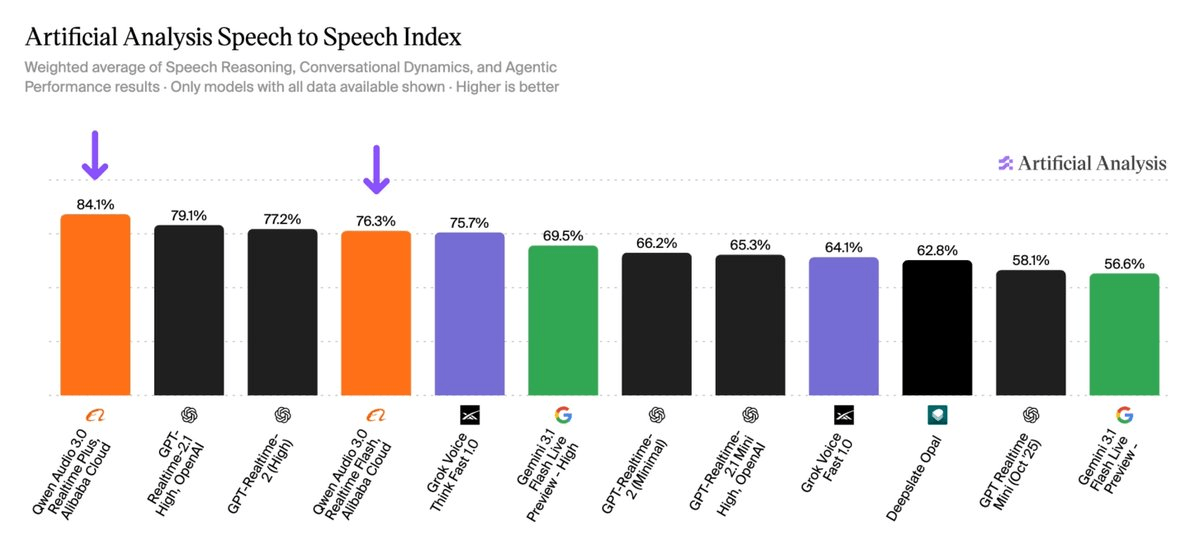
- New #1: Qwen Audio 3.0 Realtime Plus tops the Artificial Analysis Speech-to-Speech Index at 84.1%, beating GPT-Realtime-2.1 High (79.1%).
- Clean sweep: Plus variant leads all three component benchmarks — Big Bench Audio (99.2%), Full Duplex Bench (98.4%), and 𝜏-Voice (54.6%).
- Latency trade-off: Average Time to First Audio is 4.02s for Plus and 4.16s for Flash — vs. 1.14s for GPT-Realtime-2 High and 0.44s for the fastest model (Deepslate Opal).
- Pricing: Plus costs $4.42/hr of input audio — cheaper than GPT-Realtime-2.1 High ($10.75) but slightly more than GPT-Realtime-2 High ($4.14).
- Architecture: Built on Qwen3.5-Omni's Thinker-Talker MoE design with ARIA alignment for stable streaming speech and a custom AuT audio encoder trained on 40M hours of audio.
- Access: Available now via Alibaba Cloud DashScope API (WebSocket/WebRTC); new international accounts get 1M free tokens for 90 days.
Alibaba's Qwen team has taken the top spot on the Artificial Analysis Speech-to-Speech Index with Qwen Audio 3.0 Realtime Plus, scoring 84.1% overall, nearly 5 points ahead of the previous leader, GPT-Realtime-2.1 High at 79.1%. It's the first time a non-OpenAI model has led this leaderboard. The model ships in two variants: Plus (optimized for intelligence) and Flash (optimized for speed), both available via Alibaba Cloud's DashScope API.
A clean sweep across all three benchmarks
The Artificial Analysis index is a composite of three separate evaluations, each testing a different dimension of voice AI capability. Qwen Audio 3.0 Realtime Plus leads all three.
- Speech Reasoning (Big Bench Audio): Qwen Audio 3.0 Realtime Plus scores 99.2% across 32 models evaluated. This benchmark tests logical reasoning delivered as audio: counting objects, evaluating boolean logic, and detecting formal fallacies. The Flash variant scores 96.1%.
- Conversational Dynamics (Full Duplex Bench): Qwen Audio 3.0 Realtime Plus scores 98.4% on the Full Duplex Bench dataset. This measures how well the model handles real conversation flow: knowing when to speak, when to pause, how to handle interruptions, and how to respond to backchannels like "mm-hmm." Flash follows at 96.9%.
- Agentic Performance (𝜏-Voice): The Plus variant scores 54.6% on 𝜏-Voice, a benchmark that tests task completion in simulated customer service scenarios: changing a flight, disputing a retail charge, resolving a telecom issue. It edges out Grok Voice Think Fast 1.0 at 52.1%, with Flash scoring 35.9%.
How the architecture works
Qwen Audio 3.0 Realtime is built on the Qwen3.5-Omni foundation, which uses a Thinker-Talker architecture, a design pattern Alibaba introduced in Qwen2.5-Omni. The Thinker is a large language model that handles reasoning, comprehension, and text generation. The Talker is a streaming speech generation module that converts semantic representations and tokenized text into audio, running in parallel so the model can begin speaking before it has finished reasoning through the full response.
In Qwen3.5-Omni, both components were upgraded significantly. The model employs a Hybrid Attention Mixture-of-Experts (MoE) framework for both Thinker and Talker, enabling efficient long-sequence inference. The audio encoder, called AuT, was trained from scratch on 40 million hours of audio data, replacing the Whisper encoder used in earlier versions.
A key innovation for streaming speech is ARIA (Adaptive Rate Interleave Alignment). Text tokens and audio tokens are generated at different speeds, and ARIA keeps them synchronized so the output doesn't stutter or mispronounce words. Without this alignment, mismatched tokenization rates cause skipped words, incorrect pronunciations, and garbled numbers.
For speech generation, the Talker autoregressively predicts a multi-codebook sequence. At each decoding step, an MTP module outputs the residual codebooks for the current frame, after which the Code2Wav renderer incrementally synthesizes the waveform, enabling frame-by-frame streaming.
The model also supports semantic interruption: it distinguishes a user cutting in mid-sentence from a user saying "mm-hmm," which separates a natural voice agent from an annoying one.
The latency problem
Qwen Audio 3.0 Realtime Plus achieves the highest intelligence scores on the leaderboard, but it's also among the slowest to respond. Average Time to First Audio (TTFA) on the Big Bench Audio benchmark is 4.02 seconds for Plus and 4.16 seconds for Flash. GPT-Realtime-2 (High) responds in 1.14 seconds. Deepslate Opal, the fastest model on the leaderboard, starts speaking in 0.44 seconds.
A 4-second wait is a real constraint for conversational use cases. The technical report cites much lower theoretical first-packet latency (435ms for Plus, 235ms for Flash under ideal conditions), suggesting the gap is partly due to network overhead and the China-hosted endpoints tested by Artificial Analysis. Either way, it's a number builders need to account for before committing to the model in production.
Pricing: cheaper than OpenAI, with a catch
Qwen Audio 3.0 Realtime Plus costs $4.42 per hour of input audio on the Big Bench Audio subset, more expensive than GPT-Realtime-2 High ($4.14) but roughly 2.4x cheaper than GPT-Realtime-2.1 High ($10.75). The Flash variant carries a lower list price but measures $4.77 in benchmarking because it generates significantly more output tokens per response (2,043 vs. 1,232 for Plus), which drives up actual cost despite the lower rate.
The underlying DashScope API supports both WebSocket and WebRTC access. WebSocket suits server integration and quick setup. WebRTC targets browser and lower-latency voice scenarios, with audio over UDP plus built-in echo cancellation and noise reduction.
How to use it
The model is available via Alibaba Cloud's DashScope API. Access requires a DashScope API key from Alibaba Cloud Model Studio. The API accepts streaming audio and text input and returns streaming audio and text output over a WebSocket connection. Input audio is PCM at 16 kHz; output audio is PCM at 24 kHz.
A quick connection example using the DashScope SDK:
import dashscope
from dashscope.audio.asr import Recognition
# Connect to Qwen Audio 3.0 Realtime Plus
client = dashscope.RealtimeClient(
    model="qwen-audio-3.0-realtime-plus",
    api_key="YOUR_DASHSCOPE_API_KEY"
)
# Stream audio input, receive audio output
client.connect()
client.send_audio(audio_chunk)  # PCM 16kHz bytes
response_audio = client.receive()  # PCM 24kHz bytes
New DashScope accounts in the International region (Singapore endpoint) receive a free quota of 1 million input tokens and 1 million output tokens, valid for 90 days after activating Model Studio. The Global deployment mode (US Virginia) has no free quota.
Where it fits, and where it doesn't
The benchmark results point to clear use cases and clear limits.
- Voice agents that need to reason: The 99.2% score on Big Bench Audio is the highest ever recorded on that benchmark. If your agent needs to count, evaluate arguments, or solve multi-step problems spoken aloud, this is the strongest model available.
- Agentic customer service: The 54.6% score on 𝜏-Voice, covering simulated tasks across airline, retail, and telecom domains, puts it ahead of every other model on the leaderboard for this use case.
- Full-duplex conversation: The 98.4% conversational dynamics score means it handles interruptions, pauses, and backchannels better than any other tested model, including all OpenAI variants.
- Latency-sensitive applications: Real-time phone calls, live translation, or voice interfaces where a 4-second pause would feel broken should use faster alternatives. GPT-Realtime-2 (Minimal) responds in 1.10 seconds; Deepslate Opal in 0.44 seconds. Both score significantly lower on intelligence benchmarks, so the trade-off is real.
Where the field is heading
The voice AI space has been effectively an OpenAI duopoly since GPT-4o's audio capabilities launched. Qwen3-Omni is a single multimodal model that maintains competitive performance across text, image, audio, and video without degrading relative to single-modal counterparts, and on audio tasks it now leads the field.
The intelligence-latency gap also reveals a genuine engineering tension: the highest-scoring models are not the fastest ones. Qwen's approach of separating reasoning (Thinker) from speech generation (Talker) and running them in parallel is one architectural bet on closing that gap. Whether the 4-second TTFA improves with infrastructure optimization or reflects a fundamental cost of reasoning depth is the key question for production deployments.
For teams building voice agents where task completion matters more than instant response, the leaderboard has a new leader. For teams where every second of latency counts, the trade-off still favors OpenAI's faster variants until Alibaba closes the gap.
Comments
