

Alibaba's ProbeRAG Forces LLaMA to Stop Ignoring Retrieved Facts, Hitting 89.2 F1
ProbeRAG cracks open the black box of RAG faithfulness by reading hidden states directly, boosting F1 by 3 to 10 points across benchmarks.
 PRO
- ProbeRAG detects RAG knowledge conflicts by reading hidden states, not by prompting or decoding tricks
- Aligned and conflicting knowledge form linearly separable clusters in LLM latent space
- Three-stage pipeline: knowledge pruning, latent probing, conflict-aware attention fine-tuning
- Beats CANOE and Context-DPO by 3-10 F1 points across FaithEval, ConFiQA, and SQuAD
- Probes trained on MQuAKE generalize to RAG benchmarks at 82-88% accuracy
- Full code and evaluation harness available at github.com/LinfengGao/ProbeRAG
Retrieval-augmented generation was supposed to solve hallucinations. Instead, it produced a new failure mode: models that receive perfectly good context and still ignore it, either defaulting to what they memorized during pretraining or blending the two sources into something that resembles neither. A new paper from Xiamen University, Hong Kong Polytechnic, and Alibaba, titled Beyond Black-Box Interventions, argues that fixing this requires looking inside the model rather than nudging it from the outside.
The team introduces ProbeRAG, a framework that reads a model's hidden states to detect when retrieved context conflicts with parametric memory, then steers attention toward the conflicting evidence during generation. On the ConFiQA multi-conflict benchmark, it pushes LLaMA-3.1-8B-Instruct from 28.0 F1 with vanilla RAG to 89.2 F1, with similar gains on Qwen3-8B and Mistral-7B-v0.3.
Why RAG keeps ignoring its own evidence
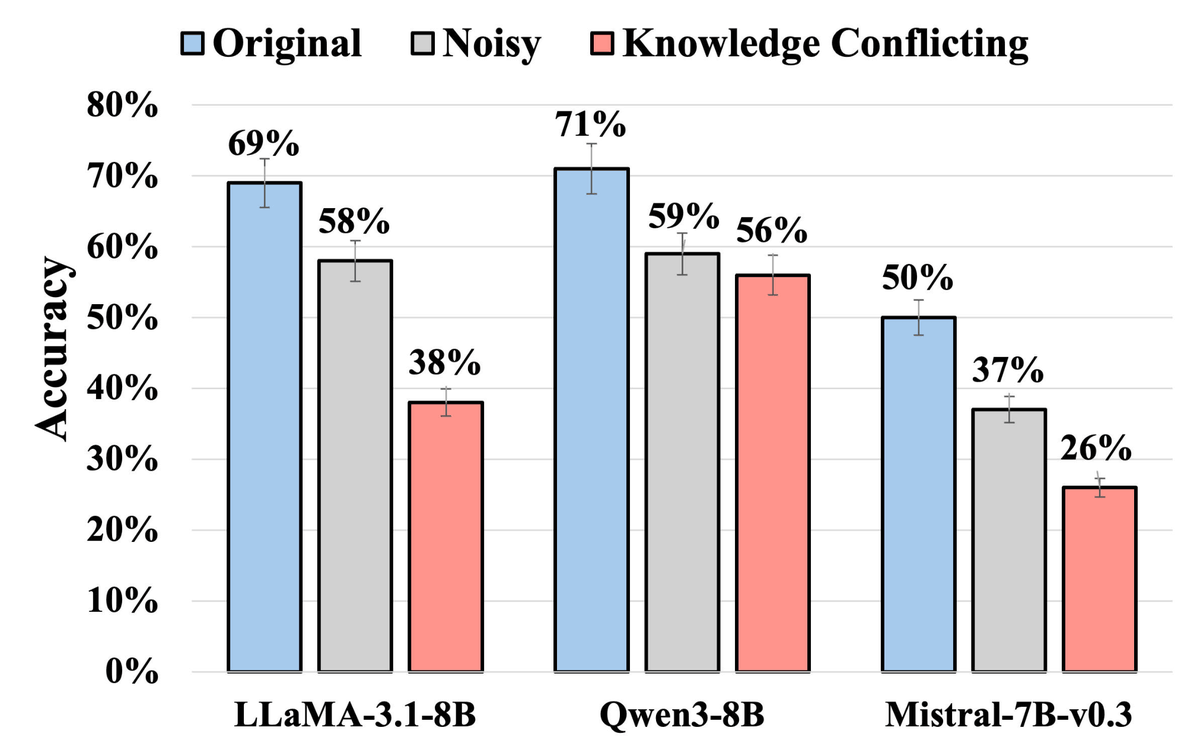
The paper opens with a diagnostic that will feel familiar to anyone running a production RAG stack. Fed clean context, Qwen3-8B hits 71% accuracy. Add semantically related but topically irrelevant passages (contextual noise) and it drops to 59%. Introduce counterfactual entities that contradict what the model already knows (knowledge conflict) and it falls further to 56%.
Existing fixes fall into three camps, all of which treat the LLM as a sealed box:
- Prompt-based methods like Self-RAG or context-faithful prompting, which are brittle and prompt-sensitive
- Decoding-based methods like Context-Aware Decoding (CAD) or COIECD, which reweight token probabilities but break when context is noisy
- Preference optimization like Context-DPO or CANOE, which need large curated preference datasets
This story is for Pro members
You've reached the end of the free preview. Upgrade to AlphaSignal Pro to read the full article - and everything else behind the paywall.
Comments
