

Alibaba's LOGOS Replaces Dozens of Science AI Models With One Open-Source Grammar
Alibaba's LOGOS is a single 8B autoregressive model that handles proteins, molecules, materials, and reactions using one shared scientific grammar
- LOGOS is a new open-source model from Alibaba that handles proteins, molecules, materials, and reactions in a single autoregressive framework.
- It encodes all scientific objects as token sequences over a shared vocabulary, eliminating the need for separate specialist models per domain.
- Spatial 3D structure is captured via discretized tokens, not geometric neural networks -- a key architectural departure from most science AI.
- The model comes in 1B, 3B, and 8B sizes; all weights are free on Hugging Face under Apache 2.0.
- Benchmarks show LOGOS matches or outperforms domain-specific baselines across retrosynthesis, ligand design, material generation, and protein tasks.
- The paper and code are fully open; inference scripts are ready to run for four tasks out of the box.
The dominant playbook for AI in science has always been specialization: one model for protein folding, another for drug design, a third for materials discovery. Every new task means a new architecture, a new training pipeline, and knowledge that never leaves its silo. LOGOS (Language Of Generative Objects in Science), a new open-source model from Alibaba's Tongyi Lab and Renmin University of China, is a direct challenge to that assumption.
LOGOS is a scientific generative language model that unifies heterogeneous tasks across the natural sciences within a single autoregressive framework based on a shared scientific grammar. In plain terms: instead of building separate specialist models, the team asked whether scientific data could be treated like language, and whether a single next-token prediction engine could handle all of it.
One grammar to rule them all
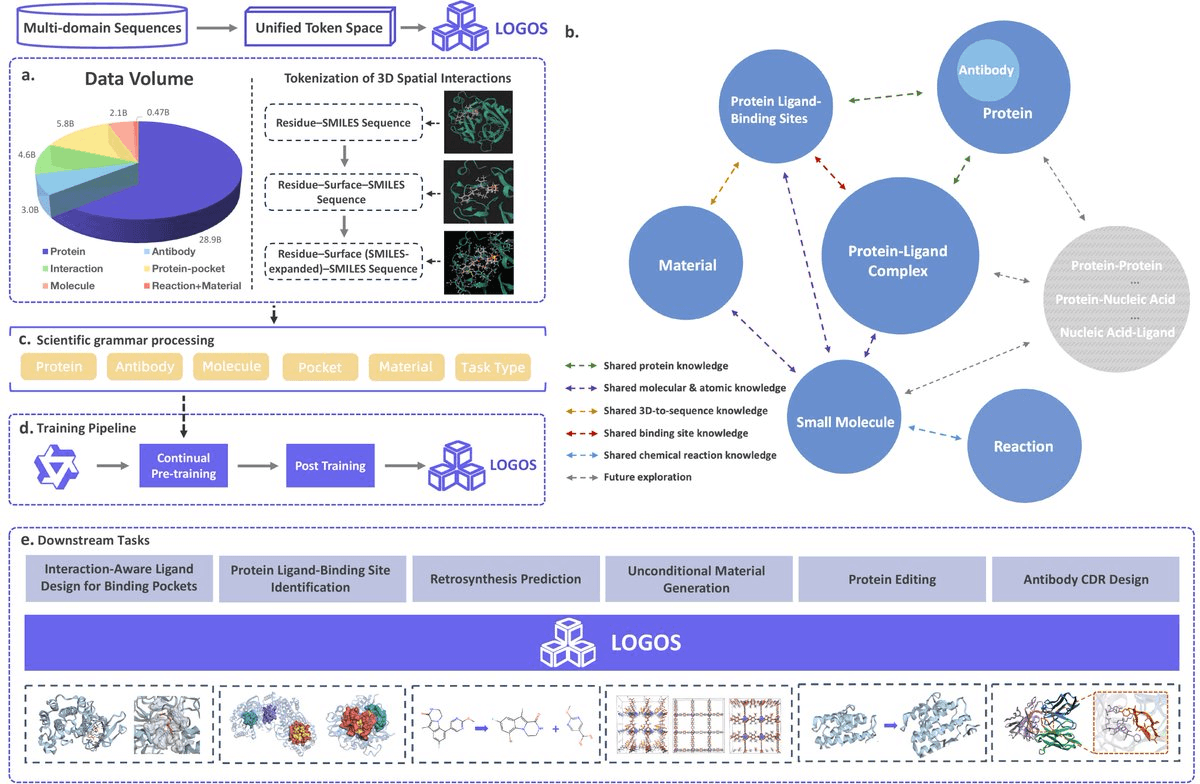
The core idea is a unified scientific grammar -- a shared vocabulary that encodes radically different scientific objects (proteins, small molecules, antibodies, chemical reactions, crystal materials) as token sequences. This is not a natural-language wrapper around existing tools. By representing spatial contact and constraint patterns as discrete tokens, the model captures complex structural interactions in a purely sequential manner, without relying on explicit coordinates or geometric neural networks.
That last point is significant. Most structure-aware models in biology and chemistry rely on 3D geometric deep learning -- specialized architectures that explicitly reason about atomic coordinates in space. LOGOS sidesteps this entirely, discretizing spatial relationships into tokens that the transformer can process like any other sequence.

This unified representation enables a wide range of downstream tasks to be formulated consistently as next-token prediction in the same grammar space, creating strong alignment between continued multi-domain pre-training and downstream objectives. The practical consequence: the same inference infrastructure, the same sampling parameters, and the same model checkpoint handle tasks that previously required entirely different stacks.
What it can actually do
LOGOS ships with four ready-to-run inference scripts covering the following tasks:
- Retrosynthesis prediction -- given a target molecule, predict the reactants needed to synthesize it (the core problem in drug manufacturing planning)
- Protein ligand-binding site identification -- find the pockets on a protein where small molecules can bind, purely from sequence
- Interaction-aware ligand design -- generate drug-like molecules specifically shaped to fit a given protein pocket
- Unconditional material generation -- generate novel, valid crystal material structures from scratch
Across diverse tasks, LOGOS consistently matches or outperforms domain-specific baselines, providing preliminary evidence for the feasibility of a unified modeling approach. The team also reports cross-domain knowledge transfer: training on protein data appears to improve performance on molecular tasks and vice versa, suggesting the shared grammar is learning something deeper than surface-level tokenization.

How it was built
LOGOS is built on an autoregressive transformer architecture -- the same family as LLaMA and Qwen -- and comes in three pretrained sizes: 1B, 3B, and 8B parameters. The flagship fine-tuned model is LOGOS-8B, available on Hugging Face. The team reports stable scaling behavior across the 1B-to-8B range, meaning the approach doesn't rely on a single lucky configuration.
The training strategy is described as pretraining-generation alignment: the grammar space is designed so that the continued pre-training objective and the downstream task objectives are formally consistent. This closes a gap that plagues many fine-tuned science models, where the model learns one thing during pretraining and is asked to do something structurally different at inference time.
Getting started requires an NVIDIA GPU and the official PyTorch Docker image:
docker pull nvcr.io/nvidia/pytorch:25.02-py3
# Then load the model via HuggingFace Transformers
from transformers import AutoModelForCausalLM, AutoTokenizer
model = AutoModelForCausalLM.from_pretrained("LOGOS-Hub/LOGOS-8B")
tokenizer = AutoTokenizer.from_pretrained("LOGOS-Hub/LOGOS-8B")
Each task has its own inference script (e.g., reversereact_gen.py, pocket_gen.py) that takes a JSONL input file and writes results with perplexity scores. The model is released under the Apache 2.0 license, so commercial use is permitted.
The bigger bet
The field of AI for science has been fragmenting for years. AlphaFold changed protein structure prediction; diffusion models reshaped molecular generation; graph neural networks dominate materials modeling. Each breakthrough came with its own bespoke architecture. LOGOS is making an explicit argument that this fragmentation is a cost, not a feature.
The paper's authors -- from Alibaba Group and the Gaoling School of Artificial Intelligence, Renmin University of China -- frame the long-term vision clearly: future AI for science systems may benefit from aligning scientific foundation models with LLMs through shared architectures, shared training paradigms, and shared inference infrastructure, rather than evolving as entirely separate stacks.
There are real limits to acknowledge. LOGOS is an early-stage research release, not a production tool. The benchmark results show it matches or outperforms domain-specific baselines -- not that it crushes them. And the tasks covered, while diverse, are a small slice of what computational science actually needs. Antibody design, protein editing, and pocket detection are included in the benchmark comparisons, but the publicly released inference scripts cover only four tasks for now.
Still, the core claim -- that a shared grammar can achieve genuine knowledge transfer across scientific domains, not just representational unification -- is the kind of assumption shift that tends to age well. The technical report and all model weights are publicly available, and the team has announced a live session with the authors for those who want to dig deeper.
Comments
