

Alibaba's Logics-Parsing-v2 Beats Every Open-Source OCR Model on Complex Documents
Alibaba's open-source vision-language model turns messy PDFs, chemistry diagrams, flowcharts, and even music sheets into clean structured HTML.
 PRO
PRO- Alibaba open-sourced Logics-Parsing, an end-to-end VLM converting document images to structured HTML.
- V2 adds Parsing-2.0: Mermaid for flowcharts, ABC notation for music sheets, code blocks, and chemistry SMILES.
- Built on Qwen2.5-VL-7B with two-stage SFT then layout-centric GRPO reinforcement learning.
- Novel reward penalizes reading-order inversions directly, fixing multi-column newspaper and poster parsing.
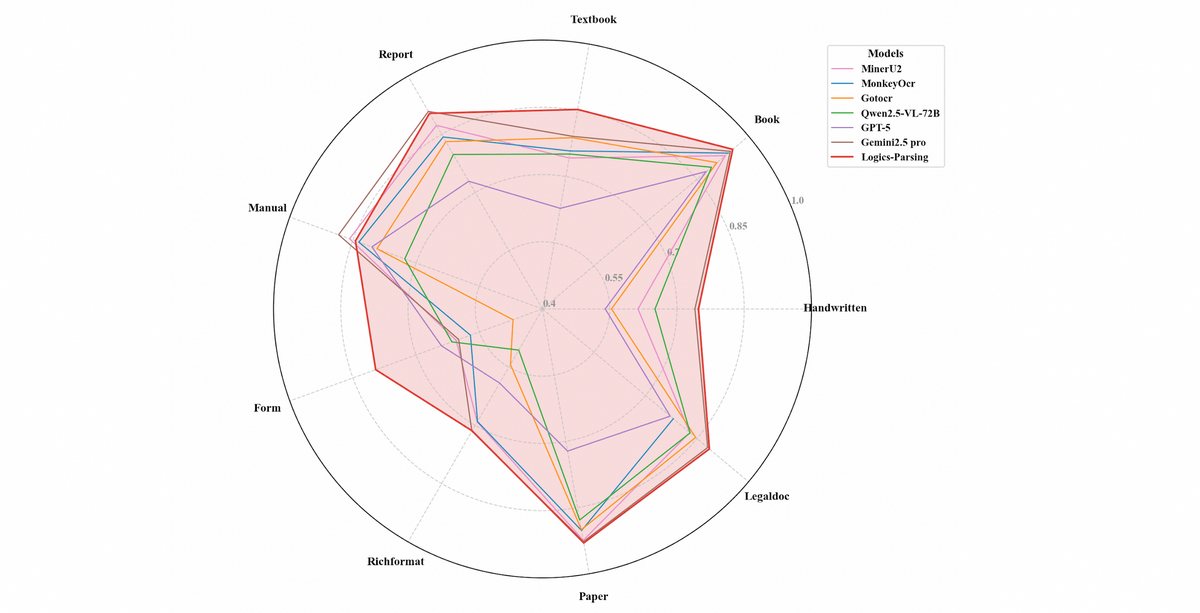
- Scores 93.23 overall on OmniDocBench-v1.5, beating open-source rivals and matching commercial tools.
- Weights on Hugging Face, Apache-2.0, with a hosted ModelScope demo available.
Alibaba's Logics Team has open-sourced Logics-Parsing, an end-to-end document parsing model that reads a page image and returns structured HTML with bounding boxes, categories, and OCR text for every block. The v2 release pushes beyond traditional OCR into what the team calls Parsing-2.0: converting flowcharts into Mermaid diagrams, music sheets into ABC notation, and code blocks into faithful reproductions of the original layout.
The repo ships two model generations under Apache-2.0. Logics-Parsing-v2 is the current flagship, with weights on Hugging Face and ModelScope, plus a hosted demo on ModelScope Studio for kicking the tires before downloading anything.
One model instead of a pipeline
Most document parsing stacks chain together layout detection, text recognition, table structure recognition, and reading order sorting as separate models. Each expert only optimizes its own local objective, which does not guarantee a global optimum for the overall document, and errors compound across stages. Logics-Parsing collapses all of that into a single vision-language model call.
The output is a clean HTML representation of the page. Every content block (paragraph, table, figure, formula) is tagged with its category, bounding box coordinates, and OCR text, and the model automatically filters out irrelevant elements like headers and footers, focusing on the core content. That structured output is what makes it directly useful for RAG pipelines, dataset construction, and downstream document understanding.
This story is for Pro members
You've reached the end of the free preview. Upgrade to AlphaSignal Pro to read the full article - and everything else behind the paywall.
Comments
