

AI4Finance Splits FinRL Into FinRL-X to Bridge Research and Live Trading
FinRL splits into a research sandbox and FinRL-X, a production-ready trading system with modular architecture, LLM support, and live broker integration
 PRO
- FinRL splits into two tracks: the original repo stays as a research sandbox; FinRL-X is the new production-ready successor.
- Weight-centric architecture: every strategy component outputs a portfolio weight vector that flows identically through backtesting and live execution, closing the research-to-deployment gap.
- Modular pipeline: stock selection, portfolio allocation, timing, and risk overlay are independently swappable without touching downstream components.
- Backtested results: Adaptive Rotation strategy achieved 22.32% annualized return and 1.10 Sharpe vs. QQQ's 0.81 over Jan 2018–Oct 2025; paper trading returned +19.76% vs. SPY's -2.51%.
- LLM-ready: FinRL-X natively supports LLM-based sentiment signals (e.g., DeepSeek) as inputs to the strategy layer alongside DRL agents and classical optimizers.
- Free and open-source: FinRL is MIT licensed; FinRL-X is Apache 2.0; both available now on GitHub with 15.5k+ and 3.2k stars respectively.
FinRL, the open-source framework that first brought reinforcement learning to quantitative trading, is undergoing its biggest architectural shift since launch. The project is now officially splitting into two tracks: the original FinRL repo stays as a research and education sandbox, while a new successor called FinRL-X takes over as the production-ready stack built for real deployment. With 15,500+ stars and over 3,400 forks, the original repo has clearly struck a nerve, and this split is the team's answer to a gap that has frustrated practitioners for years.
The problem every quant researcher knows
Financial reinforcement learning is now a practical paradigm for financial engineering, but applying RL strategies to real-world trading tasks remains a challenge, as it is error-prone and engineering-heavy. The core tension is one that anyone who has tried to go from a backtest to a live system will recognize immediately: the simulation and the real world behave differently, and most frameworks only help you with one side of that equation.
Stock and crypto trading tasks pose unique challenges due to the non-stationarity of financial data, low signal-to-noise ratios, and various market frictions. Although numerous FinRL methods have been developed, the lack of standardized task definitions, real-time high-quality datasets, close-to-real market environments, and robust baselines has hindered consistent reproduction in both the open-source community and the FinTech industry.
What FinRL-X actually fixes
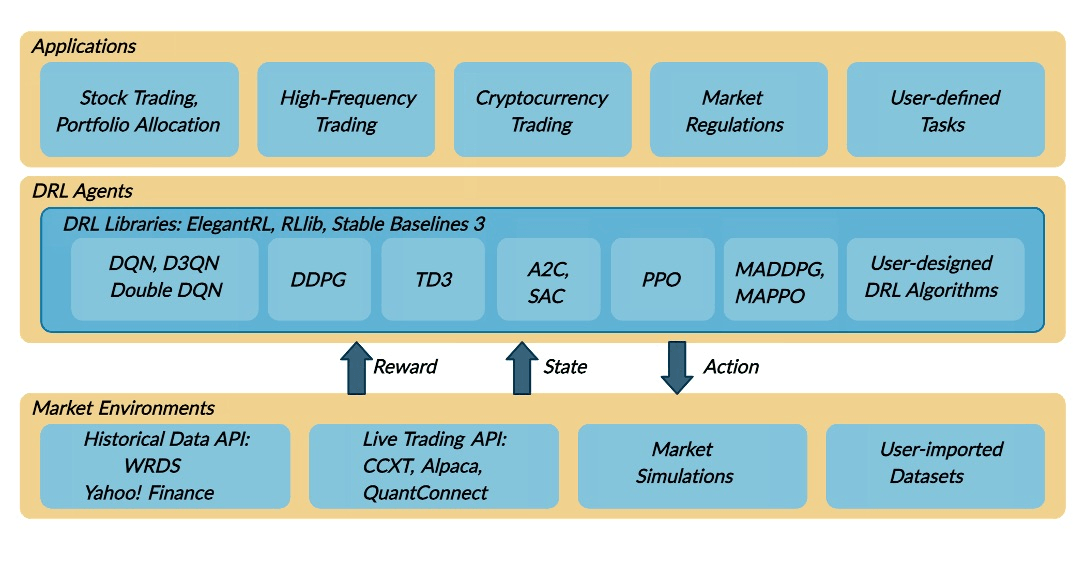
FinRL-X provides a composable strategy pipeline integrating stock selection, portfolio allocation, timing, and risk overlays, with support for both rule-based and AI-driven components, including reinforcement learning allocators and LLM-based sentiment signals. The key architectural idea is a weight-centric interface: every component in the pipeline, whether a classical optimizer or a DRL agent, outputs a single target portfolio weight vector. That vector flows identically through backtesting and live execution, so there is no translation layer to break things.
This story is for Pro members
You've reached the end of the free preview. Upgrade to AlphaSignal Pro to read the full article - and everything else behind the paywall.
Comments
