
AI4Finance's FinGPT Beats GPT-4 on Sentiment for $300 Instead of $3M
FinGPT brings open-source, LoRA-powered financial LLMs to anyone with a GPU — beating GPT-4 on sentiment at under $300 per fine-tune
 Pro
Takeaways
- FinGPT is a free, MIT-licensed framework for fine-tuning LLMs on financial tasks, built by the AI4Finance Foundation.
- Uses LoRA fine-tuning to adapt models like Llama 3.1 for under $300 — vs. ~$3M for BloombergGPT.
- Introduces RLSP (Reinforcement Learning on Stock Prices), using actual market reactions as training signal instead of human feedback.
- Achieves 82.1% accuracy on financial sentiment, outperforming ChatGPT, FinBERT, and zero-shot Llama 3.1.
- Weak on complex numerical reasoning, multi-step financial QA, and long-form summarization.
- Pretrained adapters and demos available on GitHub and HuggingFace.
FinGPT is the open-source answer to a question the finance world has been quietly asking: why should cutting-edge financial AI be locked behind a $3 million training run? Built by the AI4Finance Foundation , a nonprofit backed by researchers from Columbia University and NYU Shanghai , FinGPT is a full-stack framework for building, fine-tuning, and deploying financial large language models. It now has over 20,000 GitHub stars and an active community pushing it into new territory, from stock forecasting to robo-advisory agents.
The Problem It Was Built to Solve
While proprietary models like BloombergGPT have taken advantage of their unique data accumulation, such privileged access calls for an open-source alternative to democratize internet-scale financial data. The issue is not just cost , it is also freshness. The finance domain presents unique challenges, including high temporal sensitivity, constant dynamism, and a low signal-to-noise ratio. A model trained once and left static quickly becomes stale in a market that moves by the minute.
BloombergGPT trained an LLM using a mixture of finance data and general-purpose data, which took about 53 days, at a cost of around $3M. It is costly to retrain an LLM model like BloombergGPT every month or every week, thus lightweight adaptation is highly favorable. FinGPT was designed from the ground up to flip that equation.
How It Actually Works
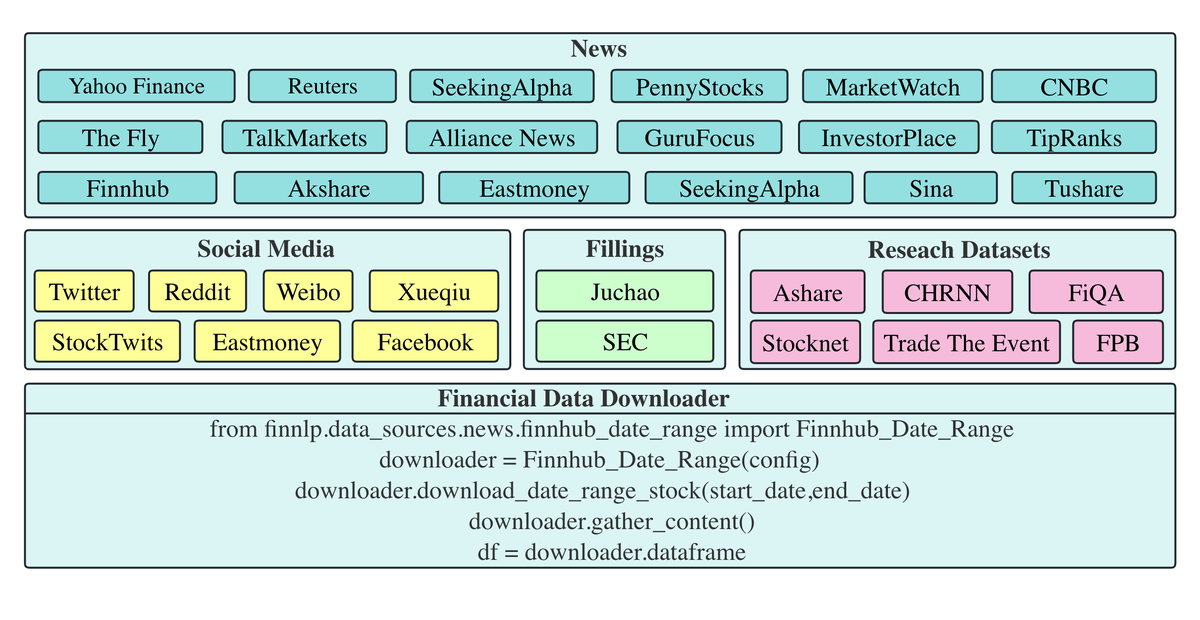
Unlike proprietary models, FinGPT takes a data-centric approach, providing researchers and practitioners with accessible and transparent resources to customize their financial LLMs. The framework is organized into five layers:
- Data source layer , pulls from financial news (Reuters, CNBC, Yahoo Finance), SEC filings, social media (Twitter, Reddit, Weibo), and academic datasets
- Data engineering layer , real-time NLP pipeline for cleaning, tokenizing, embedding, and filtering noisy financial text
- LLMs layer , fine-tuning via LoRA, QLoRA, RLSP, and RAG on top of open base models like Llama 3.1 and ChatGLM
- Tasks layer , standardized benchmarks for sentiment analysis, NER, summarization, numerical reasoning, and more
- Applications layer , ready-to-run demos including FinGPT-Forecaster and robo-advisor interfaces

The core technical bet is on LoRA (Low-Rank Adaptation) , a parameter-efficient fine-tuning technique that freezes most of the base model and only trains a small set of low-rank weight matrices injected into the transformer layers. FinGPT fine-tunes the pretrained Llama-3.1-8B-Instruct model using LoRA. Under a standard configuration, the total number of trainable parameters introduced by LoRA is approximately 8.3M, which is well below 0.1% of the original 8B-parameter model.
A Novel Training Signal: Stock Prices as Feedback
One of FinGPT's most distinctive ideas is replacing human feedback with market feedback. Standard RLHF (Reinforcement Learning from Human Feedback) relies on human annotators to score model outputs , expensive and slow. FinGPT introduces RLSP (Reinforcement Learning on Stock Prices), where the reward signal comes directly from how a stock actually moved after a piece of news was published.
The reward is the stock price's post-news reaction. This "self-labeled" approach aligns sentiment with true market reactions and avoids costly manual annotation. The training dataset contains over 620,000 cleaned financial news headlines from sources including CNBC, Reuters, Yahoo Finance, and MarketWatch, collected through the FinNLP pipeline.
The labeling logic is elegant: if a stock rose significantly after a headline, that headline is labeled positive. If it dropped, negative. This means FinGPT learns what the market actually cares about , not what a human annotator thinks sounds bullish.
Benchmark Numbers Worth Knowing
On financial sentiment classification, FinGPT's results are striking. Here is how it compares to major baselines on accuracy and Macro-F1:
| Model | Accuracy | Macro-F1 |
|---|---|---|
| Llama 3.1-8B (zero-shot) | 57.9% | 54.4 |
| ChatGPT (zero-shot) | 63.4% | 61.7 |
| FinBERT | 71.2% | 69.9 |
| FinGPT (LoRA-SFT) | 78.8% | 77.3 |
| FinGPT (SFT + RLSP) | 82.1% | 80.9 |
FinGPT has been extensively benchmarked on the Golden Touchstone bilingual evaluation suite spanning eight core financial NLP tasks. Performance details include high scores in sentiment analysis and headline classification (F1 up to 87.62% and 95.50%, respectively, comparable to GPT-4), but moderate performance in stock movement prediction (accuracy/F1 45–53%), and underperformance in complex reasoning and generation tasks (e.g., financial QA Exact Match 28.47% vs. GPT-4's 76%).

Where It Shines , and Where It Doesn't
FinGPT is genuinely strong at tasks where pattern recognition over financial text matters most:
- Financial sentiment classification (outperforms GPT-4 on structured benchmarks)
- Headline classification and named-entity recognition
- Short-term stock movement signals from news
- Structured information extraction from filings and earnings reports
But it has real gaps. FinGPT's domain-centric adaptation exhibits notable deficiencies in complex reasoning, numerical arithmetic, relation extraction, and summarization, as evidenced by multiple benchmarks. If you need a model to do multi-step financial math or generate coherent analyst-style summaries, it will fall short of frontier general-purpose models.
The Cost Argument Is the Real Story
BloombergGPT used approximately 1.3 million GPU hours for training, which translates to a cost of around $3 million per training. In contrast, FinGPT presents a more accessible solution by focusing on the lightweight adaptation of top open-source LLMs. The cost of adaptation falls significantly, estimated at around $300 per fine-tuning.
The open-source model supports weekly or monthly updates, while BloombergGPT remains static due to costly retraining requirements. For a domain as fast-moving as finance, that agility matters as much as raw benchmark performance. A model you can retrain on last week's earnings calls is worth more than a frozen giant trained on data from two years ago.
How to Get Started
Pretrained FinGPT adapters are available on HuggingFace and can be loaded in a few lines using the peft and transformers libraries. The repo ships with several ready-to-use checkpoints:
fingpt-sentiment_llama2-13b_lora, financial sentiment analysisfingpt-forecaster_dow30_llama2-7b_lora, Dow 30 stock price forecastingfingpt-mt_chatglm2-6b_lora, multi-task fine-tuned ChatGLM2
from peft import PeftModel
from transformers import AutoModelForCausalLM, AutoTokenizer
base_model = AutoModelForCausalLM.from_pretrained("meta-llama/Llama-2-7b-hf")
tokenizer = AutoTokenizer.from_pretrained("meta-llama/Llama-2-7b-hf")
model = PeftModel.from_pretrained(
    base_model,
    "FinGPT/fingpt-sentiment_llama2-13b_lora"
)
prompt = "Analyze the sentiment: 'Apple beats earnings estimates, raises guidance.'"
inputs = tokenizer(prompt, return_tensors="pt")
outputs = model.generate(**inputs, max_new_tokens=50)
print(tokenizer.decode(outputs[0]))
You can fine-tune it, customize it, and even train it on your own data, all on a single GPU. It is completely free to use and modify , no subscriptions, no paywalls, no hidden fees. The project is released under the MIT License, and the paper has been updated as recently as late 2025 with new benchmarks and a revised canonical reference for the framework.
What This Means for the Field
General-purpose LLMs captured 54% market share in 2024, while domain-specific LLMs represent the fastest-growing segment. The shift toward specialized models reflects increasing demand for industry-specific AI capabilities. FinGPT's real contribution is not just a model , it is a proof of concept that you do not need a Bloomberg-scale data moat to build a competitive financial AI system.
Projects such as FinAgents operationalize multimodal models for domain-specific tasks including search, tutoring, credit scoring, and trading, leveraging standardized protocols and agentic architectures. The ecosystem is expanding well beyond a single fine-tuned checkpoint. For teams building in fintech, quant research, or compliance automation, FinGPT offers a rare combination: a research-grade foundation, a permissive license, and a community actively pushing the state of the art.