
Abiray Brings MiniMax H3 Video AI to Consumer GPUs With 1M Downloads
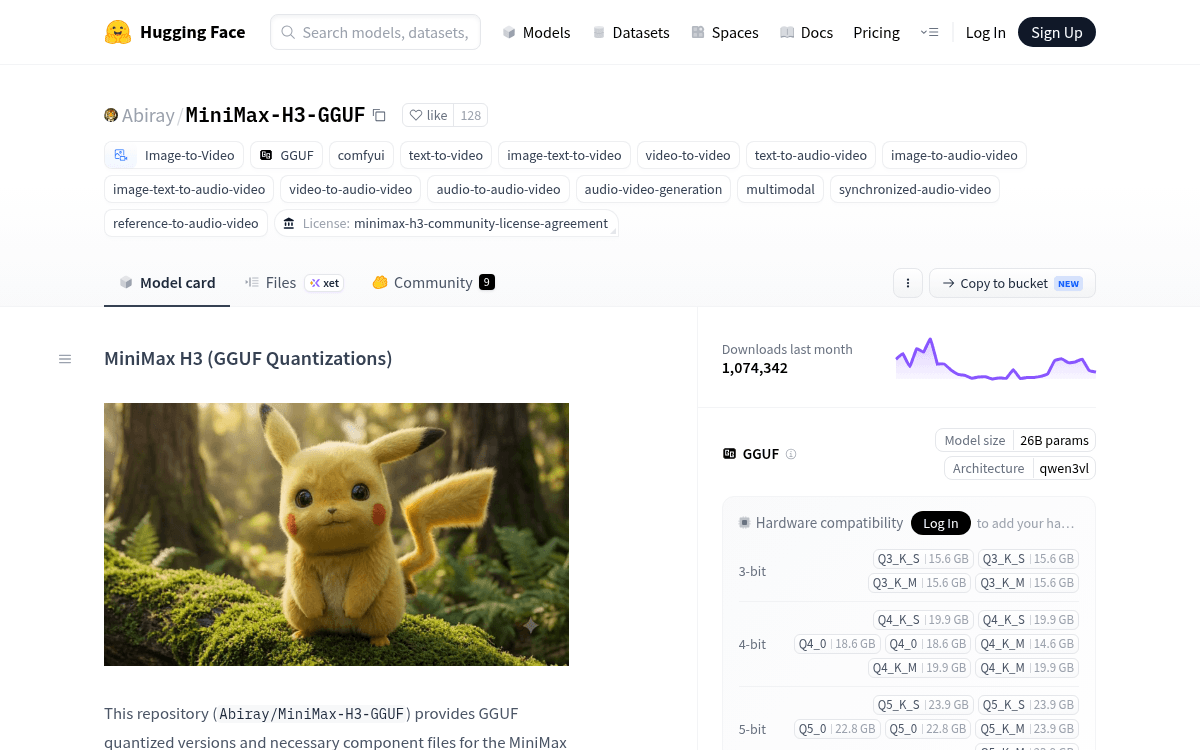
A community contributor packaged MiniMax H3, the open-weights omni-modal video and audio model, into GGUF quants that fit on consumer GPUs.
 Pro
Takeaways
- Hugging Face user Abiray uploaded GGUF quantizations of MiniMax H3, the 33B omni-modal video model.
- Quants cover Q3 through Q8 for both FL2VA and Ref2VA variants, ranging 15.6 GB to 36 GB.
- A pruned companion repo shrinks the UNet to 8.9-21.6 GB for consumer GPUs.
- Bundle includes Qwen3-VL 32B text encoder plus separate video and audio VAEs.
- H3 generates 4-15 second clips at 24 FPS with synchronized 32 kHz stereo audio.
- Released under MiniMax H3 Community License, not a standard permissive license.
A Hugging Face user going by Abiray has released GGUF quantizations of MiniMax H3, the 33B-parameter omni-modal video and audio generator, along with a pruned variant sized for a single consumer GPU. The upload has crossed a million downloads and is what most people running H3 locally through ComfyUI are actually loading.
MiniMax H3 is an open-weights model released earlier this year. It takes text, images, video, and audio as a unified context and generates synchronized video with stereo audio in a single pass, rather than stitching separate models together. At full precision the weights are too large for anything outside a datacenter, which is where Abiray's quantizations come in.
What's in the repository
The Abiray/MiniMax-H3-GGUF repo bundles quantized versions of both H3 base checkpoints plus the supporting encoders and VAEs needed for inference. Two model variants cover different input modes:
- FL2VA — first-and-last-frame mode. Takes zero, one, or two images and fills in the motion between them.
- Ref2VA — omni-reference mode. Accepts up to 9 images, 3 video clips, and 3 audio clips as references, with a 12-file maximum total.
Each variant ships in the standard llama.cpp quant ladder from Q3_K_S at 15.6 GB up to Q8_0 at 36 GB. The repo also includes a Qwen3-VL 32B text encoder in int4, NVFP4 AWQ, and Q4_K_M GGUF flavors, a 5.21 GB fp16 video VAE, and a 605 MB fp32 audio VAE.
The pruned build
Even at 3-bit, the standard H3 quants land around 15 GB for the UNet alone. Add the 14 GB text encoder and both VAEs and you are well past what a 24 GB card can hold. Abiray's companion repo, MiniMax-H3-Pruned-GGUF, prunes the architecture before quantizing. The pruned UNets range from 8.9 GB at Q3_K_M to 21.6 GB at Q8_0, bringing a Q4 configuration into reach for a 16 GB card and Q6 into reach for a 24 GB card.
What H3 actually does
H3 reads text, images, audio, and video together as a single context, so the model can relate a character's identity from a reference image to the camera movement from a reference video clip to the audio tone from a reference recording to the scene description in the prompt. Native stereo audio generates in the same pass as the video, with dialogue, sound effects, and ambient audio produced in context rather than layered on afterward.
Output specs from the model card:
- Duration: 4 to 15 seconds at 24 FPS
- Resolution: 768 pixels on the shorter side by default; 2K available via a separate H3-Regenerate-2K stage
- Audio: 32 kHz stereo
- Aspect ratios: 21:9, 16:9, 4:3, 1:1, 3:4, 9:16
- Dialogue synthesis in 11 languages including Arabic, Chinese, English, French, German, Japanese, Korean, and Spanish
Picking a quant
The memory tradeoff mirrors LLM quantization, but the pressure is heavier because you need headroom for latents, the text encoder, and both VAEs simultaneously. A rough map:
| VRAM | Recommended build |
|---|---|
| 12 GB | Pruned Q3_K_M (8.9 GB UNet) with the Q4_K_M text encoder offloaded |
| 16 GB | Pruned Q4_K_M (11.6 GB) or Q5 with careful offloading |
| 24 GB | Pruned Q6_K or Q8_0, or standard Q3/Q4 with encoder offload |
| 48 GB+ | Standard Q5 through Q8 for closest-to-original fidelity |
Practical applications unlocked at consumer scale
MiniMax framed its open release as a challenge to the closed-source dominance over video generation, which has historically meant slower iteration and a less open ecosystem than LLMs. Open weights alone only go so far, though. Community GGUF releases are what actually get a model into ComfyUI graphs and indie pipelines for users who were never going to rent an eight-card node to try it.
At consumer scale the use cases overlap significantly with what MiniMax markets to studios: brand and product shots, character continuity across cuts using reference images, dialogue replacement from a voice reference, targeted edits like relighting or object swaps, and short cinematic clips with synchronized sound in a single pass rather than a stitched pipeline of separate audio and video tools.
Before you download 36 GB
Three caveats worth checking first. This is a community quantization rather than an official MiniMax release, so numerical fidelity at lower bit widths has not been benchmarked against the reference model in any published evaluation. The pruned build trades some model capacity for size, and how much that affects dialogue synthesis quality, 2K regeneration, or long-duration coherence requires testing on your own footage. The license is MiniMax's own community license rather than a standard permissive one, so read it before shipping anything commercial.