
Zyphra's ZUNA1.1 Reconstructs Messy Brain Signals Across Any EEG Device
Zyphra's ZUNA1.1 handles messy, variable-length EEG from any headset, free and open-source under Apache 2.0
Takeaways
- ZUNA1.1 released: Zyphra's open EEG foundation model now handles variable-length recordings (0.5–30s), up from a fixed 5 seconds.
- Four dropout patterns: Trained on whole-channel, full-time, partial-time, and scattered noise dropout for real-world robustness.
- 3.5M channel-hours of training data: Up from ~2M, thanks to per-channel-per-second quality scoring that recovers partially noisy recordings.
- Channel-agnostic via 4D positional encoding: Works on any electrode layout, from a 4-channel headband to a 256-channel research cap, and can upsample to new positions.
- Free and no-code access: Available via
pip install zuna, Hugging Face weights, and a browser playground on Zyphra Cloud with no GPU required. - Research use only: Apache 2.0 licensed but not validated for clinical or diagnostic applications.
EEG data is notoriously difficult to work with. Electrodes drop out mid-session, recordings vary wildly in length, and a model trained on a clean 64-channel research cap rarely transfers to a 4-electrode consumer headband. Zyphra's ZUNA1.1 is a direct answer to that problem: a 380M-parameter open EEG foundation model that reconstructs, denoises, and upsamples brain signals across arbitrary channel layouts and recording lengths, released under Apache 2.0.
The EEG Data Problem Nobody Talks About
For decades, EEG has been one of the most accessible windows into the working brain. It's portable, noninvasive, and affordable. But anyone who has worked with EEG data knows the reality: it's noisy, it varies wildly across devices and subjects, and a model trained on one channel layout rarely transfers to another.
In AI, foundation models have reshaped text, vision, and speech processing. EEG has not followed that trajectory. Unlike language datasets scraped from the web, EEG data is fragmented. ZUNA is an attempt to apply the same pretraining logic used in language and vision models to EEG. Instead of building task-specific decoders for one experiment at a time, Zyphra is training a general representation model meant to work across datasets and electrode configurations.
Most EEG practitioners rely on spherical spline interpolation to estimate missing channels. The method, included by default in the widely used MNE software package, smooths signals across the scalp using geometric assumptions. It is computationally simple. It is also limited. Spherical splines perform reasonably well when only a few electrodes fail. ZUNA1.1 is designed to go well beyond that baseline.
What ZUNA1.1 Actually Does
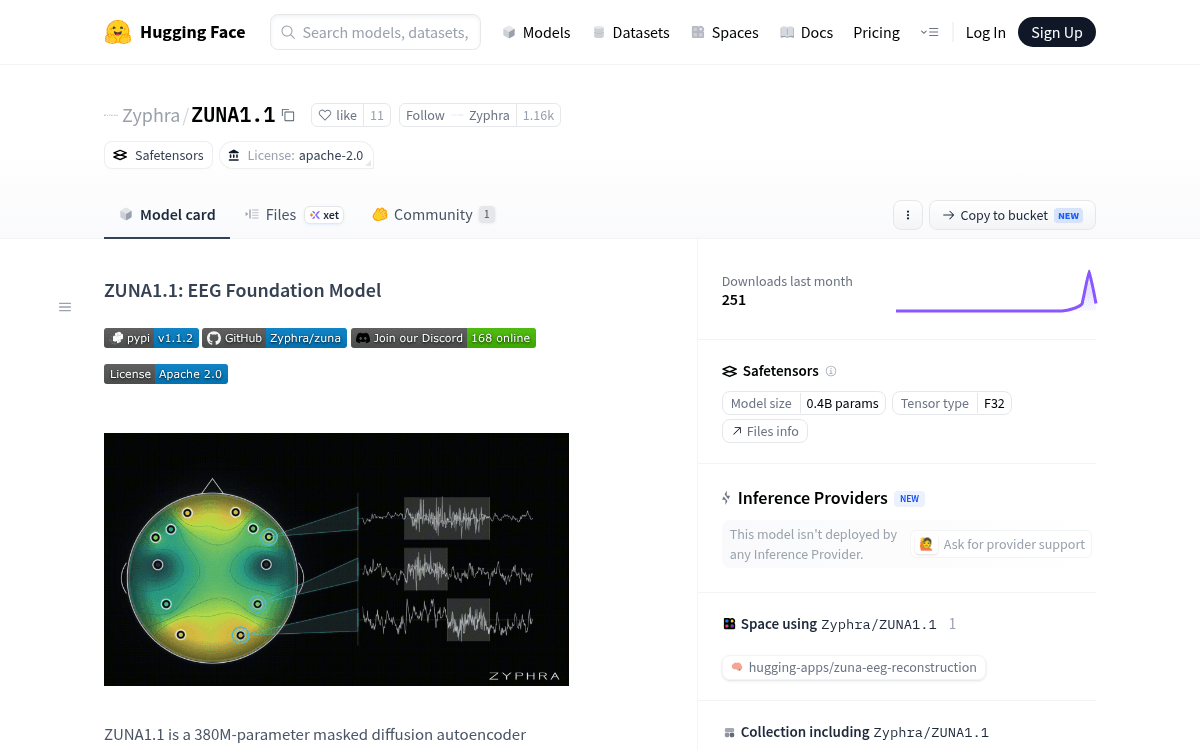
ZUNA1.1 is a 380M-parameter masked diffusion autoencoder for scalp-EEG signals. Given a subset of channels, it denoises existing EEG segments and channels, reconstructs missing ones, and predicts novel channel signals given physical coordinates on the scalp.
The key architectural trick is how the model understands electrode position. The positional encoding is the key idea. Each token carries a 4D rotary positional encoding over (x, y, z, t), the electrode's 3D scalp coordinate along with its coarse-time index. Because position, not array index, tells the model where a channel sits, ZUNA is channel-agnostic. This means it can accept any electrode layout and even generate signals at positions that were never recorded during a session.