
YOLO-World Hits 1.4M Downloads as Developers Wire Open-Vocab Detection Into Production
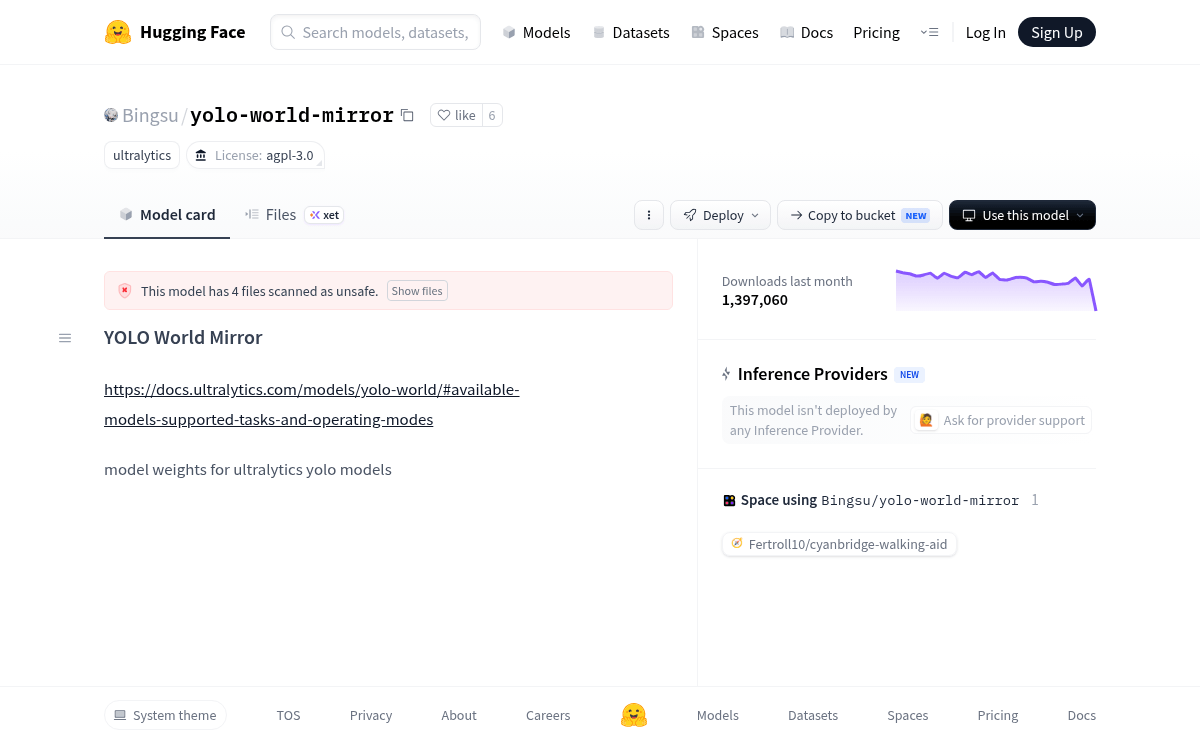
A community-uploaded mirror of YOLO-World weights on Hugging Face has quietly crossed 1.4M downloads, becoming a de facto pull point for the ultralytics-compatible checkpoints.
 Pro
Takeaways
- A community mirror at Bingsu/yolo-world-mirror has crossed 1.4M downloads on Hugging Face.
- The repo redistributes ultralytics-compatible YOLO-World weights under AGPL-3.0, with no code or benchmarks.
- YOLO-World is a YOLOv8-based real-time open-vocabulary detector using CLIP text embeddings for prompted detection.
- Its prompt-then-detect design precomputes a vocabulary so inference stays near vanilla YOLO speed.
- Training and export modes are limited in ultralytics; newer YOLOE adds masks and visual prompts.
- The download volume signals real-time open-vocabulary detection has become a default pipeline component.
A community-run mirror on Hugging Face, Bingsu/yolo-world-mirror, has quietly racked up more than 1.4 million downloads. It contains no new model, no fine-tune, and no research contribution. It redistributes the ultralytics-compatible YOLO-World weights, and developers keep pulling from it at a scale that makes it one of the busier object-detection endpoints on the Hub.
The contents are minimal: model weights under AGPL-3.0, tagged for the ultralytics library, with a one-line pointer to the official YOLO-World docs. No training code, no benchmarks, no card. The download counter is what makes it interesting. 1,406,594 pulls for what amounts to a static file mirror.
Why the mirror exists
YOLO-World is an open-vocabulary object detector built on YOLOv8. Instead of retraining a detector every time you add a class, you hand it text labels and it finds the objects, in real time, at roughly the speed of a vanilla YOLO pass.
The architectural trick: YOLO-World injects CLIP text embeddings into a YOLO neck through re-parameterizable cross-attention. Practically, you precompute your vocabulary once and get near-vanilla YOLO speed at inference. The prompt-then-detect strategy encodes custom prompts (captions or categories) into an offline vocabulary embedding, so the text encoder does not run on every frame.
Distribution is the friction point. The official Ultralytics workflow pulls weights from its own hosting, and many teams working inside locked-down environments, notebooks, or Hugging Face Spaces prefer a single, stable URL on the Hub they can pin. That is the niche this mirror fills.
What ships in the repo
- The full set of ultralytics YOLO-World checkpoints (the
s,m,l,xvariants used with theYOLOWorldclass). - An AGPL-3.0 license, matching upstream ultralytics.
- A pointer to the Ultralytics YOLO-World docs for usage.
- No inference provider integration, no custom code, no README beyond the mirror note.
Usage follows the standard ultralytics flow. Load the weights, set your classes at runtime, and predict:
from ultralytics import YOLOWorld
model = YOLOWorld("yolov8s-world.pt")
model.set_classes(["forklift", "safety vest", "pallet"])
results = model.predict("warehouse.jpg")
No fine-tuning is required with the pretrained YOLOv8s-world checkpoint, and class names can be reset at any time after loading. That is the whole appeal: point it at a new domain, list the classes in English, get boxes.
Strengths, and where it falls short
Speed on open-vocabulary tasks is the headline. YOLO-World runs at a fraction of the compute of SAM-style approaches, which puts it within reach of robotics loops, video pipelines, and edge deployments where transformer-based detectors are too heavy.
Some limits worth flagging before you build on it:
- Inference-first. The YOLO-World models in ultralytics are tuned for inference and validation; training and export modes are not supported in the standard flow, so custom fine-tuning is not a one-liner.
- Newer alternatives exist. YOLOE adds masks and visual prompts with the same API shape: swap
YOLOWorldforYOLOE, load a seg checkpoint, keep yourset_classes()call. - Frozen vocabulary at export. Once you export to ONNX or TensorRT, the class list is baked in. If you need dynamic classes at deploy time, you stay on the PyTorch runtime.
Reading the download count
Mirror repos rarely trend, and this one has just six likes. But 1.4M downloads suggests real-time open-vocabulary detection has moved from novelty to something people are quietly wiring into production: inventory tagging, moderation over image feeds, robotics perception, dataset pre-labeling. When a static weights mirror hits seven-figure pulls, the story is what it implies about the pipelines behind it. A lot of them have settled on open-vocab detection as a default component, and they need somewhere reliable to fetch the weights.