
Yehor Retires Ukraine's Most Downloaded Speech Model for w2v-bert-uk-v2.1
Yehor Smoliakov redirects users of the widely downloaded w2v-xls-r-uk Ukrainian speech model to a new 600M parameter w2v-bert successor.
 Pro
Takeaways
- Yehor/w2v-xls-r-uk model card now redirects users to the new w2v-bert-uk-v2.1 successor.
- New model is a 600M parameter fine-tune of Meta's w2v-bert-2.0 encoder.
- Reports 17.34% WER and 3.33% CER on Common Voice 10 Ukrainian test set.
- Trained on the Yehor/openstt-uk corpus rather than Common Voice for broader domain coverage.
- Legacy XLS-R model has accumulated over 882,000 monthly downloads on Hugging Face.
- Both models released under Apache-2.0 with a hosted demo Space.
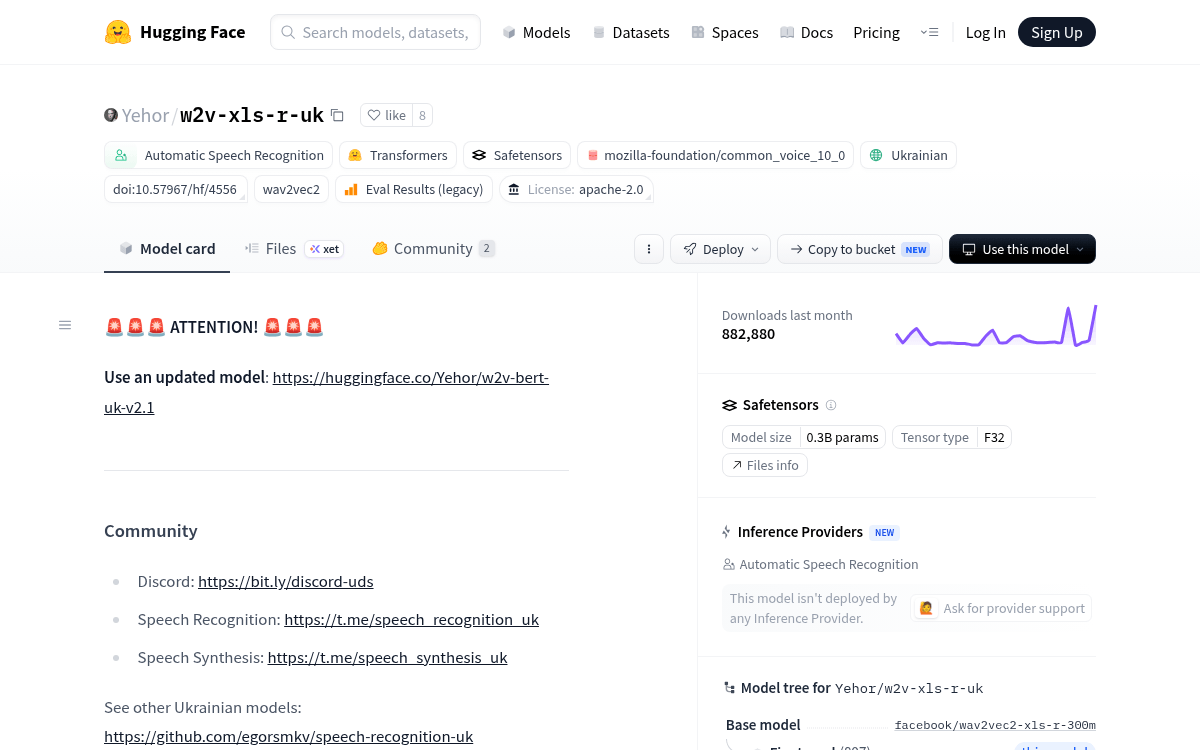
The maintainer of one of the most downloaded Ukrainian speech recognition models on Hugging Face has pushed users toward a successor. The Yehor/w2v-xls-r-uk model card now opens with a prominent notice steering users to Yehor/w2v-bert-uk-v2.1, a larger wav2vec2-BERT checkpoint fine-tuned on a different Ukrainian corpus. If you have Ukrainian audio pipelines built on the older XLS-R model, this is the recommended migration path.
From XLS-R to wav2vec2-BERT
The outgoing model was a fine-tune of facebook/wav2vec2-xls-r-300m, a 300M parameter cross-lingual speech encoder, adapted for Ukrainian using Mozilla Common Voice 10. On the Common Voice 10 test set it scored 20.24% WER and 3.64% CER, with word-level accuracy of 79.76% and character-level accuracy of 96.36%. It has racked up 882,880 downloads in the last month, making it one of the most heavily used community models for the language.
The successor swaps the backbone entirely. w2v-bert-uk v2.1 is fine-tuned from facebook/w2v-bert-2.0, a roughly 600M parameter encoder from Meta that combines wav2vec2 style contrastive learning with a BERT style masked prediction objective on top. Reported metrics land at 17.34% WER and 3.33% CER, with word accuracy of 82.66% and character accuracy of 96.67%. That is a modest error rate reduction over the XLS-R baseline while doubling the parameter count.
How to swap it in
The new checkpoint is a standard CTC model and drops into the Transformers pipeline with no glue code. The published example uses Wav2Vec2BertProcessor plus AutoModelForCTC, reading audio through soundfile at 16 kHz and running argmax decoding on the logits:
from transformers import AutoModelForCTC, Wav2Vec2BertProcessor
import torch, soundfile as sf
model = AutoModelForCTC.from_pretrained(
    "Yehor/w2v-bert-uk-v2.1", torch_dtype=torch.float16
).to("cuda:0")
processor = Wav2Vec2BertProcessor.from_pretrained("Yehor/w2v-bert-uk-v2.1")
audio, _ = sf.read("sample1.wav")
feats = torch.tensor(processor([audio], sampling_rate=16_000).input_features).half().cuda()
ids = model(feats).logits.argmax(dim=-1)
print(processor.batch_decode(ids))
Both checkpoints are Apache-2.0 licensed, so commercial use is unrestricted. A hosted Space is available for spot-checking recordings before wiring up the model locally.
Where v2.1 lands in the Ukrainian ASR field
Ukrainian ASR is a surprisingly crowded ecosystem, and it helps to see where this release fits. The community-maintained speech-recognition-uk benchmark, which uses a cleaned Common Voice 10 test split, compares more than a dozen open models. A few reference points from that leaderboard:
| Model | Params | WER | CER |
|---|---|---|---|
| nvidia/stt_uk_citrinet_1024 | ~140M | 4.32% | 0.94% |
| Yehor/w2v-bert-uk (v1) | 600M | 6.6% | 1.34% |
| Whisper large-v2 | 1.5B | 13.72% | 3.18% |
| Yehor/w2v-bert-uk-v2.1 | 600M | 17.34% | 3.33% |
| Yehor/w2v-xls-r-uk | 300M | 20.24% | 3.64% |
The interesting wrinkle is that the earlier Yehor/w2v-bert-uk reports 6.6% WER and 1.34% CER on the same test set, dramatically better than v2.1 on this specific benchmark. The gap comes from training data: v2.1 is trained on the Yehor/openstt-uk dataset rather than Common Voice, which likely hurts in-domain Common Voice scores but is intended to broaden coverage across more realistic speech.
What this means in practice
A few things are worth flagging for anyone running Ukrainian ASR in production:
- The XLS-R checkpoint is now officially considered legacy by its author, so bug fixes and improvements will land on the wav2vec2-BERT line.
- v2.1 uses a different training distribution, so it may generalize better to podcasts, broadcasts, and spontaneous speech even though it trails on Common Voice.
- For pure Common Voice style benchmark chasing, NVIDIA Citrinet 1024 and the original w2v-bert-uk remain stronger open options.
- Whisper large variants are still competitive, at 2 to 3 times the parameter count.
The pragmatic path is to A/B test v2.1 against the earlier w2v-bert-uk on your own audio before committing. Both share the same 600M parameter footprint and the same processor class, so swapping between them is a one-line change in from_pretrained.