
XLabs-AI's flux-RealismLora Rewires a 12B Model With a 22MB File
XLabs-AI shipped a 22MB photorealism adapter for FLUX.1-dev that swaps generic outputs for film-grade lighting and natural skin tones.
 Pro
Takeaways
- XLabs-AI released flux-RealismLora, a 22.4 MB photorealism adapter for FLUX.1-dev.
- Loads with two lines via diffusers
load_lora_weightson top of the base Flux pipeline. - Biases outputs toward film lighting, realistic textures, and natural color grading over default Flux.
- Hosted on Replicate at roughly $0.05 per run on A100 80GB, ~36s.
- Ships under FLUX.1-dev Non-Commercial License, so no shipping into paid products.
- Training scripts and ComfyUI workflows open-sourced in the x-flux repo.
XLabs-AI has published flux-RealismLora, a lightweight adapter that steers Black Forest Labs' FLUX.1-dev toward photographic output. The checkpoint is a single 22.4 MB lora.safetensors file that plugs into the standard diffusers loading pipeline, and it has quickly become one of the most-used community additions on top of Flux.
A tiny file that rewires a 12B model
flux-RealismLora is a LoRA fine-tune for FLUX.1-dev that biases the base model toward photorealism. It applies learned low-rank transformations to specific attention and MLP layers, changing behavior without retraining the underlying weights. The base is no toy: FLUX.1-dev is a 12-billion-parameter rectified flow transformer capable of generating high-quality images from text prompts.
Low-Rank Adaptation is a training trick where, instead of updating all 12B weights, you learn small rank-decomposed matrices that get added on top of chosen layers. That is why the entire behavior change ships as a ~22 MB file rather than a multi-gigabyte checkpoint.
What actually changes in the output
Out of the box, FLUX.1-dev produces good images with a somewhat plasticky, inconsistent photographic feel. With the LoRA loaded, outputs shift toward film-quality lighting, believable material properties, and natural color grading. Skin texture stops looking airbrushed, highlights roll off more like a real lens, and colors sit closer to graded photography.
The adapter generalizes across portraits, landscapes, and more fantastical scenes, adding depth, texture, and visual fidelity relative to the vanilla base. It handles a broad range of prompts and styles as long as you want the result to look photographic.
Dropping it into your pipeline
If you already run Flux through diffusers, the integration is two lines. Install the usual stack, then load the LoRA on top of the base pipeline:
import torch
from diffusers import DiffusionPipeline
pipe = DiffusionPipeline.from_pretrained(
    "black-forest-labs/FLUX.1-dev",
    dtype=torch.bfloat16,
    device_map="cuda",
)
pipe.load_lora_weights("XLabs-AI/flux-RealismLora")
prompt = "Astronaut in a jungle, cold color palette, muted colors, detailed, 8k"
image = pipe(prompt).images[0]
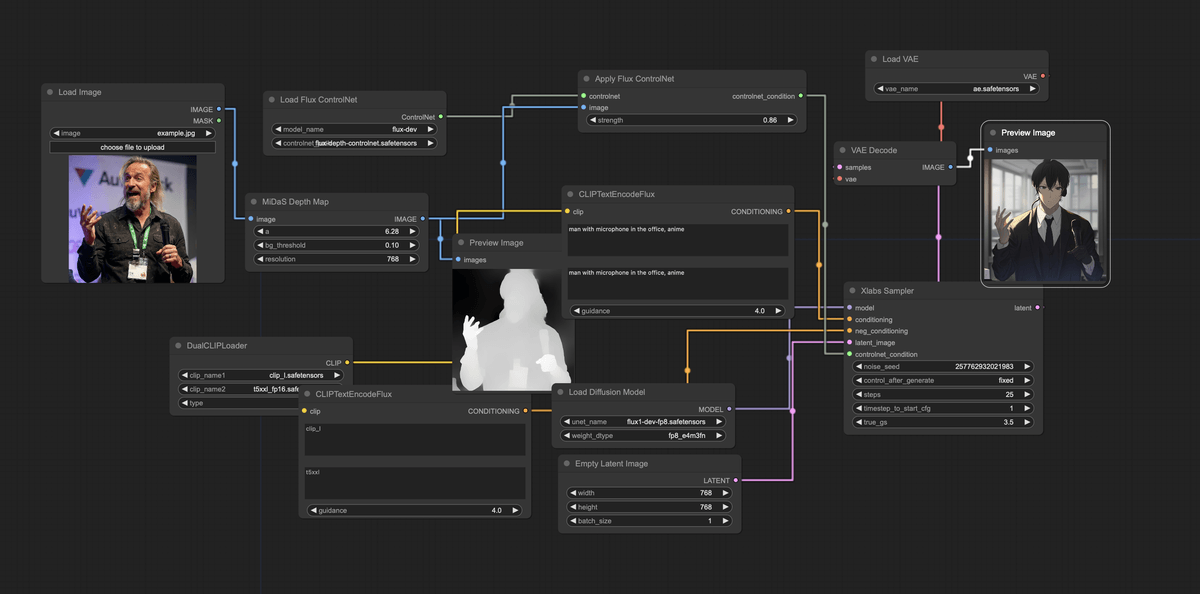
For node-based workflows, XLabs ships x-flux-comfyui with ready-made ComfyUI graphs. A hosted version runs on Replicate at xlabs-ai/flux-dev-realism for roughly $0.050 per run (about 20 runs per dollar) on an Nvidia A100 80GB, with predictions typically completing within 36 seconds.
The licensing catch
Licensing is the important footnote. The adapter inherits the FLUX.1 [dev] Non-Commercial License, restricting use to non-commercial applications. Research, prototypes, and personal projects are fine. Shipping generated assets into a paid product is not.
There is also a stylistic tradeoff. The photorealism bias can conflict with illustration prompting, pulling outputs toward realism even when you explicitly request stylization. For a wider stylistic range, the broader flux-lora-collection offers more flexibility.
Where it fits
Good matches for this adapter:
- Portraits and character work where skin, hair, and eyes need to feel real
- Product renders and mock photography for non-commercial exploration
- Concept and pre-visualization work where a photographic reference beats a painterly one
- Cinematic scene generation, since the LoRA leans into film-style lighting
Poor matches: anime, flat illustration, logos, and anything where you want a strong non-photo style prompt to win out over the realism bias.
How it was built and trained
XLabs open-sourced the training path along with the weights. The x-flux repo covers both LoRA and ControlNet fine-tuning for Flux, which is useful if you want to train a domain-specific adapter instead of relying on a general realism bias.
The dataset layout is intentionally minimal:
├── images/
│   ├── 1.png
│   ├── 1.json
│   ├── 2.png
│   ├── 2.json
│   ├── ...
Each .json file contains a single caption field with the text prompt. One caption per image, no bucketing metadata, no multi-caption schemes, no scoring fields. If you can prepare a folder of paired PNG and JSON files, you can run the training loop.
Reception
The adapter has been widely adopted across the Flux ecosystem, powering more than 100 public HuggingFace Spaces (including DamarJati/FLUX.1-RealismLora and multimodalart/flux-lora-the-explorer) and crossing 1.1M runs on Replicate's hosted endpoint. It is one of the first serious signals that Flux's LoRA ecosystem behaves like SDXL's did: small community adapters can meaningfully shift the aesthetic of a frontier open-weights model without anyone touching the base checkpoint.