
Xiaomi Open-Sources MiMo-V2.5-Pro, a 1T-Parameter Coding Agent at $1 Input
Xiaomi's new open-source MoE runs 1.02T parameters with a 1M token context, targeting long-horizon coding agents at a fraction of Opus pricing.
Takeaways
- Xiaomi open-sourced MiMo-V2.5-Pro under MIT, 1.02T total / 42B active params, 1M context.
- Hybrid attention (6:1 SWA-to-Global) cuts KV cache by 7x while holding long-context quality.
- Native 3-layer Multi-Token Prediction triples decoding throughput without bolted-on speculative decoding.
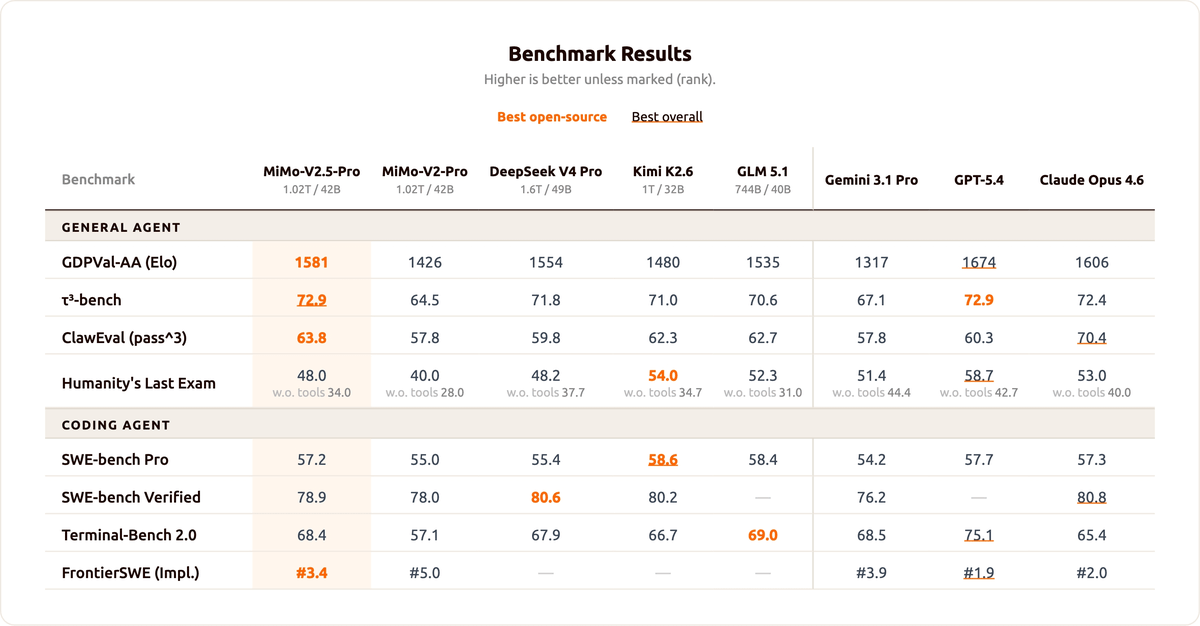
- Scores 78.9 on SWE-Bench Verified and ranks first among open models on GDPVal-AA and ClawEval.
- Priced at $1 input / $3 output per million tokens, roughly 5-10x cheaper than Opus and GPT-5.5.
- Day-zero SGLang and vLLM support with FP8 weights and MTP-based EAGLE speculative decoding.
Xiaomi's AI lab just open-sourced MiMo-V2.5-Pro, a trillion-parameter Mixture-of-Experts model built specifically for long-horizon coding agents. It ships under the MIT license, so you can deploy it commercially, fine-tune it, and continue training without additional authorization.
MiMo-V2.5-Pro carries 1.02T parameters with 42B active per token, uses a hybrid-attention architecture, and supports a 1M-token context window. Weights ship in FP8 (E4M3) mixed precision, alongside a 256K base variant for anyone who wants to continue pre-training.
Sparse routing on a serious budget
Only 42B of the 1.02T parameters activate per token. Routing picks 8 out of 384 experts each step, keeping inference cost closer to a mid-sized dense model while giving the network room to specialize across coding, math, tool use, and multilingual tasks. DeepSeek and Kimi have been pushing the same design pattern, and Xiaomi is now competitive on that curve.
The interesting engineering sits in the attention stack. Local Sliding Window Attention (SWA) and Global Attention (GA) interleave at a 6:1 ratio with a 128-token window, cutting KV-cache storage by nearly 7x at long context while preserving performance through a learnable attention-sink bias. Sliding window attention means most layers only look at the last 128 tokens, which is cheap. Every seventh layer looks at everything. The attention sink bias is a small learned parameter that lets the model dump attention onto a stable anchor token, preventing the softmax from destabilizing at extreme context lengths.

A lightweight MTP module with dense FFNs is natively integrated for training and inference, roughly tripling output throughput and accelerating RL rollouts. Multi-Token Prediction has the model predict several future tokens at once during training, then reuses those extra heads as a native speculative decoder at inference. Rather than bolting speculative decoding on after the fact, this variant is trained end to end.