
Xiaohongshu's FireRed-OCR Beats Gemini and Qwen3-VL-235B at Document Parsing
A 2B parameter document parser from Xiaohongshu beats DeepSeek-OCR 2, Gemini 3.0 Pro, and 235B general VLMs on OmniDocBench.
 Pro
Takeaways
- Xiaohongshu released FireRed-OCR-2B, an Apache-2.0 document parser fine-tuned from Qwen3-VL-2B.
- Scores 92.94% on OmniDocBench v1.5, beating DeepSeek-OCR 2, Gemini 3.0 Pro, and Qwen3-VL-235B.
- Uses Format-Constrained GRPO with rewards for formula syntax, table integrity, and hierarchical closure.
- Three-stage training: multi-task pre-alignment, specialized SFT on Markdown, then RL self-correction.
- Live demo on Hugging Face Spaces; code on GitHub.
- Weaker than Gemini 3.0 Pro on in-the-wild FireRedBench layouts (74.62 vs 79.68 overall).
Xiaohongshu's Super Intelligence Team has released FireRed-OCR, a 2B parameter document parsing model that outperforms much larger systems on structural OCR benchmarks. The release is a specialized fine-tune of Qwen3-VL-2B-Instruct, shipped under Apache 2.0 with weights, code, and a live demo available today.
The headline number is 92.94% overall on OmniDocBench v1.5, ahead of DeepSeek-OCR 2, OCRVerse, and much larger general VLMs including Gemini-3.0 Pro and Qwen3-VL-235B. A 2B model is beating a 235B mixture-of-experts and a frontier closed model on end-to-end document parsing.

The structural hallucination problem
General vision-language models are decent at reading text off a page, but they fall apart on complex documents in a specific way. They frequently produce what the FireRed team calls "structural hallucination": disordered rows, invented formulas, swapped table columns, LaTeX with unmatched braces, and scrambled reading order across multi-column layouts.
FireRed-OCR frames document parsing as structural engineering rather than caption generation. The output is a full Markdown rendering of the page with tables in HTML, formulas in LaTeX, and preserved hierarchy. The model is explicitly trained to keep those structures syntactically valid.
The three-stage recipe
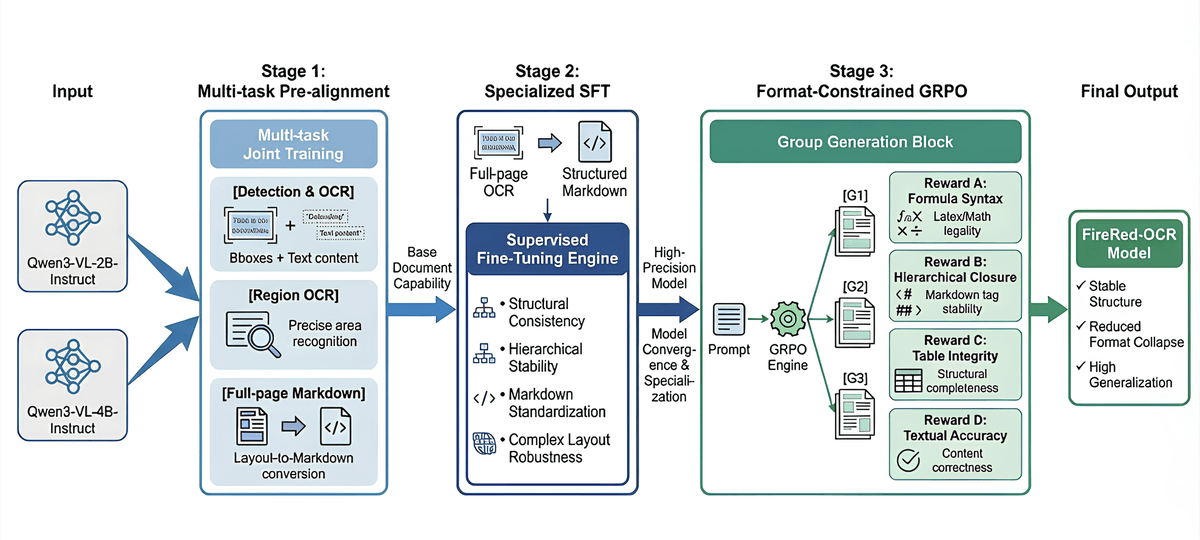
The team uses a progressive training pipeline that layers spatial grounding, format standardization, and self-correction:
- Multi-task pre-alignment: Trains on detection, region recognition, and layout-to-markdown tasks to ground visual perception.
- Specialized SFT: Fine-tunes on a high-quality, standardized Markdown dataset for logical consistency and hierarchical expression.
- Format-constrained GRPO: Applies reinforcement learning with specific rewards for formula syntax, table integrity, hierarchical closure, and text accuracy.
GRPO (Group Relative Policy Optimization) is the same RL algorithm behind DeepSeek-R1. Rather than rewarding reasoning correctness, FireRed-OCR rewards structural correctness: does the LaTeX compile, do table tags close properly, is the heading nesting valid. That RL loop is what eliminates the unclosed-tag failure mode that plagues VLM-based OCR.
Training data comes from what the team calls a "Geometry + Semantics" data factory, a data engine that uses geometric feature clustering and multi-dimensional tagging to synthesize balanced corpora across long-tail layouts. Most OCR training sets skew heavily toward standard document types, leaving models weak on invoices, forms, and scientific layouts.
Where it wins and where it loses
On OmniDocBench v1.5, FireRed-OCR-2B posts the best end-to-end scores across every subcategory: 0.032 TextEdit distance, 91.71 Formula CDM, 90.31 Table TEDS, and 0.041 R-order edit distance. It also beats specialized pipeline systems like MinerU 2.5 and PaddleOCR-VL, though the newer PaddleOCR-VL-1.5 and GLM-OCR still edge it out at the top of the pipeline category.
The picture flips on FireRedBench, the team's own in-the-wild benchmark of messy, non-standard layouts. There, FireRed-OCR-2B scores 74.62 overall, trailing Gemini 3.0 Pro at 79.68 but decisively beating DeepSeek-OCR 2 (61.61) and dots.ocr (72.93). Formula recognition holds up at 83.02 CDM, though table extraction on truly wild layouts drops to 65.63 TEDS, exposing the limits of a 2B model on unfamiliar structures.
On PubTabNet, a pure table benchmark, FireRed-OCR scores 77.0 against Gemini 3.0 Pro at 91.4. For table-only extraction from clean documents, larger models still win.
Getting it running
Because the model reuses the Qwen3-VL architecture, inference works with stock transformers. Install qwen-vl-utils, clone the GitHub repo for the conversation template helper, and load it like any Qwen3-VL checkpoint:
from transformers import Qwen3VLForConditionalGeneration, AutoProcessor
from conv_for_infer import generate_conv
model = Qwen3VLForConditionalGeneration.from_pretrained(
    "FireRedTeam/FireRed-OCR",
    torch_dtype=torch.bfloat16,
    device_map="auto",
)
processor = AutoProcessor.from_pretrained("FireRedTeam/FireRed-OCR")
messages = generate_conv("./examples/complex_table.png")
inputs = processor.apply_chat_template(messages, tokenize=True,
    add_generation_prompt=True, return_dict=True, return_tensors="pt").to(model.device)
out = model.generate(**inputs, max_new_tokens=8192)
At BF16, the 2B weights fit comfortably on a single consumer GPU, and flash-attention-2 is supported for longer documents. A Hugging Face demo is available for testing on your own PDFs before local deployment, and five community quantizations already exist for tighter memory budgets.
A third path for document pipelines
Document OCR has quietly become one of the most crowded corners of open-source AI, with Mistral OCR, DeepSeek-OCR, olmOCR, MinerU, dots.ocr, and PaddleOCR-VL all shipping in recent months. Most follow one of two paths: throw a giant VLM at the problem, or build a heavy multi-stage pipeline with dedicated layout, table, and formula models.
FireRed-OCR takes a third route, using a small VLM while treating structural fidelity as an RL reward signal rather than a post-processing cleanup step. For teams building RAG over scanned documents, financial statement extraction, or academic paper ingestion, a 2B model that produces valid Markdown out of the box is materially cheaper to run than a 72B general VLM and less brittle than a hand-tuned pipeline. The technical report has the full ablations for how much each training stage contributes.