
xAI Quietly Drops Grok 2 Open Weights Across 500 GB on Hugging Face
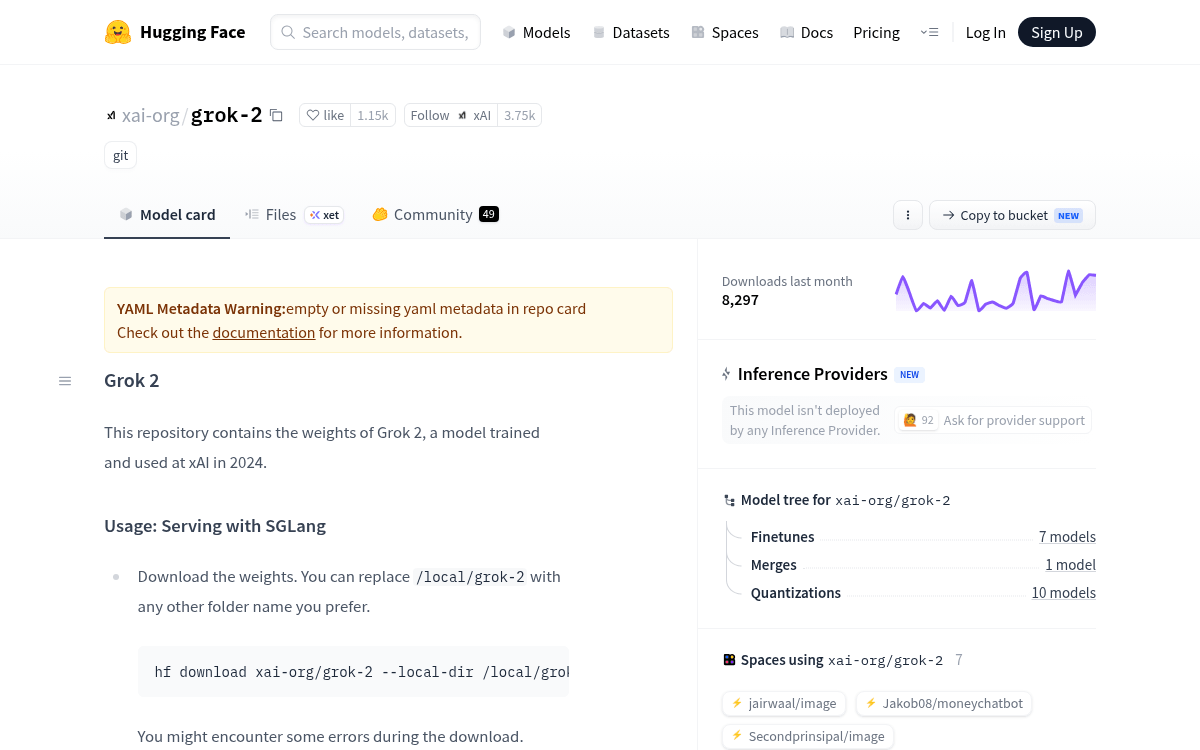
xAI released the full 500 GB weights of Grok 2 on Hugging Face under a custom community license, requiring eight 40 GB GPUs to serve.
 Pro
Takeaways
- xAI released full Grok 2 weights on Hugging Face, roughly 500 GB across 42 files.
- Serving requires 8 GPUs with 40+ GB each, using SGLang with FP8 and Triton.
- Distributed under the Grok 2 Community License, which restricts commercial use and prohibits training competing models.
- Community license criticized as containing anti-competitive terms compared to Llama.
- Musk says Grok 3 will follow as open source in roughly six months.
- Model is capable but two generations behind current Grok 4, limiting frontier use cases.
xAI has quietly pushed something substantial to Hugging Face: the full weights of Grok 2, the model that served as the company's flagship throughout 2024. The repository hosts a 500 GB checkpoint spread across 42 files, along with serving instructions targeted squarely at people who own serious hardware.
The drop is xAI's first major open source release, following through on Elon Musk's earlier pledge to release older Grok generations as newer ones ship. Musk framed it on X by noting that Grok 2.5 was xAI's best model last year, and that Grok 3 will be opened up in about six months.
What you actually get
The model card is spartan. It says the repository contains the weights of Grok 2, a model trained and used at xAI in 2024. No architecture diagram, no benchmarks, no training recipe. What it does provide is a working path to inference through SGLang.
The listed requirements are non-trivial:
- Roughly 500 GB across 42 files, requiring eight GPUs with more than 40 GB of memory each using tensor parallelism
- SGLang v0.5.1 or newer as the inference engine
- FP8 quantization and the Triton attention backend enabled by default
- A specific chat template with a
<|separator|>token between the human turn and assistant turn
The launch command from the model card looks like this:
python3 -m sglang.launch_server \
  --model /local/grok-2 \
  --tokenizer-path /local/grok-2/tokenizer.tok.json \
  --tp 8 \
  --quantization fp8 \
  --attention-backend triton
For most people, that rules out a laptop or even a single-node H100 workload. The target is an 8xH100 or 8xA100 80GB class box, which is why the release lands as open weights but already sits behind the current frontier.
The license fine print
The weights ship under a custom Grok 2 Community License Agreement rather than something permissive like Apache 2.0. It allows research and non-commercial use with conditions on commercial deployment, and explicitly prohibits using Grok 2 to develop or train other large AI models.
That last clause is the sharp edge. AI engineer Tim Kellogg flagged the license as containing anti-competitive terms, suggesting xAI wants to maintain control over how its technology gets deployed, and the terms have not generated the same enthusiasm as Meta's Llama releases, which offered more permissive usage rights. If you were hoping to distill Grok 2 into a smaller student model or use it to generate synthetic training data for your own base model, the license says no.
Where it shines and where it sags
Grok 2 is a mixture-of-experts model, part of the same design lineage adopted by models like DeepSeek-v3, which makes extremely large models more tractable and compute-efficient to serve. At its original release it was competitive with GPT-4 class models, and it handles general reasoning, coding, and chat reasonably well.
The honest community assessment is more measured. The release matters for principle and accessibility, but Grok 2's performance is outdated relative to Grok 4, which is driving significantly more capable applications today. Consider this a checkmark for transparency and developer access rather than a shot at the state of the art. You are getting a 2024-era flagship, not a 2026 contender.
When it is worth pulling down 500 GB
A few situations where this release actually matters:
- On-premise deployments where API calls are a non-starter for privacy, sovereignty, or compliance reasons.
- Research on MoE routing, expert specialization, or interpretability at frontier scale. Studying a real production-scale MoE is very different from studying a 7B toy.
- Fine-tuning for narrow domains where you want a capable base without paying per-token fees indefinitely, and where non-commercial or bounded-commercial terms are acceptable.
- Benchmarking and red-teaming the specific model behind a chatbot that has been in production and has generated its share of controversy.
For most application builders, the calculus has not changed. Llama, Qwen, DeepSeek, and quantized community ports of models like this one will remain easier to run and cheaper to serve. As a data point on the direction of the field, though, xAI delivering on its open source promises keeps pressure on closed-model labs to justify their moats, and sets up an interesting six-month clock until Grok 3 supposedly follows.