
wav2vec2-large-xlsr-korean Hits 1.78% Error Rate With 1M Monthly Downloads
A community fine-tuned Korean speech-to-text model hits 4.74% word error rate on Zeroth-Korean, quietly clearing nearly a million downloads.
 Pro
Takeaways
- Korean wav2vec2 fine-tune from user kresnik hits 4.74% WER and 1.78% CER on Zeroth-Korean
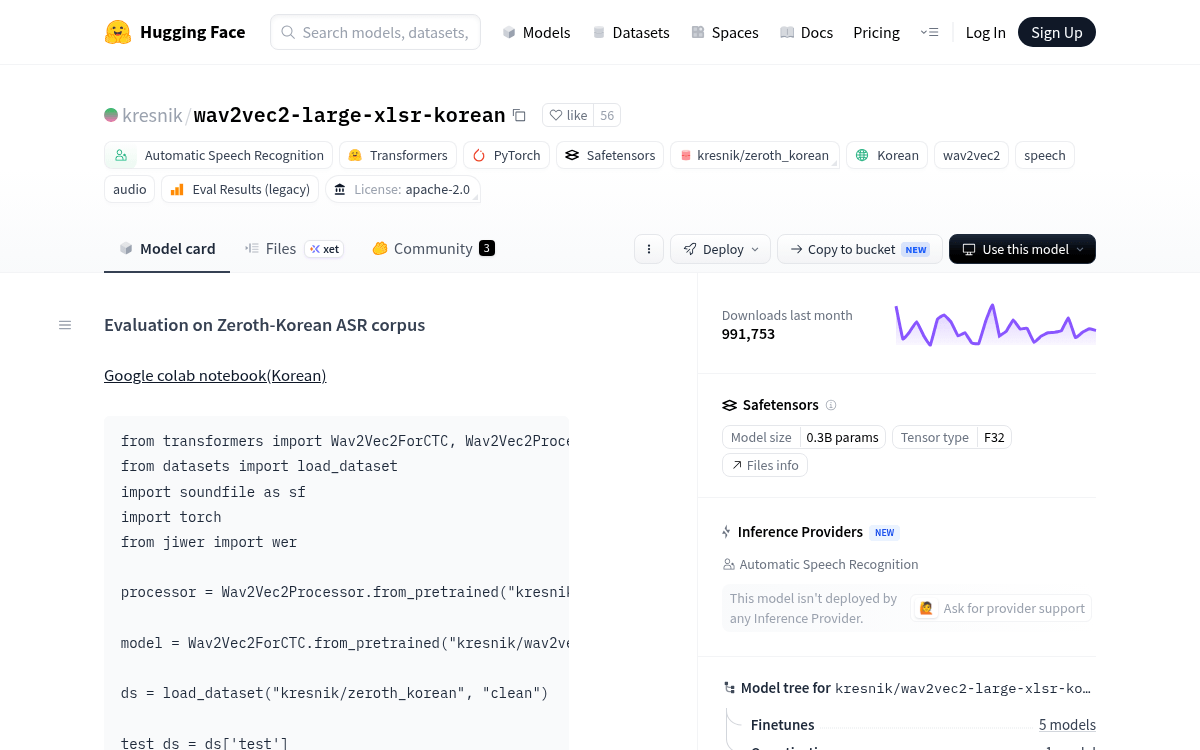
- Nearly 1 million downloads on Hugging Face, Apache-2.0 licensed, 0.3B parameters
- Built on Facebook's XLSR cross-lingual wav2vec2 backbone with CTC head
- Trained on Zeroth-Korean: 51.6 hours, 22k utterances, 105 speakers, CC BY 4.0
- Loads via standard Transformers pipeline, requires 16kHz mono audio input
- Serves as base for 5 community fine-tunes and 12 Hugging Face Spaces
Korean automatic speech recognition has long trailed English in open model availability and out-of-the-box quality. A wav2vec2 checkpoint from user kresnik has quietly become the default answer, racking up close to a million monthly downloads on Hugging Face while posting numbers that hold up against much newer systems.
The model is kresnik/wav2vec2-large-xlsr-korean, a fine-tune of Facebook AI's XLSR wav2vec2 base adapted to Korean. It ships under Apache-2.0, weighs in at 0.3B parameters in F32, and loads directly through the standard Transformers pipeline.
The numbers that matter
On the Zeroth-Korean ASR test set, the author reports an expected Word Error Rate of 4.74% and a Character Error Rate of 1.78%. For a language with rich agglutinative morphology and a syllabic writing system, sub-2% CER is the figure that signals production viability. Roughly 98 of every 100 Hangul characters come out correct.
Those benchmarks come from the Zeroth-Korean corpus, a modest but clean read-speech dataset containing about 51.6 hours of training audio and 1.2 hours of test audio, with 22,263 utterances from 105 training speakers and 457 utterances from 10 test speakers. That is small by modern ASR standards, which is exactly why the pretrained XLSR backbone matters so much here.
Why XLSR still punches above its weight
The base model is Facebook's cross-lingual wav2vec2 (XLSR), a self-supervised speech encoder trained on raw audio from dozens of languages by learning to predict masked portions of the waveform. Fine-tuning it on a few dozen hours of transcribed Korean gets you competitive accuracy because the acoustic representations were already learned from unlabeled multilingual audio.
The interesting result is less about architecture and more about scale: a hobbyist-sized fine-tune on a 50-hour open corpus can match commercial Korean ASR quality. That is why the checkpoint shows up as the backbone in five community fine-tunes and one quantized derivative, plus a dozen Spaces including streaming ASR demos.
Using it
Loading takes two lines through the Transformers pipeline:
from transformers import pipeline
pipe = pipeline("automatic-speech-recognition",
                model="kresnik/wav2vec2-large-xlsr-korean")
result = pipe("sample_ko.wav")
print(result["text"])
For evaluation or batched inference, load the processor and CTC head directly. The model card includes a full Zeroth evaluation script that pulls the dataset, resamples to 16kHz, runs greedy CTC decoding via argmax over logits, and scores with jiwer.
A few practical notes:
- Audio must be 16kHz mono. Anything else needs resampling before hitting the processor.
- The decoder is plain CTC greedy. Adding a KenLM n-gram language model on top typically shaves another point or two off WER for real-world speech.
- Safetensors weights are available, so you can skip pickle entirely.
- No inference provider hosts it, so you run it yourself on GPU or CPU.
Where it shines, where it does not
Zeroth is read speech recorded in clean conditions by adult speakers of standard Korean. That is what this model handles well: clean studio-style Korean audio, dictation, audiobook-style content, and interview segments without heavy background noise.
Expect degraded results on:
- Noisy phone-quality audio or call center recordings
- Heavy regional dialects (Jeju, Gyeongsang, Jeolla)
- Code-switching between Korean and English, common in tech and business speech
- Children's speech or elderly speakers underrepresented in Zeroth
- Domain-specific jargon (medical, legal, gaming) not covered in the read corpus
For those cases the sensible move is to take this checkpoint as a starting point and fine-tune further on your own labeled data, which is exactly what several of the community derivatives have done.
Why it still trends
Whisper-large gets most of the Korean ASR headlines, but it is 1.5B parameters, closed-training-data, and slower per second of audio. This checkpoint is about a fifth the size, streams cleanly through CTC without an autoregressive decoder, and is trivial to fine-tune on a single GPU. The Zeroth-Korean dataset is CC BY 4.0, and the model itself is Apache-2.0, so the entire stack is usable in commercial products without licensing calls.
Small, fast, permissive, and genuinely accurate on the target language: that combination keeps the download counter ticking up years after the initial upload. If you are shipping any Korean voice feature and cannot ship an OpenAI API call, this is still the checkpoint to start from.