
wav2vec2-large-xlsr-53-hungarian Beats Every Open Rival by 10 WER Points
A Hungarian speech recognition model built on XLSR-53 hits 31.4% WER on Common Voice, quietly powering 2M+ downloads.
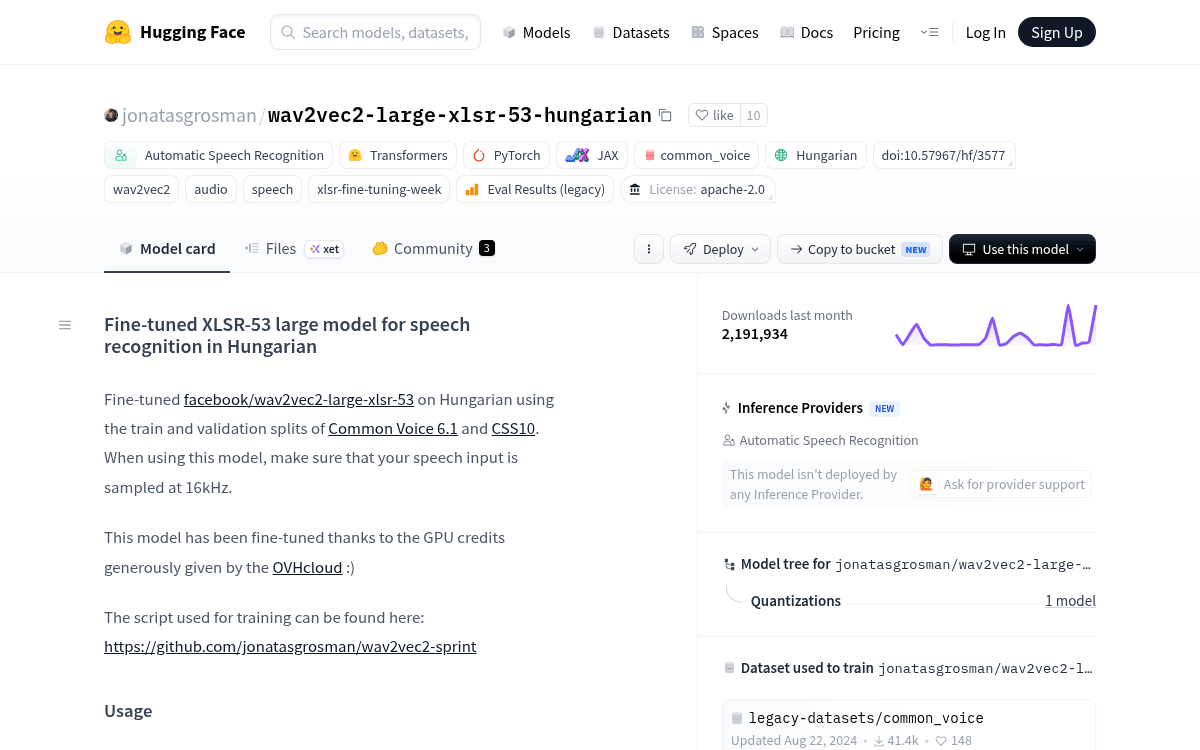 Pro
Takeaways
- Fine-tuned XLSR-53 Hungarian ASR hits 31.4% WER, 6.2% CER on Common Voice test
- Beats other open Hungarian XLSR checkpoints by 10+ WER points in head-to-head eval
- Trained on Common Voice 6.1 plus CSS10, Apache 2.0 licensed for commercial use
- Backbone is Meta's XLSR-53, pretrained on 56k hours across 53 languages
- Callable in three lines via HuggingSound or standard transformers pipelines
- Requires 16 kHz mono audio; over 2M cumulative downloads on the Hub
Hungarian tends to trip up mainstream speech recognition systems, thanks to its agglutinative grammar, vowel harmony, and a phoneme set that sits far outside the Indo-European norm. A fine-tuned wav2vec2 checkpoint from Jonatas Grosman has become the de facto open baseline for the task, and the model page on Hugging Face shows why it keeps pulling millions of downloads years after release.
The checkpoint is a Hungarian specialization of Meta's cross-lingual speech backbone. It fine-tunes facebook/wav2vec2-large-xlsr-53 on Hungarian using the train and validation splits of Common Voice 6.1 and CSS10, with GPU credits provided by OVHcloud and training scripts released in the wav2vec2-sprint repo. Everything ships under Apache 2.0, and you can pull it directly from the Hugging Face page.
Why XLSR-53 carries a language like Hungarian
The backbone is the reason any of this works. XLSR learns cross-lingual speech representations by pretraining a single model on raw waveforms from multiple languages, building on wav2vec 2.0 with a contrastive task over masked latent speech representations and a quantization codebook shared across languages. Cross-lingual pretraining significantly outperforms monolingual pretraining after fine-tuning, and XLSR-53 leverages 56,000 hours of unlabeled audio from 53 languages to reduce the data requirements for low-resource tasks. That is precisely the situation Hungarian faces on Common Voice.
Architecturally, XLSR-53 is a multilingual version of wav2vec 2.0, composed of a 6-layer CNN feature extractor and a 24-layer transformer encoder. Fine-tuning adds a CTC head on top of Hungarian character targets.
The numbers
On the Hungarian test split of Common Voice, the author benchmarked several public checkpoints under the same evaluation script. The results are lopsided:
| Model | WER | CER |
|---|---|---|
| jonatasgrosman/wav2vec2-large-xlsr-53-hungarian | 31.40% | 6.20% |
| anton-l/wav2vec2-large-xlsr-53-hungarian | 42.39% | 9.39% |
| gchhablani/wav2vec2-large-xlsr-hu | 46.42% | 10.04% |
| birgermoell/wav2vec2-large-xlsr-hungarian | 46.93% | 10.31% |
A 6.2% character error rate means the model gets roughly 94 of every 100 characters right, though word-level accuracy trails behind because Hungarian's long suffix chains mean a single missed character breaks a whole token. Looking at the sample transcriptions, most errors are morphological endings and compound word boundaries rather than wholesale hallucinations.
Two ways to run it
Two integration paths are supported. The simpler one uses the author's own wrapper library. For speech recognition you can call any CTC model hosted on the Hugging Face Hub through HuggingSound:
from huggingsound import SpeechRecognitionModel
model = SpeechRecognitionModel("jonatasgrosman/wav2vec2-large-xlsr-53-hungarian")
transcriptions = model.transcribe(["clip1.wav", "clip2.mp3"])
Alternatively, you can go straight through the HuggingSound repo and transformers with a pipeline call, loading the processor and Wav2Vec2ForCTC directly. One hard requirement: the input must be 16 kHz mono audio, otherwise the feature extractor produces garbage.
Where it fits and where it does not
This model is a strong fit when you need:
- Self-hosted, offline Hungarian transcription with no per-minute API fees
- Predictable latency for batch pipelines like podcast indexing, meeting transcription, or subtitle generation
- A CTC-based backbone you can further fine-tune on a domain corpus (medical, legal, call center)
- An open license (Apache 2.0) for commercial deployments
It is less suited to:
- Streaming with strict low-latency requirements without additional chunking work
- Noisy far-field audio, since Common Voice and CSS10 are largely clean read speech
- Applications needing punctuation and casing out of the box, since CTC output is uppercase and unpunctuated
- Cutting-edge WER, where newer XLS-R 1B or Whisper-large variants will beat 31.4%
The broader context
The Grosman collection of XLSR-53 fine-tunes covers a long tail of languages that big proprietary APIs still handle unevenly. Downloads on the Hungarian checkpoint alone sit north of two million, and it appears as a dependency inside eight public Spaces, including tokenizer leaderboards and Alexa-style NLU demos. The author's older ASRecognition library, since deprecated in favor of HuggingSound, supported Arabic, German, Greek, English, Spanish, Persian, Finnish, French, Hungarian, Italian, Japanese, Dutch, Polish, Portuguese, Russian, and Chinese. Pairing XLSR-53 with per-language CTC heads has become the standard recipe for open multilingual ASR.
For anyone building a Hungarian voice product without a Whisper-sized budget, this remains the pragmatic starting point: cheap to run, easy to fine-tune, and backed by a public benchmark that beats every other open Hungarian XLSR variant by more than 10 WER points.