
University of Sydney's ViTPose+ Hits 3M Downloads After Joining Hugging Face
ViTPose+ base lands in the Hugging Face Transformers library with a simple ViT backbone, mixture-of-experts decoder, and support for six pose datasets covering humans and animals.
 Pro
Takeaways
- ViTPose+ base is now available as a native Hugging Face Transformers model under Apache 2.0.
- Reports 81.1 AP on MS COCO Keypoint test-dev with a plain ViT backbone and lightweight decoder.
- Uses a mixture-of-experts design so one checkpoint serves six pose datasets including animals.
- Model card documents a two-stage RT-DETR plus ViTPose pipeline for multi-person inference.
- Base size is roughly 100M parameters and ships as safetensors for fast loading.
- Original research: arXiv 2204.12484 and ViTAE-Transformer/ViTPose.
Pose estimation has quietly become one of the most reliable pieces of the computer vision stack, powering everything from fitness apps to motion capture pipelines. The ViTPose+ base checkpoint from the University of Sydney community is now packaged for the Hugging Face Transformers library, making a strong keypoint model usable in a couple of lines of Python. The port has already crossed three million downloads, which says a lot about how starved this niche was for a clean, plug-and-play option.
A plain ViT, with a routing trick
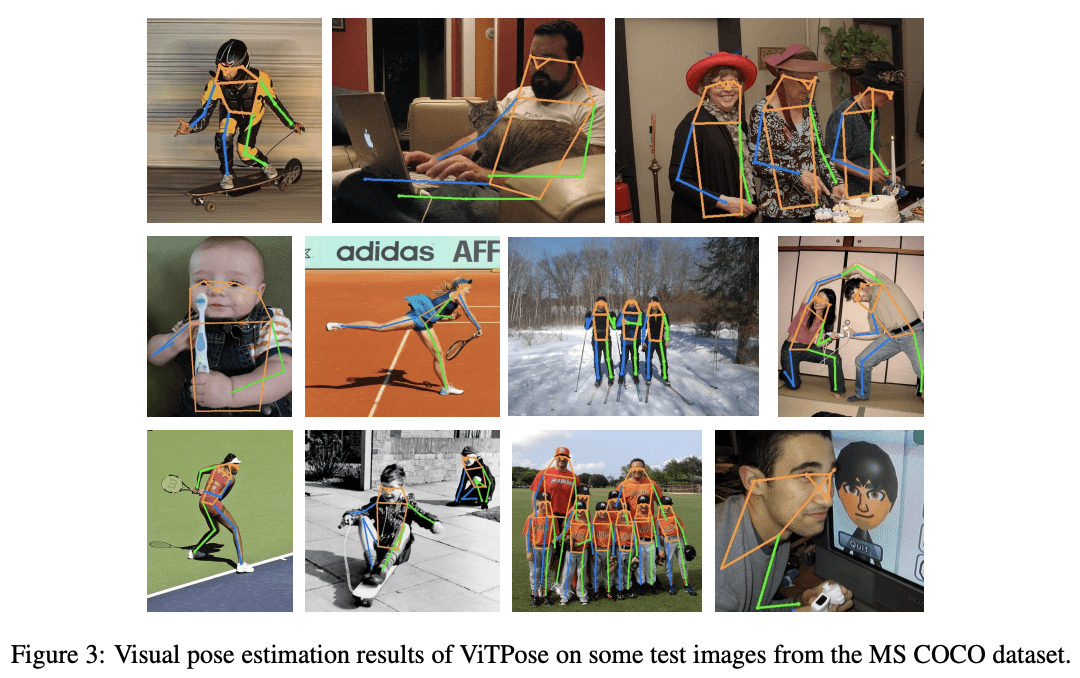
The original ViTPose paper made an unfashionable bet: skip the hierarchical backbones and clever high-resolution modules that dominated pose estimation, and just use a plain vision transformer. The authors showed that non-hierarchical ViTs work surprisingly well as backbones, extracting features for a given person instance and feeding a lightweight decoder that regresses keypoints. The design scales from 100M to 1B parameters, setting a new Pareto front between throughput and accuracy.

ViTPose+ (the plus variant this checkpoint corresponds to) extends that idea with a mixture-of-experts trick in the feed-forward layers, so a single backbone can juggle multiple pose datasets without their labels fighting each other. In the baseline multi-task setup, adding animal datasets like AP-10K and APT-36K actually dropped human pose performance from 77.0 to 76.7 AP because of conflict between the human and animal tasks, and the MoE routing is what fixes that.
What one checkpoint covers
The base model reports 81.1 AP on the MS COCO Keypoint test-dev set, which puts it near the top of open pose estimators. Because ViTPose+ was trained jointly across six datasets, one checkpoint can predict several keypoint schemas depending on which expert you route to:
- MS COCO for human pose estimation with 17 keypoints
- COCO-WholeBody, which adds face, feet and hand keypoints for a total of 133
- MPII human pose estimation with 16 keypoints
- AI Challenger for large-scale human pose data
- AP-10K and APT-36K for animal pose estimation
At the API level, you pick the schema by passing a dataset_index tensor into the processor, which selects which expert head runs during inference.
Two-stage pipeline in practice
ViTPose is a top-down estimator, meaning it expects person crops rather than raw scenes. The typical setup pairs it with an object detector such as RT-DETR to find people first, then runs pose estimation per box:
from transformers import AutoProcessor, VitPoseForPoseEstimation
processor = AutoProcessor.from_pretrained("usyd-community/vitpose-plus-base")
model = VitPoseForPoseEstimation.from_pretrained(
    "usyd-community/vitpose-plus-base", device_map="auto"
)
inputs = processor(image, boxes=[person_boxes], return_tensors="pt").to("cuda")
inputs["dataset_index"] = torch.tensor([0])  # 0 = COCO keypoints
outputs = model(**inputs)
poses = processor.post_process_pose_estimation(outputs, boxes=[person_boxes])
The base variant weighs in at roughly 100M parameters and is released under Apache 2.0, so it is fair game for commercial products. Weights ship as safetensors, and the model card includes Colab and Kaggle launch links.
Where it fits, and where it does not
ViTPose+ is a strong default when you need keypoints on humans, animals, or whole-body landmarks and want one model instead of three. Realistic use cases include fitness form analysis, sports analytics, animation retargeting, crowd behavior monitoring, and animal behavior research where AP-10K style keypoints are useful. It also handles occluded people reasonably well, having been benchmarked against the OCHuman set for heavy occlusion.

The caveats are worth knowing. Because it is top-down, throughput scales linearly with the number of people in a frame, so crowded scenes get expensive. It also depends on the quality of the upstream detector, and the authors themselves note that flexibility around attention type, input resolution and finetuning strategy is a strength but also a knob you may need to tune for specialty domains. Face landmark detection and dense animal species outside the training distribution remain open problems the paper explicitly leaves for future work.
Why the port matters
The research code has lived at the ViTAE-Transformer repo for a while, but it depended on mmpose and a specific training stack. Wrapping the model as VitPoseForPoseEstimation inside Transformers means it now behaves like any other Hugging Face model: same processor pattern, same from_pretrained, same device_map handling, and integration with the broader inference ecosystem. For teams that have been carrying custom pose code around, that is the real unlock.