
TinyLlama-1.1B Beats Bigger Models Running on Just 637MB
A 1.1B parameter chat model built on the Llama 2 architecture that runs on edge devices and continues drawing millions of downloads for lightweight inference workloads.
 Pro
Takeaways
- TinyLlama-1.1B-Chat-v1.0 is a compact Llama 2 architecture chat model with over 2M downloads on Hugging Face.
- Pretrained on ~1T tokens then fine-tuned via SFT on UltraChat and DPO on UltraFeedback, following the Zephyr recipe.
- A 4-bit quantized version is only 637 MB, making it viable for edge and offline deployment.
- Hits 24k tokens/sec per A100-40G with 56% MFU via FlashAttention 2 and fused kernels.
- Architecturally identical to Llama 2, so it plugs into existing LoRA, vLLM, and llama.cpp workflows.
- Anchors 573 finetunes, 1,574 adapters, and 150 quantizations on the Hub. See the paper.
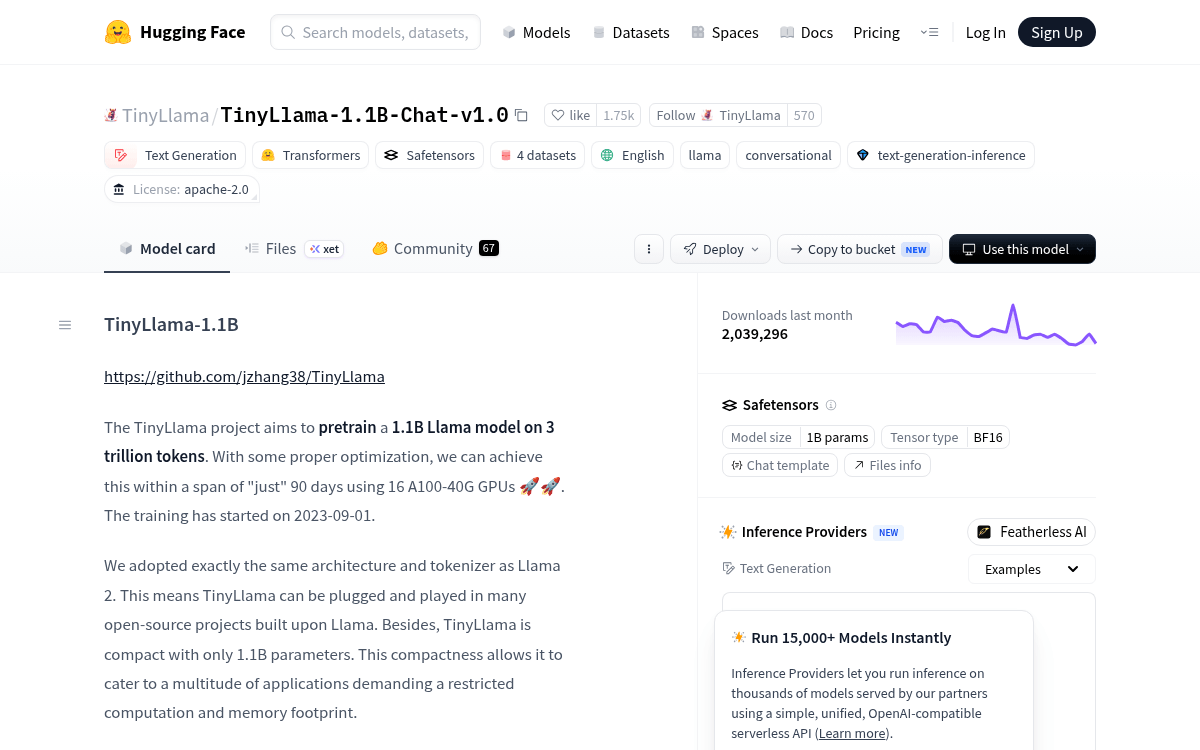
The TinyLlama-1.1B-Chat-v1.0 model on Hugging Face keeps racking up downloads, and it is worth understanding why something this small still earns a slot next to modern 7B and 8B chat models. It is a compact conversational model built on the exact Llama 2 architecture, pretrained from scratch on roughly a trillion tokens, then fine-tuned into a chatbot using the same recipe that produced Zephyr-7B.
How far can you push 1.1B parameters?
The TinyLlama project set out to answer a simple question: how much can a 1.1B Llama absorb when you feed it far more data than scaling laws say it needs? The stated goal is to pretrain a 1.1B Llama on 3 trillion tokens within roughly 90 days on 16 A100-40G GPUs, with training that kicked off on September 1, 2023. That token-to-parameter ratio sits far above Chinchilla-optimal, which is the entire point. Overtraining a tiny model produces a much stronger small model than a compute-optimal one does.
Architecturally there are no surprises. The team adopted the same architecture and tokenizer as Llama 2, so TinyLlama drops into most open-source projects built around Llama. Concretely, that means 22 transformer layers, hidden size 2048, 32 attention heads, a 32k vocab, and a 2048-token context window trained with AdamW on a cosine schedule.
Squeezing throughput out of a single A100
The interesting engineering sits in the throughput work. The codebase integrates Flash Attention 2, fused layernorm, fused cross-entropy loss, fused rotary positional embedding, and a fused SwiGLU module, together shrinking the memory footprint enough to fit the 1.1B model within 40GB of GPU RAM. Those optimizations hit 24k tokens per second per A100-40G, translating to 56% model flops utilization.
The chat variant skips a bespoke alignment stack and follows the Hugging Face Zephyr recipe: supervised fine-tuning on the UltraChat synthetic dialogue dataset, then Direct Preference Optimization on UltraFeedback using TRL's DPOTrainer, where 64k prompts and completions are ranked by GPT-4. That two-stage SFT-then-DPO approach is why the model behaves like a proper assistant rather than a raw base model.
Where it actually shines
Pretraining mixes natural language and code in a 7:3 ratio alongside techniques such as FlashAttention, and the resulting model outperforms similarly sized open-source peers on commonsense reasoning and problem-solving benchmarks. Practical strengths that fall out of the small size:
- Edge deployment on memory-constrained devices, since a 4-bit quantized weight file is only 637 MB.
- Real-time dialogue inside games, where a network round trip is not an option.
- Draft model for speculative decoding, paired with a bigger Llama to accelerate inference.
- A cheap base for domain fine-tunes. The checkpoint currently anchors 573 downstream finetunes, 1,574 adapters, and 150 quantizations on the Hub.
- A reference codebase for anyone wanting to pretrain sub-5B language models without diving into Megatron-LM.
Weaknesses are the obvious ones. The 2048-token context is short by current standards, factual recall is thin compared to 7B models, and complex multi-step reasoning falls apart quickly. This is not the checkpoint to reach for when you need agentic tool use or long-document QA.
Getting it running
The model is Apache 2.0, free to use, and works with any current Transformers install. The minimal path:
from transformers import pipeline
pipe = pipeline("text-generation", model="TinyLlama/TinyLlama-1.1B-Chat-v1.0")
messages = [{"role": "user", "content": "Who are you?"}]
print(pipe(messages, max_new_tokens=128))
For production, it drops straight into vLLM or SGLang behind an OpenAI-compatible server, and there are ready-made quantizations for llama.cpp, Ollama, and LM Studio. A single command like vllm serve "TinyLlama/TinyLlama-1.1B-Chat-v1.0" is enough to spin up an inference endpoint.
Why it still matters
The small-model niche has gotten crowded with Phi, Gemma, Qwen, and SmolLM entries, yet TinyLlama continues to pull millions of downloads. Part of that is inertia, since thousands of downstream projects pin it, and part of it is Llama 2 compatibility, which means every trick built for the Llama family, from LoRA adapters to speculative decoding kernels, works without changes. If your workload is a chatbot on a Raspberry Pi, a fast draft model, or a starting point for a domain-specific fine-tune where 7B inference is out of budget, this remains one of the most practical checkpoints on the Hub.