
timm's Tiny EfficientNet-B3 Hits 10M Downloads Beating Bigger Models
A compact 12M-parameter EfficientNet-B3 backbone from timm keeps racking up downloads thanks to a refined training recipe and tiny compute footprint.
 Pro
Takeaways
- The timm EfficientNet-B3 RA2 checkpoint has passed 10 million downloads on Hugging Face.
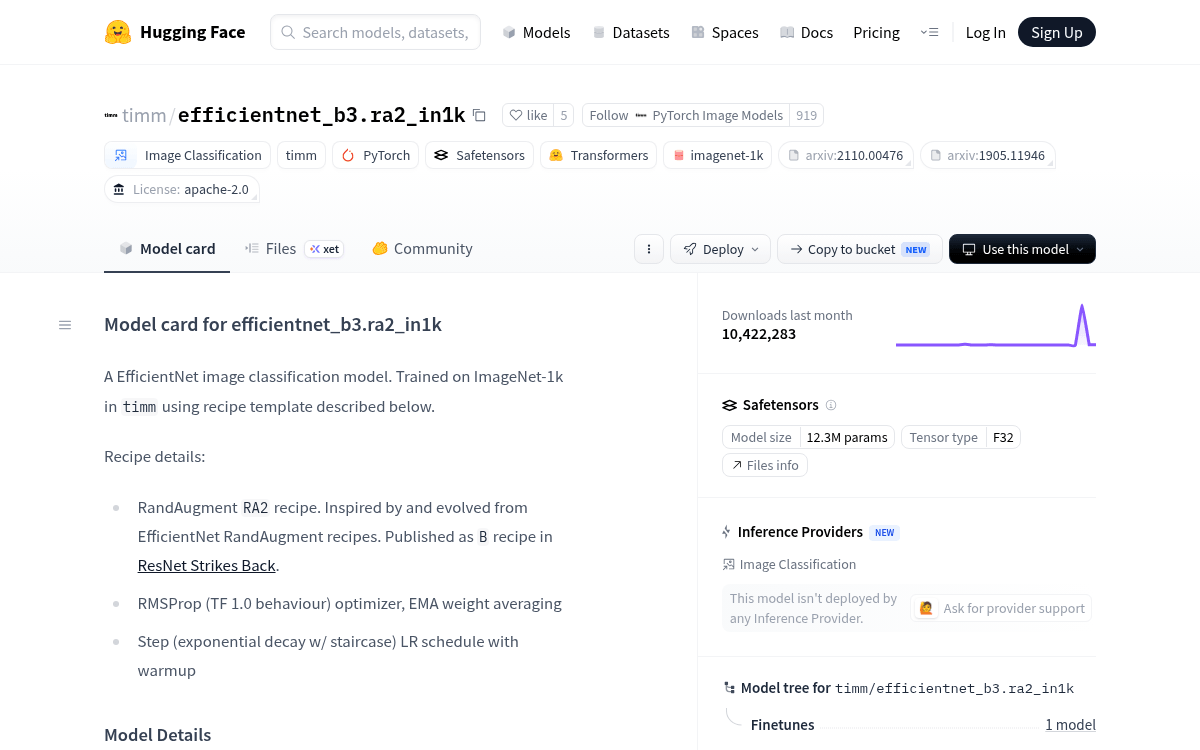
- 12.2M parameters, 1.6 GMACs, trained at 288x288 and tested at 320x320 on ImageNet-1k.
- Uses the RA2 RandAugment recipe from ResNet Strikes Back, plus RMSProp and EMA weight averaging.
- Works as classifier, feature-map extractor, or 1536-dim embedding model via a single timm call.
- Apache-2.0 licensed and supported by both timm and Hugging Face Transformers pipelines.
- Sweet spot for edge deployment and transfer learning where a ViT or CLIP is overkill.
Buried under the noise of billion parameter foundation models, a 12 million parameter image classifier from the timm library is quietly clocking over 10 million downloads. The model, efficientnet_b3.ra2_in1k, is a re-trained EfficientNet-B3 that uses a modernized augmentation recipe to squeeze better ImageNet-1k accuracy out of the same architecture. For a large slice of production computer vision work, a well-tuned convolutional backbone still beats reaching for a transformer.
The recipe under the hood
This is an EfficientNet image classification model trained on ImageNet-1k in timm using a recipe template put together by Ross Wightman. It uses the RandAugment RA2 recipe, evolved from the original EfficientNet RandAugment recipes and published as the B recipe in ResNet Strikes Back.
The mechanics of that recipe are worth unpacking for anyone considering a from-scratch run on their own data:
- RandAugment (RA2): an automated data augmentation policy that randomly samples image transforms (rotation, color jitter, shear, and so on) with a tunable magnitude, so the model sees a much wider distribution of training images.
- RMSProp with TF 1.0 behaviour: matches the quirky epsilon and gradient handling of the original TensorFlow EfficientNet training, which stabilizes training at the low learning rates these models prefer.
- EMA weight averaging: keeps a running exponential moving average of the weights, which tends to smooth out noisy end-of-training accuracy.
- Step LR schedule with warmup: a staircase exponential decay learning rate with warmup, the same schedule shape as the original EfficientNet paper.
Small model, careful engineering
The stats explain a lot of the popularity. B3 carries 12.2M parameters, 1.6 GMACs, and 21.5M activations, trains at 288x288, and is tested at 320x320. That compute budget fits comfortably on a single consumer GPU for fine-tuning, and inference is cheap enough to run on CPU or edge hardware when needed.
For comparison, its bigger sibling efficientnet_b4.ra2_in1k uses 19.3M parameters, 3.1 GMACs, 34.8M activations, and trains at 320x320 with 384x384 test resolution. B3 sits in the sweet spot where you get most of the accuracy without paying for the extra compute.
Three lines to load it
The timm API stays intentionally minimal. Loading the pretrained weights is a one-liner, and the same model object exposes classification, feature maps, and pooled embeddings:
import timm
model = timm.create_model('efficientnet_b3.ra2_in1k', pretrained=True)
model = model.eval()
data_config = timm.data.resolve_model_data_config(model)
transforms = timm.data.create_transform(**data_config, is_training=False)
For intermediate feature maps to feed a detection or segmentation head, pass features_only=True and you get a list of tensors at successive strides, roughly shaped [1, 24, 144, 144], [1, 32, 72, 72], [1, 48, 36, 36], [1, 136, 18, 18], and [1, 384, 9, 9]. For embeddings, set num_classes=0 and the forward pass returns a 1536-dimensional vector per image, ready to feed into a similarity search index or a downstream linear probe.
The weights are also wired into Hugging Face Transformers, so pipeline("image-classification", model="timm/efficientnet_b3.ra2_in1k") works out of the box if you prefer that stack. Licensing is Apache-2.0, so commercial use is fine.
Where it fits, where it stumbles
EfficientNet-B3 with the RA2 recipe is a good pick when:
- You need a general purpose vision backbone for transfer learning to a custom classification dataset.
- You want a feature extractor for detection, segmentation, or retrieval where a ViT would be too heavy.
- You care about latency and memory on modest hardware, including mobile and edge.
- You want deterministic behavior with no dependency on prompt tuning or text encoders.
Its weaknesses are the flip side of being a small ImageNet-1k classifier. There is no language grounding, so zero-shot classification against arbitrary text labels is off the table. Training data is limited to ImageNet-1k, which is far smaller and narrower than the LAION-scale corpora behind CLIP or DINOv2, so accuracy drops on out-of-distribution domains like medical imaging or satellite imagery without fine-tuning. The fixed 288 to 320 pixel training resolution also means very high resolution inputs need tiling or a different backbone.
Old architecture, modern training
The EfficientNet family was introduced in the 2019 paper on rethinking model scaling for convolutional neural networks. What the RA2 checkpoint demonstrates is how much accuracy modern training recipes leave on the table for older architectures. The ResNet Strikes Back paper made this point for ResNet-50, and the same recipe applied here bumps EfficientNet-B3 into a range that is competitive with far more complex models on ImageNet-1k, without touching the architecture itself.
For anyone building an image pipeline, the practical takeaway is that the choice of backbone often matters less than the training recipe you fine-tune it with. A well-tuned efficientnet_b3.ra2_in1k, fine-tuned with RandAugment, EMA, and a step schedule, will match or beat a much larger off-the-shelf model on many narrow tasks, at a fraction of the inference cost. Ten million downloads suggests plenty of teams have already figured that out.