
TII's Falcon-40B Beats GPT-3 Using 75% Less Training Compute
TII's 40B parameter open-source model ships under Apache 2.0, trained on a trillion tokens of curated web data with inference-optimized architecture.
 Pro
Takeaways
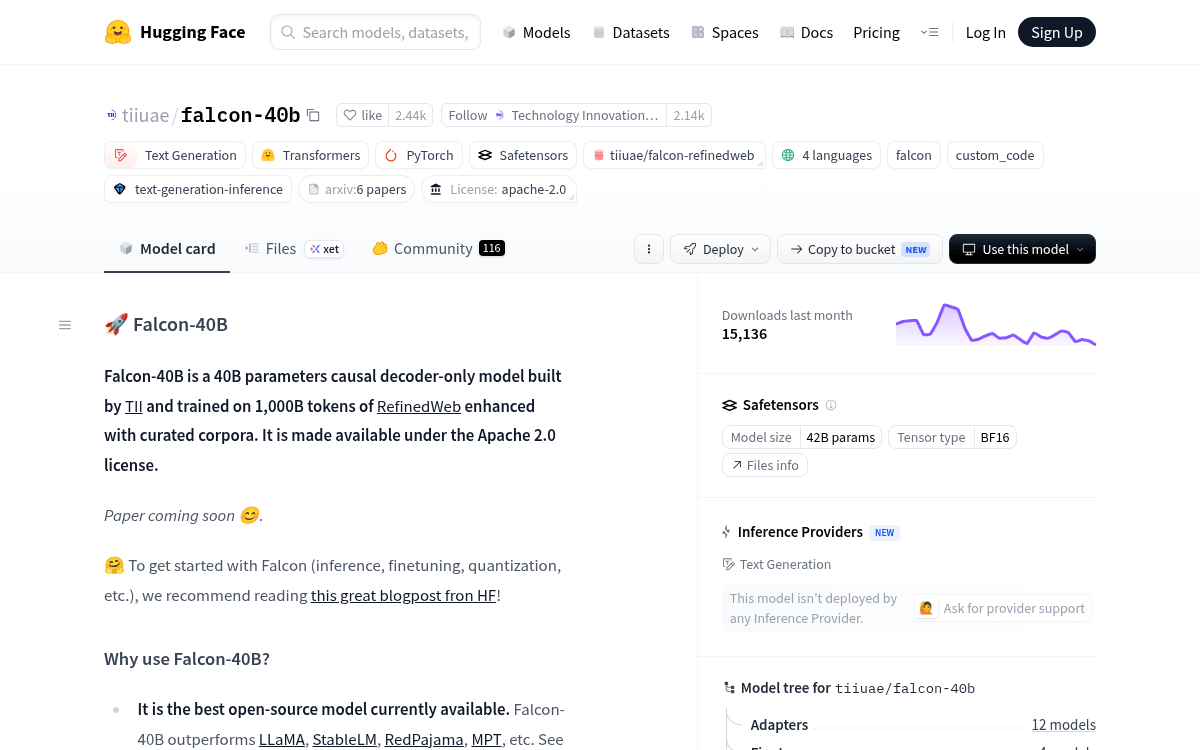
- Falcon-40B is a 40B parameter open-source LLM from TII trained on 1 trillion tokens of RefinedWeb
- Released under Apache 2.0 with no royalties or commercial restrictions
- Uses FlashAttention and multiquery attention for cheaper inference at serve time
- Trained on 384 A100 40GB GPUs using 3D parallelism plus ZeRO over two months
- Reportedly used 75% of GPT-3's compute and 40% of Chinchilla's compute for training
- Requires 85-100GB memory to run; base model needs finetuning for chat use cases
The Technology Innovation Institute in Abu Dhabi put Falcon-40B squarely on the radar of anyone building on open-weights LLMs. The 40 billion parameter causal decoder-only model arrived as one of the first serious, commercially usable alternatives to the LLaMA family, and it still sits near the top of the download charts for large open models.
The headline hook is licensing. TII trained Falcon-40B on 1,000B tokens of RefinedWeb enhanced with curated corpora and released it under Apache 2.0. No royalties, no gated access, no restrictions on commercial deployment. That was rare for a frontier-scale open model at the time of release.
Under the hood
Architecturally, Falcon-40B is a GPT-3 style transformer with a handful of modern tweaks aimed squarely at making inference cheaper. Two matter most: FlashAttention and multiquery attention. Multiquery attention (MQA) shares a single set of key and value projections across all attention heads instead of giving each head its own, which shrinks the KV cache and speeds up autoregressive generation. FlashAttention is an IO-aware exact attention kernel that reduces memory traffic between HBM and on-chip SRAM.
The rest of the design choices are what you would expect from a well-engineered decoder-only stack:
- 60 transformer layers with a hidden size of 8192 and head dimension of 64
- Rotary positional embeddings (RoPE) instead of learned or sinusoidal positions
- A parallel attention/MLP decoder block with two layer norms
- 65,024 token vocabulary and a 2,048 token context window
- bfloat16 precision throughout training
The head dimension of 64 is deliberately small, chosen to line up cleanly with FlashAttention's tiling. Combined with MQA, this is a model designed to serve, not just to win benchmarks.
How it was trained
Training ran on 384 A100 40GB GPUs for two months, using a 3D parallelism strategy (TP=8, PP=4, DP=12) combined with ZeRO. The infrastructure was AWS SageMaker P4d instances driven by a custom distributed training codebase TII calls Gigatron.
The training mix is heavily web-focused but not exclusively so. RefinedWeb English dominates at 75% of tokens (750B), with another 7% (70B) coming from a European multilingual crawl covering German, Spanish, French, and lighter coverage of Italian, Portuguese, Polish, Dutch, Romanian, Czech, and Swedish. The remainder is books (6%), conversational data from Reddit, StackOverflow and HackerNews (5%), code (5%), and technical sources like arXiv, PubMed and USPTO (2%).
The bet TII made with RefinedWeb was that aggressively filtered and deduplicated CommonCrawl can match or beat curated corpora like The Pile on its own. That runs against a lot of received wisdom in the pretraining data literature, and it is arguably the most interesting research contribution attached to the model.
The compute efficiency angle
The efficiency story is what put Falcon on the map. Based on Stanford's HELM benchmarking tool, Falcon-40B outperformed contemporaries while using 75 percent of the training compute of GPT-3, 40 percent of Chinchilla, and 80 percent of PaLM-62B. TII positioned it as the best open-source model available at release, ahead of LLaMA, StableLM, RedPajama, and MPT on the OpenLLM Leaderboard.
Running it
The base weights are on Hugging Face and integrate with the standard tooling. Memory requirements are real: TII notes you need at least 85 to 100GB to run inference comfortably, which typically means two A100 80GBs or aggressive quantization.
from transformers import AutoTokenizer, AutoModelForCausalLM
import torch
tokenizer = AutoTokenizer.from_pretrained("tiiuae/falcon-40b")
model = AutoModelForCausalLM.from_pretrained(
    "tiiuae/falcon-40b",
    torch_dtype=torch.bfloat16,
    trust_remote_code=True,
    device_map="auto",
)
It also works out of the box with vLLM and SGLang for OpenAI-compatible serving, and is available through Amazon SageMaker JumpStart, which offers pre-trained models so customers can access Falcon-40B without building their own from scratch.
Strengths and limits
Falcon-40B is a raw pretrained base model, not an instruction-tuned assistant. That is the single most important thing to understand before you download it. If you want chat behavior out of the box, the Falcon-40B-Instruct variant is the right starting point. The base weights work best as a foundation for further finetuning on your own domain.
Realistic sweet spots:
- Domain-specific finetuning for summarization, classification, or extraction tasks
- Multilingual generation across the four primary supported languages
- Retrieval-augmented pipelines where you supply the knowledge and just need a competent generator
- Research on scaling, data curation, or architectural changes with a permissively licensed baseline
Weak spots are equally clear. The 2,048 token context is short by current standards, so long-document workflows will need chunking or a different model entirely. Coverage outside its trained languages is thin, and because training used a large web corpus, the outputs will reflect the biases and stereotypes found there. TII explicitly recommends adding guardrails before any production use.
Why it still matters
Falcon-40B was one of the models that established that a non-US, non-Big-Tech lab could train and openly release a genuinely competitive frontier LLM under a permissive license. The weights climbed to the top of the Hugging Face Leaderboard for Large Language Models within the week of launch. Even now, the model remains a useful reference point for anyone comparing the compute-quality tradeoff of pretraining recipes, and its RefinedWeb dataset continues to shape how teams think about web-scale data curation.
