
This Open-Source ViT Estimates Age From Faces Without Paying per API Call
A Vision Transformer fine-tuned on FairFace offers a plug-and-play age classifier under Apache 2.0, with honest accuracy tradeoffs worth knowing.
 Pro
Takeaways
- Vision Transformer fine-tuned on FairFace for 9-class age group classification
- Base model is google/vit-base-patch16-224-in21k, 85.8M parameters, Apache 2.0 licensed
- Reports about 59% accuracy across nine age brackets, with adjacent-decade confusion dominant
- Strongest on ages 0-9 and 20-29, weakest recall on the 70+ bracket
- Available on Hugging Face with drop-in Transformers pipeline support
- Best suited for coarse analytics and moderation, not exact age or identity verification
Age estimation from face images sounds simple until you try to build it. Faces vary wildly in lighting, expression, and demographics, and off-the-shelf commercial APIs charge per call. A community-maintained Hugging Face model, dima806/fairface_age_image_detection, offers a permissively licensed alternative that drops into a Transformers pipeline in three lines of Python. Here is what it does, where it works, and where it fails.
What the checkpoint actually is
The checkpoint is a Vision Transformer fine-tuned on the FairFace dataset for nine-way age group classification. The base is google/vit-base-patch16-224-in21k, a standard 85.8M parameter ViT pretrained on ImageNet-21k, then adapted to predict which of nine age brackets a face falls into. The weights ship as safetensors under an Apache 2.0 license, so you can use them commercially without royalty. The nine classes follow FairFace conventions: 0-2, 3-9, 10-19, 20-29, 30-39, 40-49, 50-59, 60-69, and 70+.
Why the training set shapes everything
FairFace is a publicly available, large-scale face attribute dataset designed to mitigate the systematic racial imbalances present in earlier open face-image corpora, with particular emphasis on balanced representation across race, gender, and age. It comprises 86,744 training images and 10,954 validation images, with ground truth labels covering race, gender, and age binned into the nine classes above. The seven race groups defined are White, Black, Indian, East Asian, Southeast Asian, Middle East, and Latino, and images were pulled from the YFCC-100M Flickr dataset.
Predictions should be more balanced across demographics than models trained on scraped celebrity photos, but they inherit FairFace's coarse age bucketing. If your product needs to know whether someone is 32 or 37, look elsewhere.
Reading the accuracy numbers
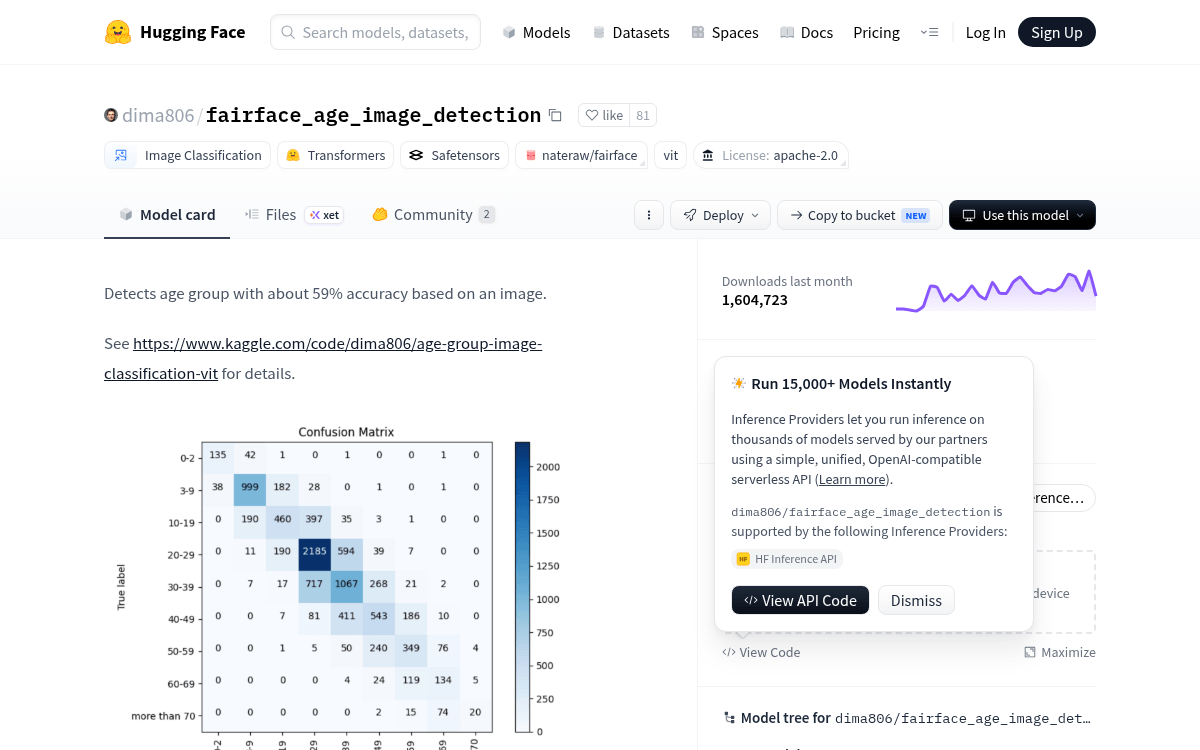
The model card is refreshingly honest: overall accuracy on the FairFace validation set sits around 59% across the nine classes. That looks low until you consider the task. Random guessing across nine classes lands at 11%, adjacent-bucket confusion is expected, and even human raters disagree on decade-level age from a single photo. The confusion matrix below tells the more useful story.

Per-class F1 scores from the published report break down like this:
| Age group | Precision | Recall | F1 |
|---|---|---|---|
| 0-2 | 0.78 | 0.75 | 0.76 |
| 3-9 | 0.80 | 0.80 | 0.80 |
| 10-19 | 0.54 | 0.42 | 0.47 |
| 20-29 | 0.64 | 0.72 | 0.68 |
| 30-39 | 0.49 | 0.51 | 0.50 |
| 40-49 | 0.48 | 0.44 | 0.46 |
| 50-59 | 0.50 | 0.48 | 0.49 |
| 60-69 | 0.45 | 0.47 | 0.46 |
| 70+ | 0.69 | 0.18 | 0.29 |
Young children (0-9) and twenty-somethings get handled well. The 70+ bracket has decent precision but terrible recall, meaning the model rarely flags anyone as elderly, but when it does, it is usually right. Middle-age brackets from 30 to 60 hover near 50% F1, and mistakes almost always fall to an adjacent decade. That tracks with the broader literature: misclassifications are concentrated near class boundaries rather than across distant age ranges.
Wiring it into code
The simplest integration is the Transformers pipeline API. Point it at a face image and get back sorted class probabilities:
from transformers import pipeline
pipe = pipeline(
    "image-classification",
    model="dima806/fairface_age_image_detection"
)
result = pipe("face.jpg")
print(result)
# [{'label': '20-29', 'score': 0.71}, {'label': '30-39', 'score': 0.18}, ...]
For batch inference or ONNX export, load the processor and model directly with AutoImageProcessor and AutoModelForImageClassification. At 85.8M parameters in FP32, the weights are roughly 340MB and comfortably fit on a single consumer GPU, or run on CPU for low-throughput jobs.
Good fits and bad bets
Good use cases include:
- Coarse audience analytics where decade-level buckets are enough
- Content moderation heuristics that flag likely minors before human review
- Dataset curation, filtering, or synthetic data auditing where you need a fast tag on millions of faces
- Research baselines for fairness studies on face attribute models
Where it falls short:
- Exact age regression, ID verification, or anything where a wrong decade has real consequences
- Non-frontal, heavily occluded, or low-resolution faces, which FairFace does not heavily represent
- Domains far from Flickr photos, such as medical imaging or CCTV frames
The FairFace dataset card and the training notebook are worth reading before deploying. If your app needs finer-grained ages, consider treating this model's logits as a prior and stacking a regression head trained on your own labeled data, or look at multi-input transformer approaches like MiVOLO that combine face and body cues for stronger performance on the same benchmark.