
This 560M Model Beats 7B Rivals Across 100 Languages on a Single GPU
A 560M-parameter open embedding model from intfloat keeps topping multilingual benchmarks, beating 7B rivals while covering nearly 100 languages under MIT license.
 Pro
Takeaways
- The intfloat multilingual-e5-large-instruct model has crossed 2.2M monthly downloads on Hugging Face.
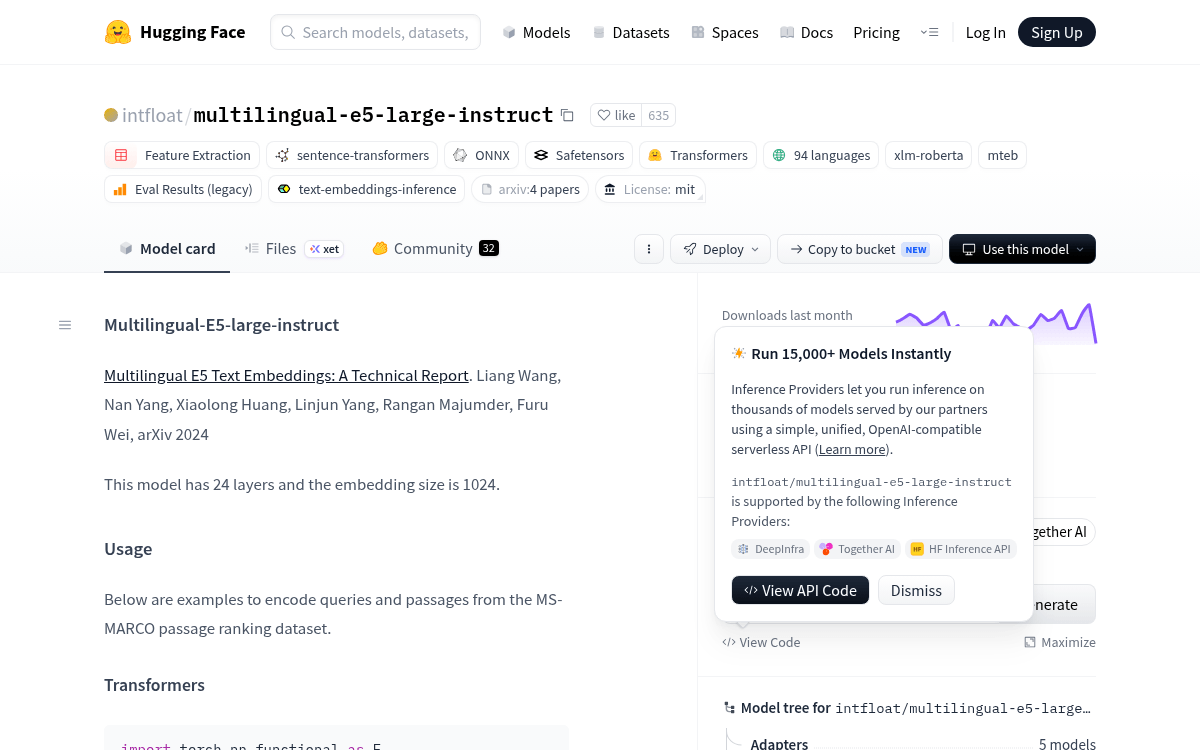
- 560M-parameter XLM-RoBERTa encoder, 1024-dim embeddings, 512-token context, MIT licensed.
- Ranked #1 publicly available model on MMTEB, beating GritLM-7B and e5-mistral-7b-instruct.
- Covers 94+ languages with strong performance on mid-to-low resource languages.
- Uses instruction-prefixed queries; documents receive no prefix, unlike older E5 models.
- Trained via contrastive pretraining on 1B pairs plus instruction fine-tuning on ~500K synthetic pairs.
The multilingual-e5-large-instruct model, published on Hugging Face under the intfloat account, has quietly become one of the most downloaded text embedding models on the platform, with more than 2.2 million downloads in the last month. It sits at a rare intersection: small enough to self-host on a single GPU, permissively licensed, and still ranked as the top publicly available multilingual embedding model on the community benchmarks that matter.
The model in one paragraph
The checkpoint is a 560M-parameter encoder described in the Multilingual E5 report by Wang, Yang, Huang, Yang, Majumder and Wei. Built on the XLM-RoBERTa architecture, it uses 24 layers and produces 1024-dimensional embeddings, with coverage across more than 94 languages. It is initialized from xlm-roberta-large and continually trained on a mixture of multilingual datasets inheriting the 100-language coverage from xlm-roberta, though low-resource languages may see degraded quality. Inputs are silently truncated at 512 tokens, which is the main architectural ceiling to keep in mind.
Why it keeps winning benchmarks
On the MMTEB benchmark, which spans 500+ tasks across 250+ languages, the result is striking. Large language models with billions of parameters can top certain language subsets, yet the best-performing publicly available model overall is multilingual-e5-large-instruct at only 560 million parameters. Both multilingual-e5-large and its instruct variant, based on XLM-R Large, generally outperform the considerably larger e5-mistral-7b-instruct and GritLM-7B, which are built on Mistral-7B. The gap is especially pronounced for mid-to-low resource languages, likely because Mistral was predominantly pre-trained on English while XLM-R targets 100 languages from the start.
MMTEB(Multilingual) scores across 132 tasks make the gap concrete:
| Model | Params | Avg | Bitext | Retrieval | Clustering |
|---|---|---|---|---|---|
| multilingual-e5-large-instruct | 560M | 63.4 | 80.1 | 58.0 | 51.5 |
| GritLM-7B | 7B | 60.9 | 70.5 | 59.1 | 50.4 |
| e5-mistral-7b-instruct | 7B | 60.2 | 70.6 | 55.4 | 51.4 |
| multilingual-e5-large | 560M | 58.7 | 71.7 | 55.0 | 43.1 |
The jump from the non-instruct variant to the instruct one is worth pausing on. Instruction-tuned models consistently beat their non-instruction-tuned counterparts across multilingual tasks, and the instruct checkpoint shows particularly large gains in bitext mining and clustering.
How it was built
The training recipe is two-stage and unusually simple for the results it produces:
- Stage one: contrastive pre-training on 1 billion weakly supervised text pairs scraped from the open web.
- Stage two: fine-tuning on datasets from the E5-mistral paper.
- The instruction-tuned derivative adds roughly 500K GPT-3.5/4-generated instruction-response pairs across 93 languages.
The prefix rule that silently breaks retrieval
The instruct variant replaces the older E5 query: / passage: convention with a task-instruction format. Get this wrong and quality drops in ways that will not show up in a demo but will show up in production.
from sentence_transformers import SentenceTransformer
def instruct(task, query):
    return f'Instruct: {task}\nQuery: {query}'
model = SentenceTransformer('intfloat/multilingual-e5-large-instruct')
task = 'Given a web search query, retrieve relevant passages that answer the query'
queries = [instruct(task, 'how much protein should a female eat')]
docs = ['As a general guideline, the CDC average requirement...']  # no prefix
embs = model.encode(queries + docs, normalize_embeddings=True)
Two rules to remember. Queries get the Instruct: {task}\nQuery: {q} wrapper, and documents get no prefix at all. Mixing the two schemes, or carrying passage: habits over from the older E5 checkpoints, is a common bug. If retrieval quality ever looks inexplicably mediocre with an E5 model, audit the prefixes before anything else.
Where it fits, where it does not
The sweet spot is multilingual retrieval, semantic search, classification, and clustering across a broad language mix at single-GPU cost. One model covering roughly a hundred languages, with no serious open competition at this serving footprint, is the core value proposition, and MIT licensing removes the usual commercial-use friction.
Limitations worth knowing before you commit:
- Hard cap of 512 tokens per input. For long-document retrieval, GritLM remains best in class on MTEB(Multilingual) retrieval with a higher maximum sequence length, and also beats multilingual-e5-large-instruct on MTEB(Code) and MTEB(eng, v2).
- Low-resource languages still degrade relative to high-resource ones despite the 94-language claim.
- Cosine similarity scores cluster in the 0.7 to 1.0 range because a low temperature of 0.01 is used for the InfoNCE contrastive loss. Relative order matters, absolute values do not, and any threshold-based filtering needs to be calibrated per dataset.
For teams building cross-lingual RAG, multilingual semantic search, or classification pipelines on a budget, the practical takeaway is straightforward: a 560M encoder released alongside a 2024 arXiv report is still the default open baseline to beat, and the newer 7B contenders have not displaced it on the metrics that generalize across languages.