
This 300M Speech Model Quietly Hit 2.4M Downloads Aligning Words Across 1130 Languages
A community port of Meta's MMS-300M wav2vec2 checkpoint brings memory-efficient forced alignment for 158 languages to Hugging Face Transformers.
 Pro
Takeaways
- mms-300m-1130-forced-aligner ports Meta's MMS-300M forced alignment checkpoint from TorchAudio to Hugging Face Transformers.
- Delivers word- and phoneme-level timestamps across 158 tagged languages, and 1130+ via romanization.
- Uses significantly less memory than the TorchAudio forced alignment API on long audio files.
- Ships with the ctc-forced-aligner Python package for a clean end-to-end pipeline.
- An ONNX build plus INT8 quantization enables fast CPU inference at roughly 340MB.
- Licensed CC-BY-NC-4.0, limiting direct commercial use without separate licensing.
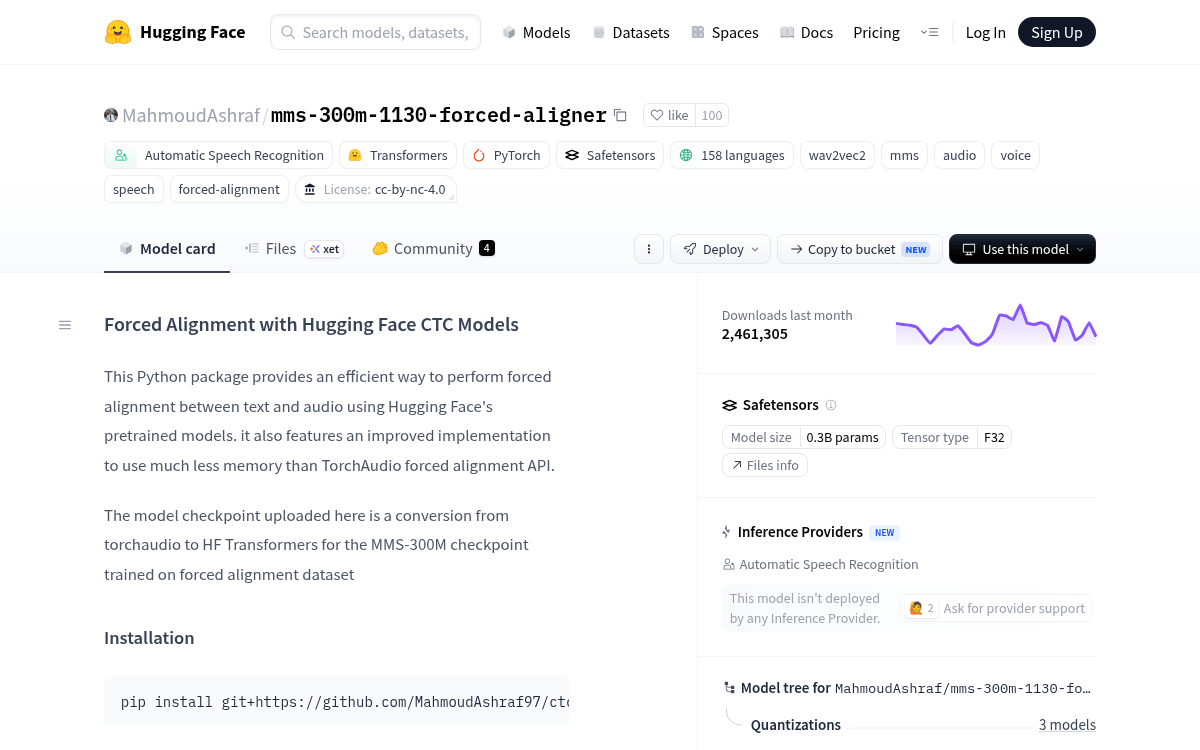
Forced alignment, the task of pinning each word in a transcript to an exact millisecond in an audio file, is unglamorous infrastructure that quietly powers subtitle generation, dataset labeling, and speaker diarization. A community-maintained checkpoint called mms-300m-1130-forced-aligner has become one of the most downloaded speech models on Hugging Face for exactly this job, crossing 2.4 million downloads while remaining a niche tool most developers have never heard of.
A TorchAudio checkpoint, unlocked for Transformers
The checkpoint is a conversion from torchaudio to HF Transformers for the MMS-300M weights trained on a forced alignment dataset, shipped with an implementation that uses far less memory than the TorchAudio forced alignment API. In practical terms, it takes Meta's Massively Multilingual Speech (MMS) work and makes it usable through the standard AutoProcessor and AutoModelForCTC classes that most speech pipelines already rely on.
The underlying architecture is worth understanding. MMS forced alignment is based on a single multilingual automatic speech recognition model for 1,107 languages, built on wav2vec 2.0, a transformer-encoder framework for self-supervised learning of speech representations. The 300M-parameter checkpoint here was fine-tuned specifically for the alignment task rather than open-vocabulary transcription, which is why it punches above its weight on timestamp accuracy.
What it actually does well
The core capability is producing precise time boundaries for text you already have. The model enables accurate word- or phoneme-level timestamping using Connectionist Temporal Classification (CTC) emissions. CTC, for the uninitiated, is a training objective that lets the network emit a symbol (or a blank) at every audio frame without needing frame-level labels, which is what makes alignment tractable at scale.
The headline features driving adoption:
- Word-level start and end boundaries with millisecond accuracy
- Support for 1130+ languages via romanized text input, with 158 languages tagged natively on the model card
- A significantly lower RAM footprint than the standard torchaudio forced alignment API
- Batched inference on CPU or CUDA, with an ONNX export and an INT8 quantized variant around 340MB for fast CPU processing
Using it in practice
The recommended path is the companion ctc-forced-aligner package, which wraps the pipeline into a handful of composable functions. A minimal end-to-end run looks like this:
from ctc_forced_aligner import (
    load_audio, load_alignment_model, generate_emissions,
    preprocess_text, get_alignments, get_spans, postprocess_results,
)
model, tokenizer = load_alignment_model(device="cuda", dtype=torch.float16)
waveform = load_audio("speech.wav", model.dtype, model.device)
emissions, stride = generate_emissions(model, waveform, batch_size=16)
tokens, text = preprocess_text(transcript, romanize=True, language="eng")
segments, scores, blank = get_alignments(emissions, tokens, tokenizer)
spans = get_spans(tokens, segments, blank)
word_timestamps = postprocess_results(text, spans, stride, scores)
The output is a list of word-level spans with start and end times plus confidence scores, which is the shape most downstream tools (subtitle formats, dataset builders, karaoke apps) expect. The pipeline covers audio processing, emission generation, tokenization, and span detection, making it suitable for speech analysis, transcript syncing, and dataset creation.
Where it fits, and where it breaks
The natural use cases cluster around three areas: generating subtitles or karaoke-style highlights for existing transcripts, building training datasets by segmenting long-form audio at word or sentence boundaries, and post-processing ASR output to add tighter timestamps than the recognizer itself produces. Researchers working with low-resource languages or building multilingual speech systems get the most leverage from it.
A few caveats worth flagging before you build on it:
- The license is CC-BY-NC-4.0, which rules out direct commercial deployment without a separate arrangement.
- It is an alignment model, not a transcriber. You must supply the text; it will not tell you what was said.
- Non-Latin scripts flow through a romanization step, so exotic orthographies get flattened before the acoustic model sees them.
Why it caught on
Community reception has been consistently positive, with users calling it the best CTC alignment implementation they have encountered, ahead of the PyTorch tutorial version. The memory optimizations matter a lot when you are aligning hour-long podcasts or audiobooks, where the naive TorchAudio path can blow past available VRAM.
The broader story is that forced alignment has quietly gone multilingual. Tools like the Montreal Forced Aligner used to require training a separate acoustic model per language, and coverage outside of English and a handful of European languages was thin. A single 300M-parameter checkpoint that handles a thousand-plus languages, ships with an ONNX build, and drops into a standard Transformers pipeline collapses that whole workflow into a few dozen lines of Python.