
Tencent's Hy-MT1.5 Beats 72B Models Squeezed Into 440MB on Your Phone
Tencent shrunk a 1.8B translation model to 440MB using ternary quantization, and it outperforms 72B open models plus Google Translate on-device.
Takeaways
- Tencent released Hy-MT1.5-1.8B-1.25bit, a 440MB offline translation model supporting 33 languages
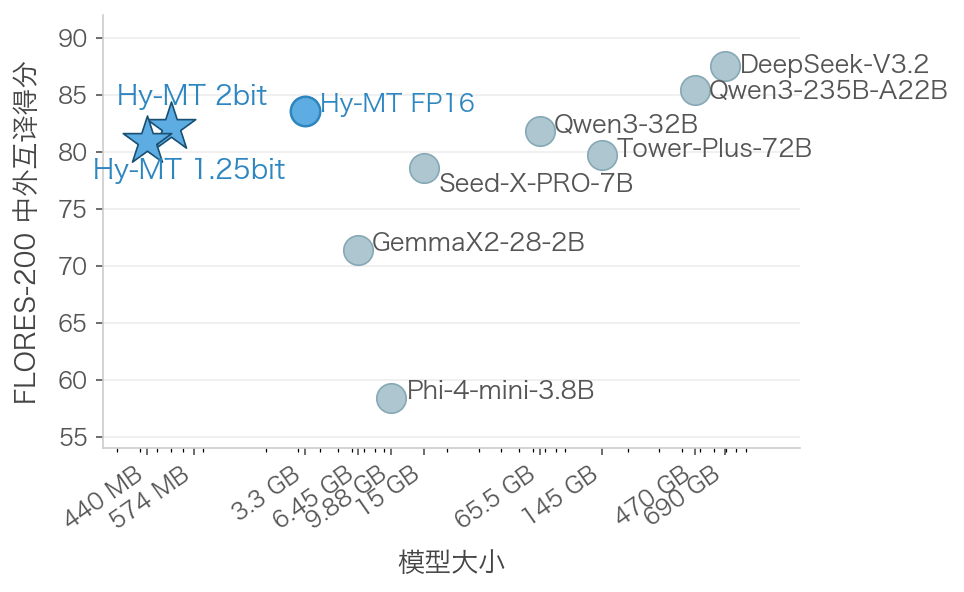
- Beats Tower-Plus-72B, Qwen3-32B and Microsoft Translator despite being 1.8B parameters
- Uses Sherry ternary quantization: 3 of every 4 weights in 1-bit, 1 zeroed
- Compresses the 3.3GB FP16 base to 440MB with minimal accuracy loss
- Runs via llama.cpp PR #22836 with custom STQ kernel for mobile CPUs
- 1.5x faster than the 4-bit version on Apple A15; Android APK demo available
Tencent's Hunyuan team has released a translation model small enough to fit in a phone photo, yet capable of beating models 40 times its size. Hy-MT1.5-1.8B-1.25bit is a 440MB fully offline translator that supports 33 languages, 5 dialects and minority languages, and 1,056 translation directions. It ships with an Android APK you can sideload today.
The compression is what makes the release worth attention. Tencent squeezed a 1.8B parameter model that outperforms much larger open-source models like Tower-Plus-72B and Qwen3-32B, along with commercial APIs including Microsoft Translator, into a footprint smaller than most mobile games.
The 1.25-bit trick
The compression is powered by Sherry, a ternary quantization method accepted at ACL 2026. Standard quantization tries to represent each weight in as few bits as possible, but going below 2 bits usually destroys accuracy. Sherry sidesteps that by combining quantization with structured sparsity.
The recipe is a 3:4 fine-grained sparsity pattern. For every 4 model weights, the 3 most important are stored in 1-bit ({-1, +1}), while the remaining 1 is zeroed out. That packs 4 weights into 5 bits, giving an effective 1.25-bit width with power-of-two alignment and compressing the original 3.3GB FP16 model to 440MB with minimal accuracy loss.
The power-of-two alignment matters because it lets the weights map cleanly onto SIMD instructions on mobile CPUs. Tencent paired the format with a custom STQ kernel and submitted it upstream as