
TaylorAI's bge-micro-v2 Runs Semantic Search at Sub-Millisecond Speed Without a GPU
A 17.4M parameter sentence embedding model distilled from BGE-small offers a compact option for semantic search and clustering on tight compute budgets.
 Pro
Takeaways
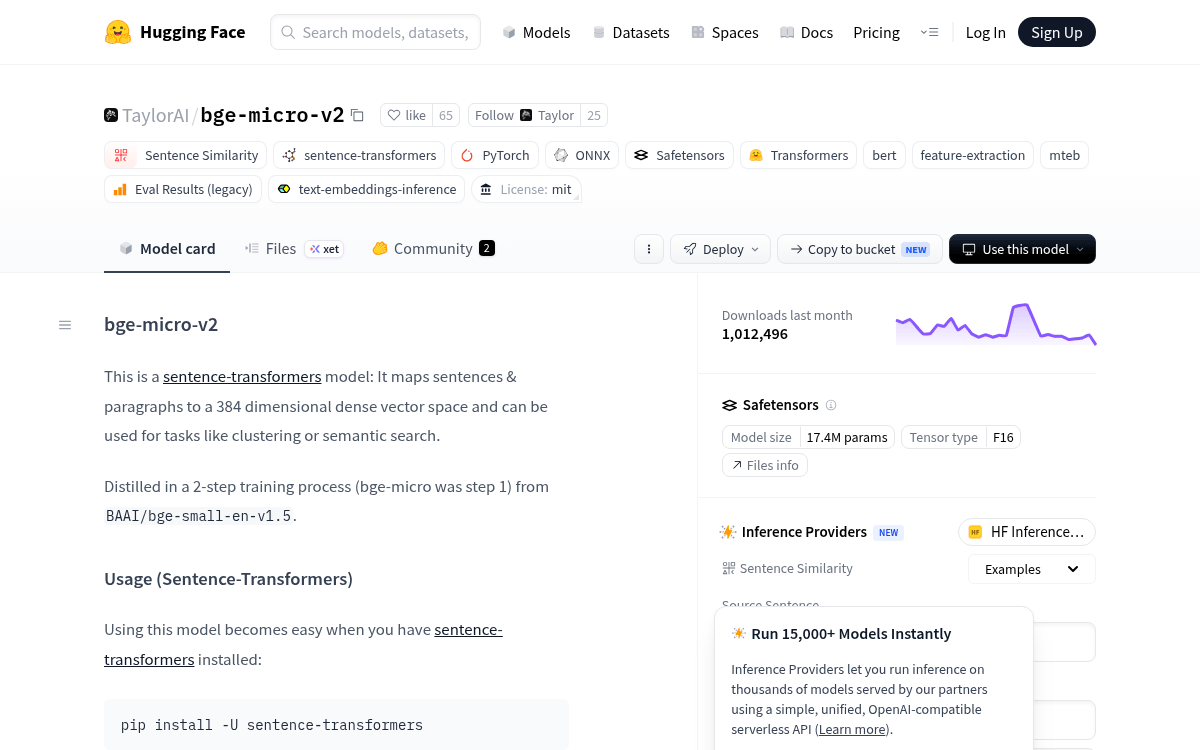
- bge-micro-v2 is a 17.4M parameter sentence embedding model producing 384-dim vectors.
- Distilled in two steps from BAAI/bge-small-en-v1.5 under an MIT license.
- Supports 512-token inputs with BERT architecture and mean pooling over tokens.
- Ships in PyTorch, ONNX, and Safetensors, compatible with sentence-transformers out of the box.
- MTEB scores: 67.76 on AmazonCounterfactual, 79.76 on AmazonPolarity, 37.45 on AmazonReviews.
- Targets CPU, edge, and browser retrieval where larger encoders are impractical.
If you have ever tried to run a retrieval pipeline on a Raspberry Pi, a browser tab, or a serverless function with cold-start anxiety, you know embedding models are usually the fat part of the stack. TaylorAI's bge-micro-v2 is one of the smallest well-benchmarked options in that category, and it keeps showing up in low-latency retrieval stacks for reasons worth unpacking.
The model is a sentence transformer that maps text to a 384-dimensional dense vector space, usable for clustering, semantic search, and similarity work. What makes it interesting is the size: 17.4M parameters, distilled from BGE-small. For comparison, that is roughly a third the size of the all-MiniLM-L6-v2 baseline most RAG tutorials still default to.
Two-step distillation, boring architecture
The training recipe is straightforward knowledge distillation done in two passes. Step one produced bge-micro, a first-pass student distilled from BAAI/bge-small-en-v1.5 with a quarter of the non-embedding parameters of its teacher and about half the parameters of all-MiniLM-L6-v2, at similar quality. Step two refined that student into v2.
The architecture itself is unchanged BERT plumbing: mean pooling, case-sensitive input, a 512-token maximum sequence length. Nothing exotic, which is part of why it slots cleanly into existing sentence-transformers pipelines.
Running it
The model ships in PyTorch, ONNX, and Safetensors formats under an MIT license, so it drops into most inference runtimes without friction. The canonical usage path is through sentence-transformers:
from sentence_transformers import SentenceTransformer
model = SentenceTransformer("TaylorAI/bge-micro-v2")
sentences = [
    "That is a happy person",
    "That is a happy dog",
    "That is a very happy person",
    "Today is a sunny day"
]
embeddings = model.encode(sentences)
similarities = model.similarity(embeddings, embeddings)
print(similarities.shape)
# [4, 4]
If you want to skip the wrapper and pool manually, the raw transformers path works too. Mean pooling over the attention mask is the correct choice to match how the model was trained.
Where the numbers land
MTEB scores tell the practical story. Self-reported evaluation results on the model card include 67.76 accuracy on AmazonCounterfactualClassification, 79.76 accuracy on AmazonPolarityClassification, and 37.45 accuracy on AmazonReviewsClassification. Respectable numbers for a model this small, and they expose the tradeoff cleanly: fine-grained review classification is noticeably weaker than binary polarity, which is what you would expect when you compress a model by roughly 4x.
Strong fits and hard limits
- Strong fit: semantic search, document similarity, clustering, and feature extraction for downstream tasks, particularly where compute is constrained but embedding quality still needs to be usable.
- Weaker fit: multilingual retrieval (it is English-only), long-document retrieval beyond 512 tokens, and tasks that benefit from the nuance of a 1024-dim or larger embedding space.
- Ecosystem fit: the Hugging Face page lists 14 finetunes, 2 merges, and 3 quantizations built on top of it, plus 31 Spaces using it as a component. It has also been mirrored to guarantee continued availability.
Why a tiny embedder still matters
The embedding model market has drifted toward bigger and multilingual, with 1B+ parameter encoders leading MTEB. That is great when you have GPUs to spare. A lot of real workloads are still CPU-bound: on-device search in note-taking apps, edge classifiers, hybrid retrieval where the dense component is a filter rather than the final ranker. In those settings a 17.4M parameter model producing 384-dim vectors is doing a different job than a top-of-leaderboard encoder.
The ONNX path is worth flagging too. Quantized to INT8, the model runs at sub-millisecond latencies per sentence on a modern laptop CPU, which opens the door to embedding entire local corpora without ever touching a GPU or an API.
Who should actually reach for it
If your retrieval quality bottleneck is a reranker or your generator, a smaller first-stage embedder often costs you very little and frees up meaningful compute. If you are shipping semantic search inside a desktop or mobile app, this model is one of the few that fits comfortably in memory alongside everything else. And if you are prototyping a RAG system where you want to iterate on chunking and prompting before committing to an embedding vendor, starting here keeps your feedback loop tight without locking you into an API bill.