
SYSTRAN's faster-whisper Runs OpenAI's Whisper 4x Faster Without Retraining
A CTranslate2 port of OpenAI's Whisper base model delivers up to 4x faster transcription with identical accuracy while cutting memory usage.
 Pro
Takeaways
- SYSTRAN's faster-whisper-base is a CTranslate2 port of OpenAI's Whisper base model.
- Up to 4x faster than reference Whisper with identical accuracy and lower memory.
- INT8 quantization cuts VRAM by ~40% and roughly doubles speed vs FP16.
- Covers 99 languages, ships MIT-licensed, runs on CPU or NVIDIA CUDA GPUs.
- Bundles FFmpeg via PyAV, removing a common system dependency headache.
- Default engine for WhisperX and the go-to for self-hosted Whisper on CUDA.
Whisper became the default for open-source speech recognition, but running it in raw PyTorch is slower and hungrier for memory than it needs to be. SYSTRAN's faster-whisper-base is a drop-in replacement that keeps OpenAI's original weights intact and swaps the inference engine underneath. The result pulls in over 1.5 million downloads a month on Hugging Face.
Same weights, faster plumbing
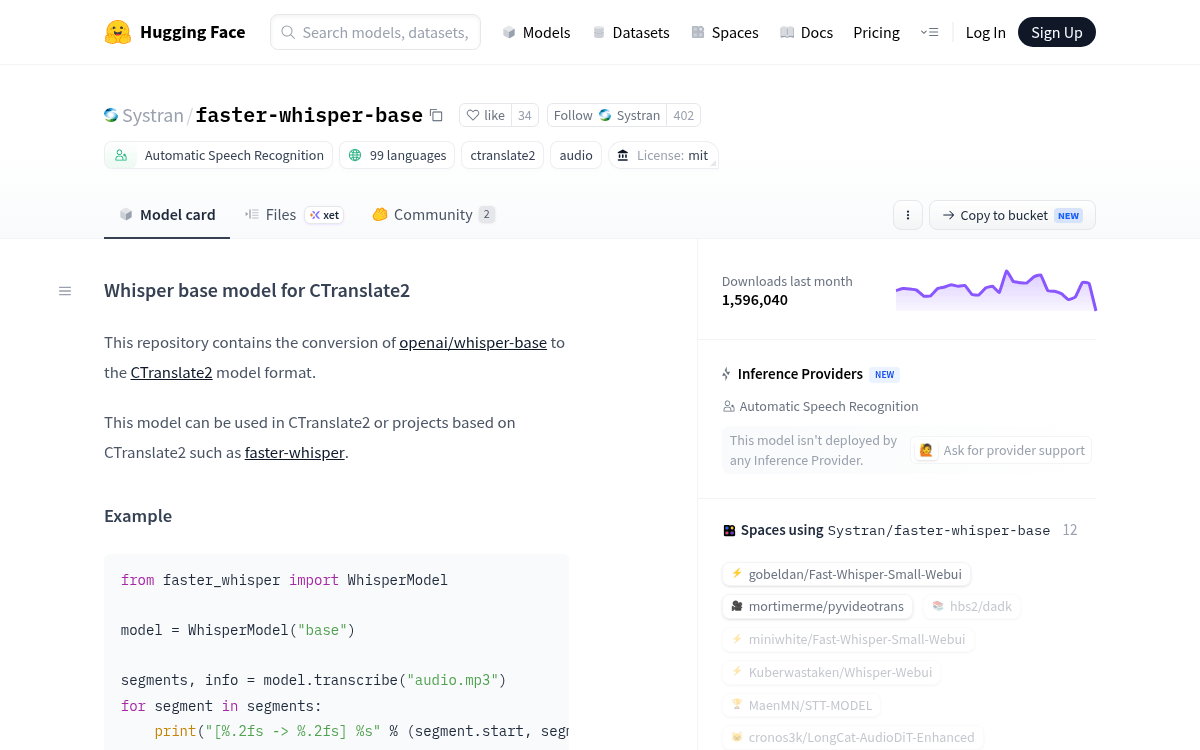
The model is a straight conversion of openai/whisper-base into the CTranslate2 format. faster-whisper reimplements OpenAI's Whisper using CTranslate2, a fast inference engine for Transformer models. In practice, this runs up to 4 times faster than openai/whisper at the same accuracy while using less memory, and 8-bit quantization on CPU or GPU squeezes out more.
Under the hood, CTranslate2 is OpenNMT's high-performance inference engine for transformer models, providing custom CUDA kernels, INT8/FP16 quantization, fused operations, and SIMD-optimized CPU code. Same accuracy, better throughput, lower memory. No new training, no distilled variant, just an inference stack that stops leaving performance on the table.
Getting it running
Installation is a single pip install faster-whisper, and the weights download automatically when you name the size. A minimal transcription script:
from faster_whisper import WhisperModel
model = WhisperModel("base")
segments, info = model.transcribe("audio.mp3")
for segment in segments:
    print("[%.2fs -> %.2fs] %s" % (segment.start, segment.end, segment.text))
The base weights ship in FP16, but compute_type at load time lets you switch to INT8 for a smaller footprint or FP32 for maximum precision. One quality-of-life win over the reference implementation: FFmpeg does not need to be installed on the system. Audio is decoded with PyAV, which bundles the FFmpeg libraries in its package. That removes a common deployment headache on locked-down machines.
What the base tier is actually good for
The base model is the second smallest in the Whisper family. It handles 99 languages, ships under an MIT license, and runs comfortably on CPU. The tradeoffs are what you would expect from a small model:
- Suitable for real-time captioning, voice commands, and short clips where latency matters more than nailing quiet or accented speech.
- Reasonable for English podcast rough-cuts and meeting notes where a human will still edit the output.
- Weaker on noisy audio, heavy accents, technical jargon, and non-English languages than
small,medium, orlarge-v3. - A poor fit when word-level accuracy is contractual, or when you need speaker diarization out of the box.
If you outgrow it, the same API loads any size up to large-v3 by changing one string.
Why INT8 matters more than the version number
Speed is the headline, but the practical breakthrough for anyone deploying on modest hardware is quantization. CTranslate2 INT8 quantization cuts VRAM by roughly 40% and roughly doubles inference speed versus FP16, with negligible WER impact (less than 0.1% absolute). A base-sized model runs on a laptop CPU with usable throughput, and larger sizes fit on consumer GPUs that would otherwise choke.
Independent benchmarks back that up at the top of the range. On an RTX 4070 with 12 GB running large-v3 in INT8, testers measured around 12x real-time at roughly 2.5 GB VRAM. An RTX 3060 with the same setup hit around 8x real-time at the same memory footprint. The base model, at a fraction of the size, is dramatically faster still.
Where it fits in the stack
faster-whisper has quietly become the plumbing for a lot of adjacent tooling. It is the default engine for WhisperX and the standard choice for self-hosted Whisper on CUDA. If you use WhisperX for word-level timestamps and diarization, you are already using faster-whisper underneath.
The surrounding ecosystem is worth knowing when scoping a project:
- faster-whisper itself, the Python library.
- whisper-ctranslate2, a command line client compatible with the original from openai/whisper.
- whisper-diarize, a speaker diarization tool built on faster-whisper and NVIDIA NeMo.
- whisper-standalone-win, standalone CLI executables for Windows, Linux, and macOS.
- Support for distil-whisper, a knowledge-distilled Whisper trained via large-scale pseudo-labelling, if you want an even smaller footprint.
The catches worth knowing
Two operational details bite people. GPU support is Nvidia only. Platform support covers CPU with INT8 quantization and NVIDIA CUDA GPUs. There is no Apple Metal path, so it runs CPU-only on Mac. On Apple Silicon with a preference for GPU acceleration, whisper.cpp is the better choice.
CUDA versions have also moved on. Current ctranslate2 releases only support CUDA 12 and cuDNN 9. Older container images and pinned dependencies from a couple of years ago will fail in ways that are annoying to debug. Pin your versions carefully, or start from a clean CUDA 12 base image.
For the base tier specifically, this is the model to reach for when you want speech-to-text that fits in a Docker container smaller than a gigabyte, runs on the CPU of a cheap VM, and does not require reading a research paper to get sensible output. When accuracy stops being enough, the same three lines of code will load a bigger model without any other changes to your pipeline.