
SYSTRAN's Faster-Whisper Fixes Batched Pipeline and Upgrades Noise Detection
SYSTRAN shipped a maintenance release for its CTranslate2 Whisper port, upgrading Silero VAD to V6 and fixing batched inference edge cases.
 Pro
Takeaways
- SYSTRAN released faster-whisper v1.2.1, a maintenance update to the CTranslate2 Whisper port.
- Silero-VAD upgraded to V6 for more robust voice activity detection on noisy audio.
- Fixes
<|nocaptions|>tokens leaking into output from the BatchedInferencePipeline. - Batched inference now correctly respects user-supplied
clip_timestampsranges. - Model download retries offloaded to the Hugging Face Hub client for cleaner error handling.
- Library sits at 25.1k stars and underpins WhisperX, WhisperLive, aTrain, and Whisper-Streaming.
The faster-whisper project has tagged a point release, v1.2.1, that cleans up rough edges in one of the most widely used speech-to-text runtimes on GitHub. The library reimplements OpenAI Whisper on top of CTranslate2 instead of PyTorch, and this update focuses on the batched inference pipeline that landed last year, plus a bump to the newest Silero voice activity detector.
If you're already running Whisper behind an API, the upgrade is a pip install -U faster-whisper away. Nothing in the public API changed.
What actually shipped
The release notes list five merged pull requests. The headline items:
- Silero-VAD V6 upgrade. The voice activity detector that trims silence before transcription now uses the latest Silero weights, which tend to be more robust on noisy audio and short utterances.
- Batched pipeline fix for
<|nocaptions|>tokens. TheBatchedInferencePipelinecould occasionally emit the special no-captions token as literal output. That leak is patched. - Clip timestamp handling. Segment merging now only happens when
clip_timestampsaren't provided, and batched inference respects user-supplied clip ranges more faithfully. - Download retries offloaded to the Hugging Face Hub client, so transient network hiccups on model pull are handled by the library that already knows how to handle them.
Two new contributors landed their first PRs in this cycle, and the tag sits three commits behind master at release time.
Why this library still carries the ecosystem
faster-whisper reimplements OpenAI's Whisper using CTranslate2, a fast inference engine for Transformer models. It runs up to 4 times faster than openai/whisper for the same accuracy while using less memory, with further gains from 8-bit quantization on both CPU and GPU. That combination is why the repo has crossed 25.1k stars and why so many downstream projects depend on it.
A short tour of what sits on top:
- WhisperX layers word-level timestamps and speaker diarization on top of it.
- WhisperLive uses it as the backend for near-real-time streaming transcription.
- Whisper-Streaming treats it as the recommended backend for a self-adaptive latency policy on live audio.
- aTrain, built at the University of Graz, wraps it in a Windows and Linux GUI for transcription and diarization.
Every one of those tools inherits the VAD upgrade and the batched-pipeline correctness fix the moment they bump the dependency.
The batched pipeline context
Batched inference was the big feature of the 1.1 line. SYSTRAN advertised it as a new batched inference mode that is 4x faster and accurate, alongside support for the large-v3-turbo model and a 3x speed-up on the CPU VAD filter. Batched mode processes multiple 30-second audio chunks in parallel through the encoder, which is where most of the compute lives, so it's the mode most production servers reach for.
The catch has been that batched mode occasionally diverged from the sequential path on edge cases: user-supplied clip ranges, special tokens leaking through, silence-boundary quirks. v1.2.1 is a targeted cleanup on exactly those seams.
When it's the right tool
For any local speech-to-text workload on NVIDIA hardware, faster-whisper remains the default recommendation. Recent benchmarks note that on NVIDIA GPUs, faster-whisper is the fastest local Whisper implementation available, and that CTranslate2's int8 quantization cuts VRAM by roughly 40% and roughly doubles inference speed versus float16, with under 0.1% absolute WER impact. One trade-off worth knowing: there's no Apple Metal support, so on Mac it runs CPU-only and whisper.cpp is usually the better pick.
A minimal usage sketch stays unchanged from prior versions:
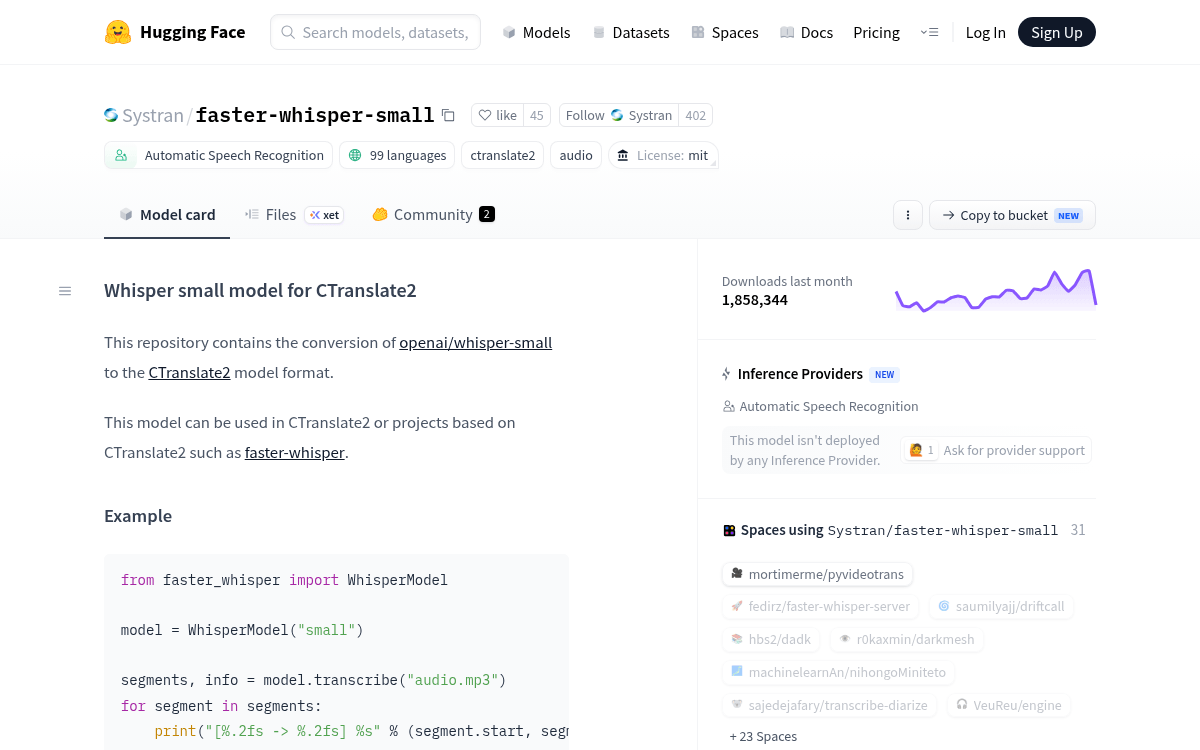
from faster_whisper import WhisperModel
model = WhisperModel("small", device="cuda", compute_type="int8_float16")
segments, info = model.transcribe("audio.mp3", vad_filter=True)
for seg in segments:
    print(f"[{seg.start:.2f} -> {seg.end:.2f}] {seg.text}")
If you're on the 1.1 line and running any batched pipeline in production, this is the release to pull. If you're already on 1.2.0, the Silero V6 bump alone justifies the upgrade for anyone processing noisy real-world audio.