
Sweden's National Library Built a 1.7M-Download Swedish Speech Model That Beats Whisper
A Swedish speech recognition model from the National Library of Sweden hits 1.7M downloads with a 2.5% word error rate and CC0 license.
 Pro
Takeaways
- KBLab's VoxRex Swedish wav2vec 2.0 model has crossed 1.7M downloads on Hugging Face.
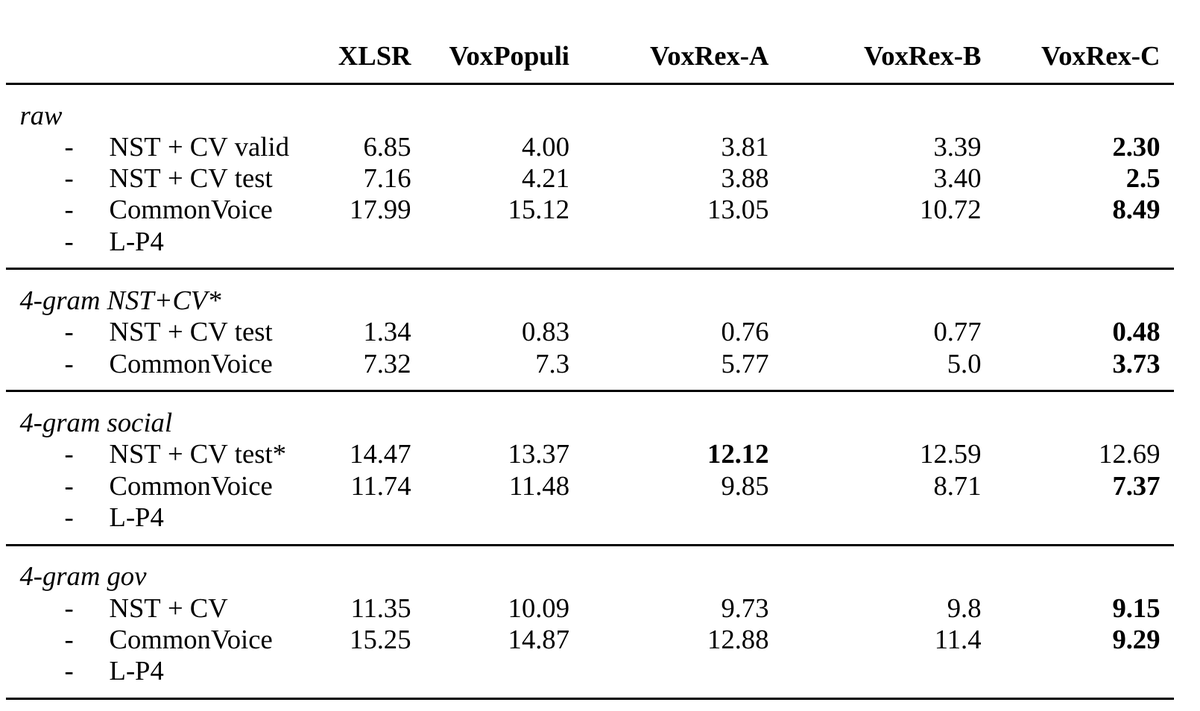
- Reports 2.5% WER on NST + Common Voice, 8.49% on Common Voice alone, 7.37% with a 4-gram LM.
- Trained on Swedish radio (P4), NST database and Common Voice with dialect balancing.
- Released under CC0-1.0, making it fully usable for commercial products with no attribution.
- 0.3B parameter CTC model, plugs into the standard Transformers ASR pipeline at 16 kHz.
- Details in the Hearing voices at the National Library paper.
Sweden's national library has quietly built one of the most downloaded non-English speech recognition models on Hugging Face, and it is worth a closer look if you work with audio outside the usual English-centric pipeline. Wav2vec 2.0 large VoxRex Swedish, from KBLab at the National Library of Sweden, has crossed 1.7 million downloads and 3,500 likes, and the checkpoint ships under a CC0-1.0 public domain license.
What VoxRex actually is
VoxRex is a fine-tuned version of KB's VoxRex large model, trained on Swedish radio broadcasts, the NST Swedish ASR Database, and Common Voice data. The base architecture is standard wav2vec 2.0 with a CTC head, roughly 0.3B parameters, and it expects 16 kHz mono audio. Evaluation without a language model gives a WER of 2.5% on the NST + Common Voice test set (2% of total sentences), and 8.49% on Common Voice directly, dropping to 7.37% with a 4-gram language model.
For a monolingual open-weights model, those numbers are strong enough that VoxRex has become the default acoustic backbone for Swedish ASR pipelines across the community.
How it was built
The work is documented in the Hearing voices at the National Library paper. The team evaluated several routes for a Swedish speech-to-text pipeline built on wav2vec 2.0, drawing on speech corpora assembled from KB's collections. That included pretraining a Swedish acoustic model from scratch and fine-tuning existing monolingual and multilingual checkpoints, with a deliberate effort to balance regional dialects and produce a more representative model.
The training recipe is unusual for a few reasons:
- The pretraining corpus was sampled from millions of hours of speech, most of it coming from the P4 Swedish radio archive.
- Dialect balancing was treated as a first-class concern rather than an afterthought, which matters for a country where regional pronunciation varies a lot.
- The released checkpoint was fine-tuned for 120,000 updates on the combined NST + Common Voice data.
The resulting acoustic model outperforms existing Swedish ASR baselines, including the monolingual VoxPopuli-sv model and the multilingual XLSR checkpoint, and pairing it with pretrained language models pushes performance further.
Three lines to production
The model plugs directly into the standard Transformers ASR pipeline. Nothing exotic is needed:
from transformers import pipeline
pipe = pipeline(
    "automatic-speech-recognition",
    model="KBLab/wav2vec2-large-voxrex-swedish",
)
result = pipe("my_swedish_audio.wav")
print(result["text"])
If you need lower-level control (custom decoding, batching, alignment), the processor and Wav2Vec2ForCTC classes work as expected. Resample to 16 kHz first, since the model was trained at that rate and will silently produce garbage otherwise.
Where it shines and where it doesn't
The strong points are clear: it is small enough to serve on a single GPU, the CC0 license means zero legal friction for commercial use, and the CTC output makes forced alignment and timestamping straightforward. It is a good fit if you are:
- Building Swedish transcription for podcasts, meetings, or call centers.
- Doing forced alignment on Swedish audiobooks or parliamentary audio.
- Fine-tuning further on domain-specific vocabulary (medical, legal, technical Swedish).
- Running on-device or on-prem where sending audio to a cloud API is not an option.
The weak points are the usual wav2vec 2.0 limitations. There is no punctuation or casing in the output, since CTC just emits characters. It does not do speaker diarization, language ID, or translation. And while a 4-gram language model helps, the gap between the 2.5% in-domain WER and the 8.49% Common Voice WER shows the model is more comfortable with clean, studio-like Swedish than with noisy user-recorded audio.
Why a monolingual model still wins
Modern multilingual models like Whisper get most of the attention, but a targeted monolingual model still wins on latency, cost, and predictability for a single language. VoxRex sits at a useful spot: a corpus balanced across regional dialects, with an acoustic model that beats prior Swedish ASR baselines. It also offers a template for how a national library or public institution can turn archival audio into a public research asset, and the same pattern is now being copied for other under-resourced languages. If Whisper has become your reflex for every language, VoxRex is a reminder that a well-trained monolingual model, with the right data and a permissive license, is often the sharper tool.