
Supertone's Supertonic 3 Beats A100 GPU Models Running on a Laptop CPU
Supertone released a 99M-parameter multilingual TTS that runs on CPU, browsers, and Raspberry Pi, jumping from 5 to 31 languages with expression tags.
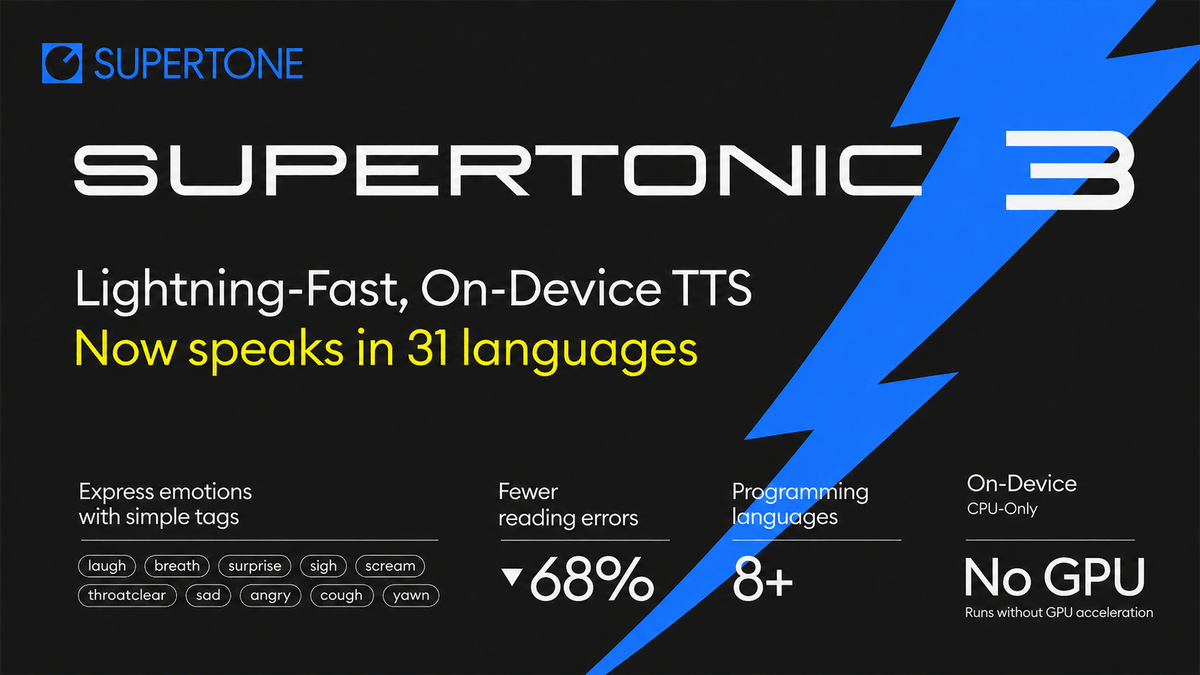
Takeaways
- Supertone released Supertonic 3, a 99M-parameter on-device TTS running via ONNX Runtime.
- Language coverage expanded from 5 to 31 languages, including Arabic, Hindi, and most European languages.
- Runs faster on CPU than 2B-class competitors on A100 GPU, with much lower memory footprint.
- Adds 10 expression tags like
<laugh>,<breath>,<sigh>for emotional nuance without reference audio. - SDKs for Python, Node.js, browser WebGPU, Java, C++, Rust, Swift, iOS, Flutter via GitHub.
- Model licensed under OpenRAIL-M (use-based restrictions), sample code MIT; check terms before commercial use.
Supertone has released Supertonic 3, an open-weight text-to-speech model that fits in roughly 99 million parameters and runs entirely on local hardware through ONNX Runtime. The pitch is simple: near real-time synthesis without a GPU, without a cloud round trip, and now across 31 languages instead of the 5 that shipped with the previous version.
The project is unusual in the current TTS landscape because it optimizes hard for footprint rather than parameter count. At about 99M parameters across the public ONNX assets, Supertonic 3 comes in well below the 0.7B to 2B class of open TTS systems. That gap matters when you are trying to bundle a voice model into a browser extension, a mobile app, or a Raspberry Pi image.

CPU speed that outruns bigger GPU models
The headline benchmark is the runtime footprint. Supertonic 3 runs fast on CPU even compared with larger baselines measured on A100 GPU, and uses substantially less memory. A laptop without a discrete GPU can beat an A100 running a 2B-parameter TTS competitor on latency, because the smaller model plus ONNX Runtime avoids the tokens-per-step overhead that autoregressive systems accumulate.
The system outputs studio-grade 44.1kHz 16-bit WAV directly, ready for production playback without any external upsampler, which removes a common post-processing step in edge deployments. On the extreme end, the team demonstrates it running on an Onyx Boox Go 6 e-reader in airplane mode at an average real-time factor of 0.3x, generating audio three times faster than playback speed.