
SuperQwen3.8 Runs Uncensored on One Box at 1.77x Faster Speeds
A community fine-tune of Qwen3.8-27B strips refusals, fixes the resulting weight damage, and ships in four formats tuned for local inference.
Takeaways
- SuperQwen3.8-27b-abliterated-GGUF released by Jun Song: uncensored, multimodal, weight-repaired Qwen3.8-27B build.
- Rank-4 OBLITERATUS refusal-subspace edit; vision tower and MTP weights preserved exactly.
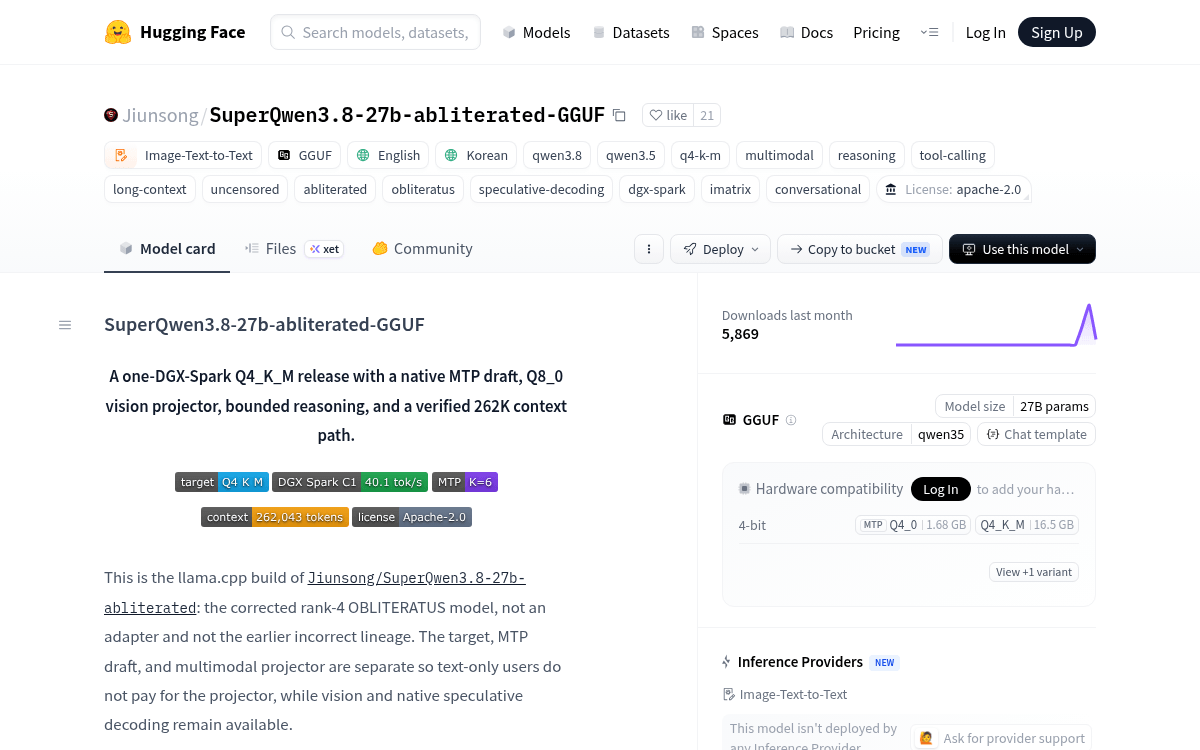
- Q4_K_M target plus MTP draft and vision projector total 17.56 GiB, fits one DGX Spark.
- C1 decode: 12.5 tok/s baseline, 22.1 tok/s with native MTP K=3 speculative decoding.
- 262K context metadata, verified 46,235-token needle retrieval, Apache-2.0 license.
- Four native formats also available: BF16, NVFP4, GGUF, and MLX 4-bit.
A new community release is making the rounds on Hugging Face: SuperQwen3.8-27b-abliterated-GGUF, a repackaged and behavior-modified variant of Qwen3.8-27B that ships in a single-box GGUF bundle designed to run on one NVIDIA DGX Spark. The author, Jun Song, describes it as an uncensored, weight-repaired, multimodal build with a 1M token context, and the release covers four native formats: BF16, NVFP4, GGUF, and MLX 4-bit.
What abliteration actually did here
The base of this release is Jiunsong/SuperQwen3.8-27b-abliterated, which applies a measured rank-4 OBLITERATUS refusal-subspace edit to Qwen/Qwen3.8-27B while preserving the official vision tower and MTP weights exactly. Abliteration is a direct weight edit that identifies the internal direction a model uses to represent refusal and subtracts it, so the model complies with prompts the parent would decline. No LoRA or inference-time adapter is required, so the modification is baked into the weights.
Naive abliteration usually damages the model. The originating announcement calls out that the super-tune takes much more time than normal abliterated variants, because fixing weights and running evals takes about a week, and Song says the damage was patched using an agent swarm before release. According to the model card, the result is a capability floor of 7/8, with tool call and vision gates passing, plus reasoning that stops on all nine deterministic tasks at default, low, medium, and xhigh.