
SulphurAI's Sulphur-2 Uncensored Video Model Hits 875K Downloads in Days
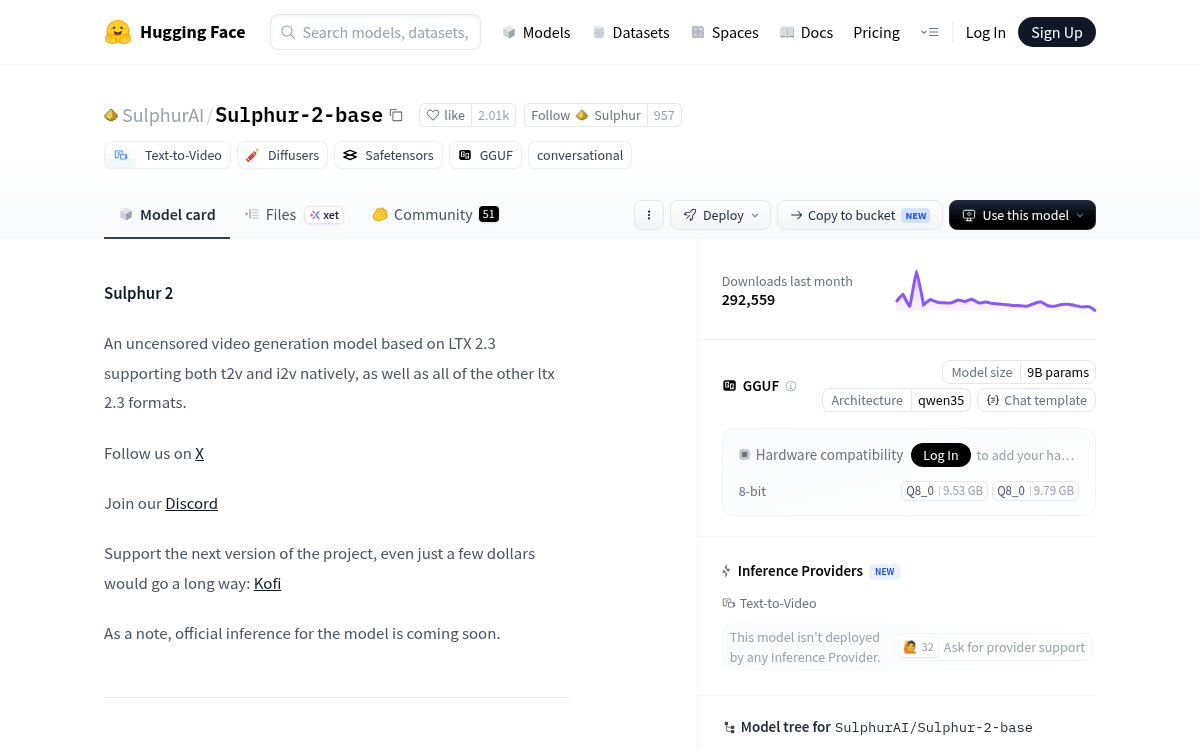
SulphurAI released an uncensored fine-tune of Lightricks LTX 2.3, packaged with distill LoRAs, ComfyUI workflows and a local prompt enhancer.
Takeaways
- SulphurAI released Sulphur-2-base, an uncensored fine-tune of Lightricks LTX 2.3 for text-to-video and image-to-video.
- Ships with bf16 and fp8mixed weights, distill LoRAs, four ComfyUI workflows, and a local Qwen 3.5 9B prompt enhancer.
- Trained on around 125,000 real video clips at 10 seconds and 24 fps, roughly 500 GB total.
- Inherits LTX 2.3's 22B DiT architecture, 4K output, 20-second clips and native synchronized audio.
- Runs on 24-32 GB VRAM comfortably, 16 GB with fp8mixed, and 8 GB via community GGUF quants.
- Distributed under the LTX-2 Community License, not Apache 2.0 despite the upstream base.
A community group calling itself SulphurAI has quietly turned into one of the most downloaded open video model releases of the year. Their flagship checkpoint, Sulphur-2-base, is a fine-tune of Lightricks' LTX 2.3 that strips out most of the content filtering while keeping the underlying architecture, workflows and tooling intact. It has already pulled in more than 875,000 downloads on Hugging Face.
SulphurAI is an open-source project developing uncensored generative video models. Sulphur-2-base is a 9B parameter text-to-video and image-to-video model with a built-in prompt enhancer, hosted entirely on Hugging Face and maintained by a single developer (FusionCow). The framing matters here. This is a set of weights, LoRAs and ComfyUI graphs designed to slot straight into an existing LTX 2.3 pipeline, not a new architecture or a hosted product.
The engine underneath
To understand what Sulphur 2 actually is, you need to understand its base. Lightricks released LTX-2.3, a 22B parameter open model that generates 4K video at 50 FPS with synchronized audio under an Apache 2.0 license. It was the first open release to unify video and synchronized audio, producing frames and matching sound in a single pass, a capability previously locked inside closed commercial products.
LTX 2.3 uses a Diffusion Transformer, the same broad family of architectures that powers Sora and other frontier video models. Version 2.3 ships a rebuilt variational autoencoder, a quadrupled text encoder built on Gemma 3 12B, and a gated-attention text connector for better prompt adherence. A variational autoencoder, or VAE, is the component that compresses pixels into the compact latent space the diffusion model actually works in. A cleaner VAE means less mush in fine details like hair, fabric and small text.
Sulphur 2 is a derivative, so it inherits all of that. The upstream model supports text-to-video, image-to-video, audio-to-video, extend, and retake, with fast variants for text-to-video and image-to-video when speed matters, portrait 9:16 support, 24/48 FPS options, and LoRA fine-tuning across the board. The Sulphur team describes their build as a drop-in replacement inside existing LTX 2.3 ComfyUI graphs.